Archive for February, 2012

Shanghai (上海)

Posted on 29. Feb, 2012 by in Culture, sightseeing, travel

You can get from Beijing to Shanghai in just 5 hours now with the high-speed railway. As such, we took a short trip there during the National Holiday (国庆节) in 2011, which is a busy but exciting time to travel. Check out the Yuyuan Gardens, the view of the Bund, and some delicious Shanghai dumplings in this short video.

YouTube Preview Image

旅行团 – lǚ xíng tuán
tour group

北京南站 – běi jīng nán zhàn
Beijing South Railway Station

上海 – shàng hǎi
Shanghai

这是我们第一次乘坐京沪高速铁路 – zhè shì wǒ men dì yī cì chéng zuò jīng hù gāo sù tiě lù
This is our first time riding the Beijing-Shanghai high-speed railway.

二等座 – Èr děng zuò
second class seat

上海是一个非常大的城市 – shàng hǎi shì yī gè fēi cháng dà de chéng shì
Shanghai is a really big city.

爱上海吗?请举手 – Ài shàng hǎi ma? qǐng jǔ shǒu
Love Shanghai? Please raise your hand.

黄浦江 – huáng pǔ jiāng
Huangpu River

天际线 – tiān jì xiàn
skyline

越南餐厅 – yuè nán cān tīng
Vietnamese restaurant

因为这是国庆节所以人太多了 – yīn wèi zhè shì guó qìng jié suǒ yǐ rén tài duō le
Because this is National Day, so there are too many people.

豫园 – yù yuán
Yuyuan Garden

小吃 – xiǎo chī
snack

小笼包 – xiǎo lóng bāo
steamed soupy dumplings

东方明珠塔 – dōng fāng míng zhū tǎ
Oriental Pearl TV Tower

环球金融中心 – huán qiú jīn róng zhōng xīn
World Financial Center

外滩 – wài tān
The Bund

激光搏击 – jī guāng bó jí
laser tag

Introduce Yourself in Chinese (Video)

Posted on 25. Feb, 2012 by in grammar, Vocabulary

Last month I made a post about how to introduce yourself. In a follow-up to that, here’s a video you can use to follow along with my basic self-introduction. Use the video to practice making sentences about yourself, and before you know it you’ll be confidently introducing yourself to new friends in Chinese.

YouTube Preview Image

自我介绍 – zì wǒ jiè shào
introduce myself

我叫Sasha – wǒ jiào Sasha
My first name is

我姓 – wǒ xìng Savinov
My surname is

我是美国人 – wǒ shì měi guó rén
I’m American

我是加拿大人 – wǒ shì jiā ná dà rén
I’m Canadian

我是英国人 – wǒ shì yīng guó rén
I’m British

我是西班牙人 – wǒ shì xī bān yá rén
I’m Spanish

我二十六岁 – wǒ èr shí liù suì
I’m 26 years old

我是老师 – wǒ shì lǎo shī
I’m a teacher

我是学生 – wǒ shì xué shēng
I’m a student

我是商人 – wǒ shì shāng rén
I’m a businessperson

我家有九个人 – wǒ jiā yǒu jiǔ gè rén
My family has 9 people.

爸爸,妈妈,四个弟弟,两个妹妹,和我
bà ba, mā ma, sì gè dì dì, liǎng gè mèi mei, hé wǒ
Dad, mom, four little brothers, two little sisters, and me.

我还没结婚 – wǒ hái méi jié hūn
I’m not married

我结婚了 – wǒ jié hūn le
I’m married

我没有孩子 – wǒ méi yǒu hái zi
I don’t have children

我有一个儿子 – wǒ yǒu yī gè ér zi
I have a son

我有一个女儿 – wǒ yǒu yī gè nǚ’ ér
I have a daughter

我有女朋友 – wǒ yǒu nǚ péng yǒu
I have a girlfriend

我有男朋友 – wǒ yǒu nán péng yǒu
I have a boyfriend

我的爱好是 – wǒ de ài hào shì…
My hobbies are…

旅游 – lǚ yóu
traveling

听音乐 – tīng yīn yuè
listening to music

打篮球 – dǎ lán qiú
playing basketball

我很高兴认识你 – wǒ hěn gāo xìng rèn shi nǐ
I’m very pleased to meet you!

Harbin – China’s Winter Wonderland

Posted on 24. Feb, 2012 by in Culture, festivals, sightseeing, travel, Uncategorized

Harbin (哈尔滨 – Hā ěr bīn) is the capital of Heilongjiang province (黑龙江省 – hēi lóng jiāng shěng), located in the area of China known as Dongbei (东北 – dōng běi), or the Northeast. The city’s name comes from a Manchu word meaning “a place for drying fishing nets.” A city with thousands of years of history, Harbin has always been an important and influential place in China. Known for its Russian influence, Harbin once served as an escape from the Soviet Union for many White Russians who supported the czarist state. You can still see this today, with plenty of Russian style buildings and restaurants, including the beautiful St. Sophia Cathedral (圣索非亚教堂 – shèng suǒ fēi yà jiào táng). Although you can’t attend a mass in this old Orthodox church, you can learn about the history of Harbin’s architecture as it now serves as a museum.

St. Sophia

Walking along the city’s Central Avenue (中央大街 – zhōng yāng dà jiē), which is pedestrian only, you can see the influence from many countries in the building styles while you go shopping, and you can also find plenty of restaurants and bars. On our trip there, we dropped by the USA Bucks bar, which is run by a Chinese cowboy. Go there to see for yourself.

The bustling Central Avenue of Harbin.

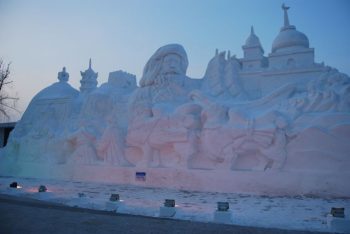
These days, Harbin’s biggest attraction is its annual Ice and Snow Festival (冰雪节 – bīng xuě jié). Thanks to its frigid winter temperatures, Harbin is able to support massive ice and snow sculptures for months at a time. During the daytime, it’s best to hit the Sun Island International Snow Sculpture Art Fair (太阳岛国际雪雕艺术博览会 – tài yáng dǎo guó jì xuě diāo yì shù bó lǎn huì), where you can stroll around the park admiring the massive snow sculptures and take part in a variety of activities (which cost extra, of course). Each year there is a different theme for the sculptures, such as Greek mythology, which was on display when I visited in 2011. Thankfully, there are plenty of makeshift shops where you can warm up with a hot cup of coffee or a steaming bowl of noodles.

Athena on display at the Snow Festival.

Coffee shop igloo.

Massive snow sculptures like this one abound.

When the sun sets, its best to head over to the Ice and Snow World (冰雪大世界 – bīng xuě dà shì jiè), which features enormous structures made of ice that are illuminated with neon lights. From scaling ice castles to speeding down an ice slide to taking horse-drawn carriage rides, there’s plenty to do here. Just make sure you dress appropriately, as temperatures are well below freezing. I’m talking multiple layers here, people – wear a few pairs of socks, double down on your gloves, and make sure you have a thick scarf. If that’s not enough to warm you up, there’s always vodka (伏特加酒 – fú tè jiā jiǔ), which is quite popular in Harbin (thanks, Russians!).

The entrance to the frozen wonderland.

Castles made of ice and lazers? Yeah, China does that.

Now THAT'S a cold one!

Before you head out of Harbin, it’s worth it to take a trip out to the Siberian Tiger Preserve (老虎公园 – lǎo hǔ gōng yuán), which is about a 30-minute taxi ride outside of the city. Here, you can ride on a bus through the grounds where dozens of huge tigers and lions roam freely. There’s plenty of food available for purchase, too – not for you, but for the hungry, hungry animals. For just 10 RMB, you can feed one of the cute kitties a strip of beef with a pair of tongs. Up that price to 40, and you can toss a live chicken to them. You can even feed the whole gang by dropping a cool 2,000 on a live cattle. I doubt that ever happens, but it is on the menu. Sorry, PETA, but China isn’t really keen on the “animal rights” thing. In addition to the lions and tigers, there are also a variety of other animals, such as cheetahs, bears, and even a liger.

What's on the menu?

Tigers chillin' out.

For those of you who love flying down the slopes in wintertime, you also have the option of catching a train out to Yabuli (亚布力 – Yà bù lì), one of China’s largest skiing resorts. Apparently, there’s also stuff to do in Harbin in the summer, but with so much going on during the winter, that’s definitely the best time to visit.

Check out my video series about my trip to Harbin on our YouTube page:

YouTube Preview Image