Archive for July, 2010

Veturu Ĉirkaŭmonde kun Esperanto // Travel Around the World with Esperanto

Posted on 28. Jul, 2010 by in Travel, Uncategorized

Marte, 2009, du francaj biciklistoj, Roz kaj Cirilo, forlasis la hejmojn en Narbono, Francio, kaj komencis la aventuron pedelante ĉirkaŭmonde. La itinero enhavas Italion, Turkion, Iranon, Baraton, Tajlandon, Aŭstralion, Kanadon, Usonon, Meksikion, Panamion, Peruon, Argentinon, Brazilon, Senegalion, kaj Hispanion. In March of 2009, two French bicyclists, Rose and Cyrille, left their homes in Narbonne, France, and began their adventure of pedaling around the world. Their itinerary includes Italy, Turkey, Iran, India, Thailand, Australia, Canada, United States, Mexico, Panama, Peru, Argentina, Brazil, Senegal, and Spain.

Kiom da lingvoj necesas por komuniki kun lokuloj de ĉiuj landoj de diversaj lingvoj kaj kulturoj? How many languages would they need to use to communicate with locals in all these countries of diverse languages and cultures?

Kompreneble, vi jam scias la respondon, alie vi ne estus leganta ĉi tiun blogon. Nur unu. Of course, you already know the answer, or you wouldn’t be reading this blog. Just one.

Aprile 2010, Roz kaj Cirilo alvenis la urbon San Francisko, Kalifornio, kaj la loka esperanta klubo, SFERO, gastigis ilin vespermanĝe ĉe la Kastro Sausage Factory. Ili rigalis nin per la rakontoj de la aventuroj okazintaj trans tri kontinentoj. Finvidinte ilin, ili pedalis suden al San Luis Obispo. Vi povas legi pri iliaj vojaĝoj ĉe la retpaĝaro. In April of 2010, Rose and Cyrille arrived in San Francisco, California, and the local Esperanto club, SFERO, treated them to dinner at the Castro Sausage Factory. They regaled us with tales of their adventures across three continents. The last we saw of them, they were headed south towards San Louis Obispo. You can read about their travels at their website.

En 2003, du polaj studentoj ĉe la Universitato de Toruno, Marzena Staniszewska kaj Wojciech Mysiara, estis inspiritaj per la vojaĝo de iliaj amikoj, Agnieszka kaj Krzysztof kaj ekkomencis petveturi ĉirkaŭmonde, uzante esperanton por komuniki kun lokuloj. Irante orienten, ili atingis Tibeton en 2006, kaj havis problemojn kun iom da maoistoj, kaj la retpaĝaro ne estis ĝisdatigita ek de tiom. Do mi rete skribis kaj starigis kelkajn demandojn. In 2003, two Polish students at the University of Toruń, Marzena Staniszewska and Wojciech Mysiara, inspired by the journey of their friends, Agnieszka and Krzysztof, set out to hitch-hike around the world using Esperanto to communicate with locals. Going east, they got as far as Tibet in 2006 and ran into some problems with some Maoists, and their website hasn’t been updated since. So I wrote to them and asked a few questions and find out what happened to them.

Esperanta Blogo: Kio okazis post la evento en Tibeto? C’u vi daŭrigos la vojaĝon?

Wojciech Mysiara: Post Tibeto ni vojaĝis al Pakistano, Barato, denove Pakistano, re al Barato, Nepalo, re Barato kaj fine ni flugis trans Singapuro al Ĉinio kaj poste hejmen al Pollando. Tuta vojaĝo daŭris de 06-2003 ĝis 10-2006. Post reveno ni nur vojaĝas por komerco, eble iam ni kontinuos vojaĝon, sed nun ni havas malgrandan bebon do estas iom malfacile.

Esperanto Blog: What happened after Tibet? Will you continue your vojage?

Wojciech Mysiara: After Tibet, we traveled to Pakistan, India, again to Pakistan, back to India, Nepal, again to India and finall we flew across Singapore to China, and after home to Poland.  The entire trip lasted from June, 2003 till Octorber 2006.  Since the return, we only travel for business, maybe sometime we’ll continue the trip, but now we hae a small baby, so it’s a little difficult.

EB: Ĉu vi trovis ke esperanto vere helpis vin? 

WM: Jes, multfoje. Ekzemple lokaj e-amikoj tradukis oftaj vortoj kaj tiamaniere ni havis malgrandan vortaron por vojaĝo en tiuĉi lando. Alie, dum vojaĝo ni konatiĝis kun e-komercistoj kaj ĝis nun komercas kun ili. Verdire komerco per Esperano estas nia ĉefa enspezo.

EB: Did you find that Esperanto really helped you?

WM: Yes, a lot.  For example, local e-friends translated frequent words and by that method we had a small dictionary for traveling in that land.  Elsewise, during the trip we made the acquaintance with e-business-people and we have done business with them since.  To tell the truth, business via Esperanto is our chief source of income.

EB: Krom la espranta kaj la pola, kiujn aliajn lingvojn vi devis uzi?

WM: En Ukrainio kaj Rusio (iom en Mongolio) ni ofte uzis rusan, ĉar ni konas ĝin. En Ĉinio iom anglan, sed finfine ni lernis bazan ĉinan lingvon. En landoj kiel Pakistano, Barato, Nepalo plej ofte ni uzis anglan.

EB: Aside form Esperanto and Polish, what other languages did you have to use?

WM: In Ukraine and Russia (a bit in Mongolia) we often used Russian because we know it.  In China a little English, but in the end we learned basic Chinese.  In countries like Pakistan, India, Nepal most often we used English.

Do, nun vi vidas.  Ili veturis transazie kaj entreprenistiĝis esperante, kaj naskis bebon!. So there you have it.  They traveled across Asia and became Esperantist entrepreneurs, and had a baby!

Tiuj estas nur kvar el plifamaj internacinevelja esperantaj veturantoj. Ĉiutage, estas tramonde malpl ambiciaj veturantoj kiuj uzas esperanton renkonti kaj resti kun lokuloj. Those are just four of the more famous worldclass Esperanto travelers. Every day, there are less ambitious travelers all over the world who use Esperanto to meet and stay with locals.

Estas verŝajne esperantoparolantoj en ĉiu lando surtera, kaj la plimulto da ili sentas komunecon kun aliaj esperantistoj. La problemo estas trovi ili. There are probably Esperanto speakers in every country on Earth, and most of them feel a sense of community with other esperantists. The problem is finding them.

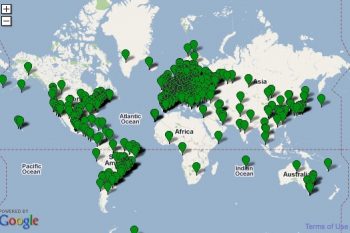
Jen kiel la Pasporta Servo komenciĝis. Tio estas gastiga servo, komencita en 1974. La adresaro, eldonata de TEJO – la Tutmonda Esperantista Junulara Organizo – montras la kontaktinformojn de homoj ĉe ĉiu kontinento krom Antarkto, kiuj volas gastigi senpage esperantistojn. En 2009, TEJO komencis retan version de tiu servo nomita Pasporta Servo 2.0, kiu pretendas 1500 uzantojn. That’s how the Pasporta Servo got started. This is a hospitality service, started in 1974. It’s directory, published by TEJO – the Tutmonda Esperantista Junulara Organizo (Worldwide Esperantist Youth Organization) – lists the contact information of people on every continent except Antarctica who are willing to host esperantists for free. In 2009, TEJO started an online version of this service called Pasporta Servo 2.0, which boasts 1500 users.

Bedaŭrinde, la distribuado de gastigantoj estas iom neegala, koncentrita ĉefe en la Amerikoj kaj Eŭropo, sed ankoraŭ, estas multaj gastigantoj en Azio, sed tre malmultaj en Afriko kaj Barato.
Mapo de uzantoj de Pasporto Servo 2.0 // Map of Pasporta Servo 2.0 users
Unfortunately, the distribution of hosts is rather uneven, focused primarily in the Americas and Europe, but still, there are plenty of hosts in Asia, but very few in Africa and India.

Unuafoje kontrolante la mondmapon ĉe la retpaĝaro, surprizis min trovi ke esperantistoj vere loĝis en Antarkto, sed tiuj nur estas uzantoj kiuj aŭ konfuziĝis pri la mapo aŭ ne multe zorgis kie ili musklakis. When I first checked out the world map at the website, I was amazed to find esperantists living in Antarctica, but they turned out to be users were either confused by the map, or just didn’t care where they clicked.

Multe da esperantistoj diras, ke la Pasporta Servo estas la kialo, ke ili lernis Esperanton. Many esperantists have cited the Pasporta Servo as their reason for learning Esperanto.

Alia avantaĝo resti kun Esperantistoj estas ke oni povas vidi kiel vivas la lokuloj anstataŭe tiuj kiuj vivas per la turistokomerco. Kaj la lokuloj scias ĉiujn bonegan lokojn vizitindajn, kaj povas diri al vi rakontojn ke la ĉiĉeronoj ne estas permesita mencii. Another advantage to staying with Esperantists is that one can see how the locals live rather than just people who live on the tourist trade. And the locals know all the great places to visit, and can tell you stories that the tour guides aren’t allowed to mention.

Do, kion vi pensas? Ĉu pasigi la someron marŝante transeŭrope, renkontante verajn homojn, sen la altkosto de ĉiĉeronoj? So, what do ya think? Spend the summer hiking across Europe meeting real people without the high cost of tour guides?

Esperanto kaj Politiko / Esperanto and Politics

Posted on 22. Jul, 2010 by in Double Language (EN-EO) Posts, Esperanto Language, Uncategorized

Per iliaj karaktero homoj estas sociaj kaj politikaj estaĵoj. Neeblas ke pli ol unu homo asociĝi senpolitike. Esperantistoj estas certe nenia escepto. Humans by their nature are social and political creatures. It’s impossible for more than one person to form an association without politics. Esperantists are certainly no exception.

Unu apartaĝo de Esperanto, kiu distingas ĝin de multe da aliaj konstruitaj lingvoj kiuj provis plenumi la bezonon por internacia lingvo, estas ke neniu posedas ĝin. D-ro Zamenhof rezignis regadon de la lingvo fondinte la fundamenton. Iu, kiu volas lerni ĝin rajtas uzi ĝin. Ĉi tiu klare kontrastas kun, instance, Volapuko. La kreinto, Johann Schleyer, insistis ke li reteni la proprietajn rajtojn de la lingvo, kaj refuzis permesi ŝanĝojn. Estis skismo en la movado, kaj la lingvo malviglis. Hodiaŭ, la vorto Volapuko estas esperanta slango por sensenco. Nek unu sola persono, nek lando nek registaro nek korporacio regas esperanton, kaj ĝi viglis. One aspect of Esperanto that sets it apart from many of the other constructed languages that tried to fill the need for an international language is that it doesn’t belong to anybody. Dr. Zamenhof gave up control of the language after setting up the fundamentals. Anybody willing to learn it is welcome to use it. This is in sharp contrast to, for instance, Volapük. Its creator, Johann Schleyer, insisted on keeping proprietary rights to the language, and refusing to allow any changes. This lead to a schism in the movement and the language languished. Today, the word Volapuko is an Esperanto slang word for nonsense. No one person or country or government or corporation controls Esperanto, and it has flourished.

Kiam homoj enlistigas la avantaĝojn de esperanto al etnaj lingvoj kiel interkultura pontolingvo, unu el tiu listo estas ke esperanto estas politike kaj kulture neŭtrala. Tamen, tiu neŭtraleco problemiĝis en Eŭropo antaŭ mondmilito du. When people count off the advantages of Esperanto over ethnic languages as an intercultural bridge language, one of them is that it is politically and culturally neutral. But this very neutrality became a problem in Europe before World War II.

Veras, ke mi renkontis esperantistojn de ĉiu politika standardo. Tamen, la lingvo ŝajne pli allogas homojn de specifaj pensmanieroj. Homoj kiuj havas tutmondan vidpunkton de la homaro kaj la tero, homoj kiuj kredas ke niaj samaĵoj estas pli gravaj ol la diferencoj, homoj kiuj interesiĝas pri universalaj idealoj, homoj kiuj pensas pri la planedo kaj specio anstataŭ nacio kaj partio – Tiaj homoj trovas ke la lingvo plej utilas. Estis tiaj homoj, kiuj Hitler kaj Stalin konsideris esti minaco al la reĝimoj. While I have met esperantists of every conceivable political stripe, it seems to appeal more to certain mindsets. People with a global view of humanity and the earth, people who tend to see our similarities as being more important than our differences, people who are interested in universal ideals, people who think in terms of a planet and a species instead of a nation or a political party – these are the kinds of people who find the language most useful. And these are the people who were considered a threat to the regimes of Hitler and Stalin.

En 1921, Eugène Adam, uzante la pseŭdonimon Eugène Lanti, fondis la organizon Sennacieca Asocio Tutmonda kiel organizaĵo de la Laborista Esperanto Movado kiu travivas hodiaŭ kiel organizo kiu subtenas socialisman, pacan, laborsindikatan, kontraŭnaciistan, feministan kaj ekologiajn agadojn tutmondajn. Ĉi tiu certe ne estas politike neŭtrala organizo, sed post nur dek jaroj la membreco jam kreskis ĝis proksimume 6500 homoj en 42 landoj kaj fariĝis Esperantan triumfon. In 1921, Eugène Adam, using the pseudonym Eugène Lanti, founded the Sennacieca Asocio Tutmonda (Worldwide Association without Nations) as an organization of the Workers’ Esperanto Movement which survives today as an organization which promotes socialist, peace, trade union, anti-nationalist, feminist and environmental activities which span the world. This is far from a politically neutral organization, but in just ten years it boasted a membership of about 6500 people in 42 countries and became an Esperanto success story.

La Nazia reĝimo komencis subpremon de Esperanto en 1933, kaj en 1935 Bernhard Rusto, Germana Ministro pri Scienco, Edukado kaj Publika Edukado, malpermesis la publikan instruadon de Esperanto, dirinte ke ĝi kondukus al “malfortigo de esencaj valoroj de la nacia karaktero”. Ĉi tiu poste estigis la areston kaj ekzekuton de esperantistoj tra Eŭropo. Then the Nazi regime began a suppression of Esperanto in 1933, and in 1935 Bernhard Rust, German Minister for Science, Education and Public Education, banned the teaching of Esperanto in public schools, saying it would lead “to weakening of the essential values of national character.” This eventually lead to the arrest and execution of esperantists across Europe.

La libro de Ulrich Lin, La Danĝera Lingvo; Studo pri la persekutoj kontraŭ Esperanto, priparolas problemojn pri cenzuro en Hitlera Germanio kaj Sovetunio, kie estis deklarita ke Esperanto estas la lingvo de la malamikoj: laboristoj, komunistoj, pacifistoj, kosmopolitismoj, kaj la burĝoj. Ulrich Lins’ book, La Danĝera Lingvo; Studo pri la persekutoj kontraŭ Esperanto, (The Dangerous Language; A study about the persecution against Esperanto) describes problems with censorship in Hitler’s Germany and the Soviet Union, where it was declared that Esperanto is the language of the enemies: laborists, communists, pacifists, cosmopolitanites, and the bourgeois.

Samtempe en Japanio, la registaro aktive malinstigita kaj eĉ persekutis esperantistojn, komparante ilin al akvomelonoj, “– verdaj (koloro de Esperanto) ekstere sed ruĝaj (Komunistaj) enterne.” At the same time in Japan, the government actively discouraged and even persecuted Esperanto speakers, likening them to watermelons, ” — green (a color associated with Esperanto) on the outside but red (Communist) on the inside.”

En la 21a jarcenta mondo, politika uzado de Esperanto ankoraŭ estas trovita ĉe la maldekstro. Porokaze ĉe la ekstrema maldekstro. Krom la Sennacieca Asocio Tutmonda, ankaŭ la Asocio de Verduloj Esperantistaj, basita germanie, kiu uzas Esperanton por unuigi verdulojn (sence de ekologio) tutmondajn, kiu interesiĝas ĝas pri socia, ekonomia kaj ekologia progreso; kaj la Internacia Komunista Esperantista Kolektivo. In the 21st Century world, political use of Esperanto is still mostly on the left. Sometimes way on the left. Aside from Sennacieca Asocio Tutmonda, there is also the Asocio de Verduloj Esperantistaj (Association of Esperantist Green-people) based in Germany, which uses Esperanto to unite Green (in the environmental sense) people around the world who are interested in social, economic and environmental progress; and the Internacia Komunista Esperantista Kolektivo. (International Communist Esperantist Collective.)

Ekzemplo de la uzado de Espoeranto de la politika deksto troviĝas en Japanio. En 2008, la G-8 (forumo por la registaroj de ok nacioj: Francio, Germanio, Italio, Japanio, Unuiĝinta Reĝlando, Kanado, Rusio kaj Usono) okazigis la kunvenon en Hokkajdo. Kontraŭ-tutmondigaj aktivistoj, korpe de la Libera Esperanto-Asocio en Hokkajdo, organizis protestojn kontraŭ la G-8, batalante tion, kion ili nomigis “nov-liberalismon.” La grupo atentigas, ke kontraŭ-tutmondigo ne egalas izoladon, kaj ili uzas Esperanton por komuniki kun aliaj kontraŭ-tutmondiguloj tramondaj. Oni povas esti partoprenanta membro de la mondokomunumo senrezignante la kulturan kaj nacian identecon, kaj senkapitulacante regon de lokaj ekonomiaj kaj ekologiaj aferoj. We can find an example of the use of Esperanto by the Right in Japan. In 2008, the G8 (a forum for the governments of eight countries: France, Germany, Italy, Japan, the United Kingdom, Canada, Russia and the United States) held their summit in Hokkaido. Anti-globalization activists in the form of the Libera Esperanto-Asocio en Hokkajdo (Esperanto Association for Freedom in Hokkaido) organized anti-G8 protests, fighting what they term “neo-liberalism”. They point out that anti-globalization is not the same thing as isolation, and they use Esperanto to communicate with other anti-globalization activists all over the world. It’s possible to be a participating member of the world community without giving up one’s cultural and national identity, and without surrendering control over local economic and environmental issues.

Malakceptante la anglan kiel internacia lingvo, la grupo ankaŭ usas Esperanton malrespektante aŭtoritaton, dirante, “Rigardu! Ni ne bezonas vian anglolingvon!” Rejecting the use of English as an international language, they also use Esperanto as a way to stick it to tha man, saying, “See! We don’t need no stinking English!”

Esperanto jam estis parto de mondaj politikoj kaj historio dum la antaŭaj cent jaroj. Neniu aliaj konstruita lingvo povas pretendi tion. Esperanto has been a part of world politics and history for the last hundred years. No other constructed language can make this claim.

Esperanto subculture.

Posted on 19. Jul, 2010 by in Double Language (EN-EO) Posts, Esperanto Language

Esperanto Subculture

Esperanta Subkulturo

In our previous article we discussed the idea of the Esperanto Culture – a world-wide, progressive culture in which the primary occupation is to talk to people in other countries. Antaŭartikile, ni diskutis la ideon de la Esperanto Kulturo – Unu tutmonda, progresa kulturo en kiu la primara okupo estas paroli al homoj en aliaj landoj.
In this article, we will explore subcultures. Ĉiartikole, ni esploros subkulturojn.
There seems to be two basic kinds of esperantists in the world.  The first and probably larger group is passionate about the language and the movement and the Interna Ideo, and the second group thinks of the language merely as a convenient tool for communicating and conveying what they have to say. Ŝajne estas du bazaj specoj de esperantistoj en la mondo. La unua kaj verŝajne pli granda grupo estas pasia pri la lingvo kaj la movado kaj la Interna Ideo, kaj la dua grupo pripensas la lingvon simple kiel oportuna komunikilo por diri tion kion ili volas.
Regardless of which type of esperantist is speaking, what do esperantists talk about when they talk to people in other countries?  A cursory examination of Esperanto communication – web pages and discussion fora and the like – would lead one to believe that we mostly discuss Esperanto, and that wouldn’t be an inaccurate observation.  Often, it’s the only common interest between people in disparate parts of the world.  But there are some themes that are so universal, we could as easily have a discussion with an Inuit as a Czech.  The 2010 FIFA World Cup was a huge topic in several Esperanto online fora. Senkonsidere de kiu speco de esperantisto parolas, kion esperantistoj priparoli kiam ili parolas al homoj en aliaj landoj? Supraĵa ekzameno de esperanta komunikado gvidus onin kredi ke ni plejparte diskutas esperanton, kaj tio ne estus erara.  Ofte, la lingvo estas la sola komuna interesaĵo inter homoj el malsamaj mondopartoj.  Tamen, estas iom da temoj kiuj estas tiel universala, ke ni povus tiel facile diskuti kun inuito kiel ĉeĥo. La 2010 Futbalo Monda Pokalo estis grandega temo en kelkaj Esperanto retforumoj.
While we tend to be passionate about our language, it’s usually not the only thing we’re passionate about. Religion, politics, sports, games and life-styles are on almost everybody’s list of Things to be Passionate About.  The following is not intended to be an exhaustive list, but a brief presentation of some of the groups which combine their passion for Esperanto with their passion for something else, too. Ni tendencas estis pasiaj pri nia lingvo, tamen, ĝi ne estas kutime la sola afero kiun ni pripasias. Religio, politiko, sportoj, ludoj kaj vivostiloj estas inkluzivitaj en preskaŭ ĉies listo de Aferoj por Pripasii. La sekvonta listo ne estas presentita kiel ĝisfunda, sed estas nelonga prezentado de iom de la grupoj kiuj kombinas ilian pasion por Esperanto kaj ankaŭ ilia pasio por aliaj aferoj.
Religion

In 1911, still early in the Esperanto movement, KELI, the Kristana Esperantista Ligo Internacia, was created at the Universala Kongreso in Antwerp.  This is a group of Christians of diverse churches in 48 countries, who convene together almost every year.  This year in Beregdarc, Hungary, August 2-9, 2010.

Religio

En 1911, ankoraŭ frue en la esperanta movado, KELI, la Kristana Esperantista Ligo Internacia, krieitiĝis dum la Universala Kongreso ĉe Antverpeno. Ĉi tiu estas grupo de kristanoj de variaj eklizoj de 48 landoj, kiuj kunvenas preskaŭ ĉiujare.  Ĉijare en Beregdaróc, Hungario, la 2an ĝis la 9an de Aŭgusto.

According to their website, their mission statement is “To create an effective contact between diverse countries, and using Esperanto to spread the knowledge of the Gospel of Jesus Christ.” Laŭ la retpaĝaro, ĝia celo estas “Krei efikan kontakton inter kristanoj el diversaj landoj kaj per Esperanto diskonigi la Evangelion pri Jesuo Kristo.”
KELI is a mostly Protestant organization, but Catholic esperantists can
find each other at the Internacia Katolika Unuiĝo Esperantista (IKUE).
KELI estas plejparte protestanta organizo, tamen katolika esperantistoj povas trovi unu la alian ĉe la Internacia Katolika Unuiĝo Esperantista (IKUE).
Their mission statement is pretty simple – 1. Introduce Catholics to Esperanto.  2. Introduce esperantists to Catholicism. La celo de IKUE estas simpla – 1. Enkonduki Katolikojn al Esperanto. 2. Enkonduki esperantistojn al Katolikismo.
According to their website, their magazine, Espero Katolika, is the oldest continuously published Esperanto publication.

Neither of these two Christian groups responded to email inquiries for interviews

Laŭ la retpaĝaro, la gazeto, Espero Katolika, estas la plej malnova, daŭre aperanta esperanta revuo.

Neniom de tiuj kristanaj grupoj respondis al petojn por intervjoj.

Christians are not the only ones using the Universal Language to spread the faith.  There is, among others, the Japana Budhana Ligo Esperantista. Kristanoj ne estas la solaj kiuj uzas la universalan lingvon disvastigante la fidon.  Estas ankaŭ, inter aliaj, la Japana Budhana Ligo Esperantista.
The Baha’i Faith seems to have a special relationship with Esperanto. They advocate the introduction of an auxiliary international language, and consider this to be a prerequisite for the unification of mankind and the establishment of lasting peace. Ŝajnas, ke la Baha’i Fido havas specialan interrelato kun Esperanto.  Ili subtenas la enkondukton de internacia helplingvo, kaj kredas ke tio estas antaŭkondico por la unuigo de la homaro kaj estigo de daŭra paco.
Though the language doesn’t have to be Esperanto, Bahá’u'lláh traveled to Europe and met Dr. Zamenhof, and decided that Esperanto was an excellent candidate language, and Zamenhof’s daughter, Lidia, became a baha’i. Kvankam tio lingo ne devas esti Esperanto, Bahá’u'lláh vojaĝis al Eŭropo kaj renkontis d-ron Zamenhof kaj dicidis Esperanto tre taŭgis kandidate, kaj la filino de Zamenof, Lidia, baha’iiĝis.
You can find more information on the Baha’i Esperanto League here. Vi povas trovi plu da informo pri la Baha’i Esperanta ligo ĉi tie.
I don’t know if it’s where I live or who I know, but it seems like most of the esperantists in my circle of friends are Unitarian Universalists.  The Unitarian Universalists are using Esperanto to “… achieve the 6th Principle of world community with fairness in communication…” and state that “…The ‘interna ideo’ within Esperanto is a match with Unitarian Universalist principles, beliefs and actions.”

http://www.grupoamikema.org/UUEN.html

Mi ne scias, se pro aŭ kie mi loĝas aŭ kiun mi konas, ŝajnas ke la plejmulto de esperantistoj kiun mi konas estas unitariana-universalistoj. Tiuj uzas esperanton “Por atingi la celon de la 6-a Principo pri mondkomunumo kun justeco pri komunikado per Esperanto” kaj diras ke, “… la ‘interna ideo’ ene de Esperanto akordas kun la principoj, kredoj kaj agadoj de Unitaria-Universalistoj.”

http://www.grupoamikema.org/UUEN.html

I spoke with Steven Schwichow in San Francisco and recorded his thoughts on the interconnection between UU-ism and Esperanto.  Unfortunately, it was in a noisy restaurant with bad lighting. Mi parolis kun Steĉjo Schwichow en San Francisko, kaj registris liajn pensojn pri la ligoj inter UU-ismo kaj Esperanto.  Malsorte, tio okazis en brua restoracio kun malbona lumado.
YouTube Preview Image
I tried to find groups of Wiccans and other pagans who use esperanto, but could only find individuals.

We’ll follow up this report with an article how some political organizations are using Esperanto.

Mi penis trovi grupon de Vikano kaj aliaj pagonoj kiuj uzas esperanton, sed nur trovis individuaojn.

Ni plutraktos ĉi tiun raporton kun artikolo pri iam kelkaj politikaj organizoj, kiu uzas esperanton.