Archive for January, 2011

Czech Wikipedia translated from Esperanto?

Posted on 27. Jan, 2011 by in Interview

You may now know the history of the Esperanto Wikipedia, but did you know that the Czech Wikipedia was started through Esperanto? Back in November 2002, the Esperanto Wikipedia was already a year old and maturing, but the Czech Wikipedia didn’t even have its interface translated yet! Well, today I have a guest article which originally appeared in a Czech magazine about Wikipedia called Wikimedium about how the Czech Wikipedia got started and the important role which Esperanto played. The follow is an interview with Miroslav Malovec who translated the interface for the Czech Wikipedia back in 2002. You can also read the original article in Czech (PDF, p. 4-5) or its Esperanto translation at Libera Folio.

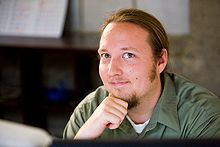
Miroslav Malovec. Esperanto translator, author of several publications and Esperanto textbooks. Founder of the Czech Wikipedia.

Photo: CC-BY-SA, Wikimedia Czech Republic

You founded the Czech Wikipedia in 2002. Then even the English Wikipedia had only been around for 20 months. How did you first come into contact with it?

I first heard about Wikipedia through Esperanto. Already in Spring 2000, I wrote in our association’s bulletin (Starto 2/2000, p. 3), that we need a general encyclopedia in Esperanto, because foreign languages serve people more as a source of information than as a way to get to know a random foreigner. When an magazine article appeared from our Rotterdam HQ (Esperanto 3/2002, p. 68) informing that the American student Chuck Smith founded the Esperanto version of the online encyclopedia Wikipedia (it was the first time that I heard about Wikipedia), I was filled with joy, that I found a kindred spirit and I immediately signed up for an account. I needed a bit of time to understand Chuck’s instructions of how the system worked, but after that I regularly contributed.

How do you remember your decision to found the Czech Wikipedia?

In November of the same year, we had a conference about technical applications of Esperanto in Dobřichovice near Prague. There I met Chuck Smith (then 23 years old), who came to lecture about Wikipedia. One week later, he was travelling to Budapest, and stopped by my home on the way and asked “Why don’t you start the Czech Wikipedia?” I answered, “Because I don’t know how to do that!” He then asked permission to connect my computer to the Internet, downloaded a TXT file and said, “Don’t touch what’s in English, those are commands for the machine. Translate everything in Esperanto to Czech, because those are instructions for humans.” The translation took around two weeks, and then I sent the result to Brion Vibber, who announced two days later that the Czech Wikipedia works already. We finished that at almost the end of 2002. But I found many typos and some commands which I incorrectly understood, so I asked about corrections. He gave me passwords, so I could correct everything myself. I fulfilled this task and forgot the passwords. Afterwards, new people started to sign up and I let them work and decided to dedicate myself to the Esperanto version. After a while, they reminded me that I’m still registered as an administator and I’m not fulfilling my duties, so I resigned from that position.

What did you expect founding the Czech Wikipedia? In what direction and to what extent did you suppose it would evolve?

In the Esperanto version, I hoped to create an information system which would make it possible for Esperanto to fulfill one of its main tasks of an international language, that is to deliver information about everything imaginable. At the same time, I wanted to present Czech culture to the world in much more detail than what can typically be found in paper encyclopedias. I also hoped that other Esperanto speakers would also present their national cultures. For example, the greatest painters of the world are already seen until we’re tired of them, but I’m also interested in painters from Denmark, Hungary, Finland, Iceland, etc., which are possibly less well-known, but there are certainly some very original artists among them (like our Lada or Zrzavý). Last, but not least, I wanted to record the history of Esperanto. Chuck asked me to copy the 2600 articles of the Enciklopedio de Esperanto from 1935, which describes our organizations, magazines, books and people of that time. Many articles were immediately updated and completed by other Wikipedians. And new articles kept appearing describing the last 75 years.

The Czech version Wikipedia was another situation. At first, I wanted to fulfill Chuck’s request and second, I didn’t want the Czech version to be missing among the other languages. And, of course, I liked the idea, that the Czech version has Esperanto to thank for being brought into existence. I planned to write about interlinguistic topics, but I’d leave everything else to other Czechs. I supposed, that online versions of our paper encyclopedias would form, but every article had to be rewritten from scratch because of copyrights. The main advantage is that updates appear in Wikipedia which can take several years to reach a printed encyclopedia and often they never reach it. Wikipedia reacts immediately, even hair-raisingly fast (for example, after the death of a celebrity), and one can describe things in a lot more detail, which the collective of authors of a classic encyclopedia would refuse to include due to lack of space. Or they write two sentences about someone, because the person didn’t seem that important to them, but you can put more details into Wikipedia. You can include young artists, athletes, scientists and politicians, which would appear in a paper encyclopedia only many years later. But often even older famous people are missing, which deserve to be included, but the encyclopedia’s authors don’t know about them. For example, the Vienna professor Eugen Wüster, founder of the technical standards and terminology, isn’t in any Czech encyclopedia. There are certainly thousands of other similar cases. I think that every person who works on a paper encyclopedia has written many notes in the margins, pasted in magazine clippings, etc. and Wikipedia allows us to propose such completions.

In the first weeks and months, indeed even years, the Czech Wikipedia was completely different than now. So that the readers can imagine that: what were some of the main differences?

In the beginning, copyrights were neglected. Some contributors wrote stories instead of encyclopedia articles, a certain form and structure still needed to crystalize. Also some unserious people “contributed” to vent their frustrations. For example, they wrote about one politician, that he was a cretin, nothing more. But the next day, someone else posted a serious detailed article, so thanks to that misstep, the politician (whose name I won’t confess) entered Wikipedia possibly as the first politician. Step by step, the need evolved, for every assertion to be documented, from where the writer pulled their information. A rule about neutrality was created: you couldn’t write that Jesus was the son of God, but rather had to formulate it like this: “Christians believe that Jesus is the son of God.” As for pictures, you had to prove, that it was not blocked by copyright or for some other reason. Professionals overwhelmed Wikipedia with criticism, that it wasn’t trustworthy nor serious, which caused much more severe rules to be established. – On the other hand, Wikipedia has information about current affairs and is very valuable, because it turns its readers into authors and active contributors. That means that people learn to work together with people they don’t know, and have to study a topic in more detail before writing about it, which enriches them much more than a passive reading of an article, even an article which was written by a professional.

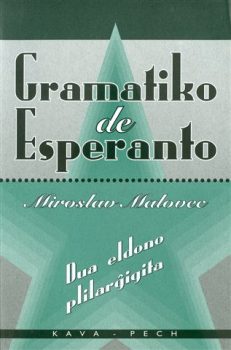
Malovec's Grammar of Esperanto

You’ve done much more work for the Esperanto Wikipedia, where you still contribute to this day. Does it appeal to you more?

We have many Czech encyclopedias, and Wikipedia is just a further step in their evolution and of course, there are plenty of other Czechs, which contribute to the project. If every Esperanto speaker would run away to their native language version, the Esperanto version would become a ghost town. That’s why we leave the national language Wikipedias to our compatriots and we dedicate our energy to the Esperanto version as a common international creation, moreover the first of its kind in the history of Esperanto. I’ll sporadically contribute to the Czech Wikipedia about topics relating to Esperanto, but for example about Czech artists and other items of the past, I’d rather write in the Esperanto version and in this way promote Czech culture abroad. In addition, we don’t want to forget about people who worked for Esperanto before us, that’s why we also write about the history of our movement which I already mentioned. But Wikipedia is only one of my activities. I also contribute to the Encyclopedia of Brno and to the Authorities of the National Library, if I find errors or anything which is missing. For the biological library BioLib, I added 11,000 Esperanto names of animals and plants, and contributed some digital books to the Project Gutenberg. I’m also working on a manuscript of Esperanto speakers who have passed away and I edit the association’s bulletin. I’ve also translated some texts to Esperanto for the Esperanto Museum in Svitavy, so I guess you could say that I hop from one thing to another, whenever the need rises to work on that.

How would you rate the current state of the Czech Wikipedia? Do you use it yourself as a reader?

Of course, when I need encyclopedic information, I check out different languages in Wikipedia, because each one has something which is missing from the others. Often it helps me with terminology, when I need to know how different languages name a certain object. In every version, I meet model articles and also those where there is just a minimum of information. Finally, it’s possible to print Wikipedia as a book. I just saw the German version in book form! I think that the Czech version isn’t mature enough to print, but there is not much missing.

And what about the other Wikimedia projects, in Czech or in Esperanto? Are you intimately connected to them as an author or a user?

I don’t occupy myself with the other projects. I’ve only worked a little bit on the Esperanto Wikibooks, but that was already some years ago.

When someone visits your personal website, he won’t even know that you founded the Czech Wikipedia. Are you not proud of that?

I don’t want to appear as a braggart, that’s why I prefer that people say that Esperanto speakers founded the Czech Wikipedia and not me personally. By the way, Chuck Smith and Brion Vibber effectively created it, I was just the first person they requested to translate Wikipedia commands to Czech. That wasn’t such a large task. Maybe in that sense, I’ll rewrite my website.

The founder of the English Wikipedia, Jimmy Wales, is now one of the largest figures online with not a small influence. That can’t be said about you. Does that not bother you?

No, my translation of a short text is not comparable with the creation of an idea, of the respective program, putting it online, and spreading it all. Jimmy Wales deserves his influence, if he effectively has it. In recent months, he was exposed in Wikipedia as a beggar, shaking his wallet. I don’t know if that’s the right glory and right influence.

Looking back on this ten-year anniversary, what do you want for Wikipedia, not just for Czech, but also the worldwide project, for its next ten years?

I believe that encyclopedias, dictionaries and similar things of educational character stay online “forever” and every new generation perfects and works through them. It would make no sense to wipe out work that’s already done and write everything over again from scratch. I hope that professionals stop criticizing Wikipedia because of its mistakes and start contributing to the common work to correct its errors. There are also quite a few errors swarming around classic encyclopedias, because no one person can know everything, a professional as well as an amateur copies from earlier encyclopedias, including their errors. But errors cannot be so easily corrected anywhere else like in Wikipedia’s open system. When I find an error in a paper encyclopedia, you’ll correct it with a pen in your copy, but the authors won’t know about that, and will repeat the same error in the next edition. In Wikipedia, you’ll write a comment, why you think the text has an error, and after some discussion the error will be corrected and there will appear a notice that there exists two sources with different information. In that way, Wikipedia can approach the trustworthiness of professional encyclopedias and at the same time keep its grassroots character. Thanks to the fact, that every Internet user can contribute, Wikipedia collects a great mass of information which can’t be found elsewhere, and that’s why Wikipedia is unique among other encyclopedias. It becomes a collective work of all mankind and I suppose that that won’t change until the end of human civilization. In the next decade, new languages will probably appear, for example African and Indian, which will bring in riches about culture and reality, which are now only mentioned marginally – and not only in Wikipedia. I hope that the current decade will become the decade of virtual libraries, which are now looking for their optimal form (Gutenberg, Europeana, among others) but sometime they will become a virtual variant of national and scientific libraries, where you can find fiction, technical literature, tourism information, photos, sound recordings, videos, films, and of course, also encyclopedias. So, I wish for Wikipedia, that it keep its extraordinary position in that virtual world.

In Brno (in the Czech original: Jan 6, 2011) by Miroslav Malovec
(Esperanto translation: Jan 22, 2011) by Miroslav Malovec
(English translation: Jan 25, 2011) by Chuck Smith

This article is under the Creative Commons BY-SA license by Wikimedia Czech Republic.

New format at NASK after 40 years

Posted on 25. Jan, 2011 by in Esperanto Culture, Events

Today, I have Ellen Eddy with me who runs the North American Summer Esperanto Institute (in Esperanto: Nord-Amerika Somera Kursaro, NASK) which is an Esperanto course always run at an American university where people come from around the world to learn Esperanto intensively for a few weeks. I actually attended it myself in Brattleboro, Vermont back in 2004 when they offered training for Esperanto teachers. This year, they’re experimenting with changing the format and I’m excited to find out what’s new.

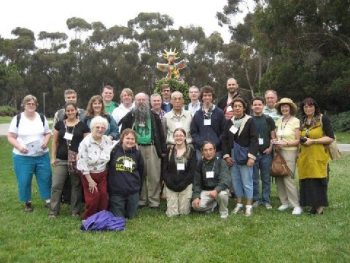
NASK students enjoy some fresh California air

How did NASK get started?

NASK started in San Francisco in 1970 after Bill and Cathy Schulze convinced the regents of San Francisco State University that it was a viable course to add to their summer sessions. What was its original purpose? The original purpose was to train teachers in how to teach Esperanto and to raise the language capability of U. S. speakers of Esperanto. Before NASK a person would have to go to Europe to get such training.

When and where does it take place?

This year for the fifth time the classes will be at the University of California, San Diego. The students will be housed together in the International House of the Eleanor Roosevelt College. Students arrive on July 2 and leave on July 10.

Kie veganoj loĝas? En Vego! ;)

What is a typical day like for someone attending NASK?

After getting dressed, students walk to the nearby Cafe Ventanas for breakfast. Afterwards, they head to class which starts at 8:30. Classes continue until 12:30 with a short break around mid-morning. Lunch is from 12:45 until 13:30. Afternoons vary. There can be short learning sessions, games, trips to nearby places of interest (especially the beach which is within walking distance), special presentations by teachers or students. Dinner is at 17:30 to 19:00. Evenings are filled with special programs planned by the students and/or instructors. We try to leave some time for homework, too.

Who will be teaching this year?

Birke Dockhorn from Germany, Bertilo Wennergren from Sweden and Lee Miller from the US. This is the third time this group has worked as a team. Students in the past were particularly happy to ask Bertilo grammer questions as he is the author of the popular PMEG (Plena Manlibro de Esperanta Gramatiko, Complete Handbook of Esperanto Grammar).

Why did you decide to change the format?

We were finding more potential students saying that they didn’t have three weeks of vacation time or/and as much money as needed for the typical NASK. Also the economy and job situation in the US has suffered so much and the prices at the university are still going up. We thought it was time to try a new format. Using the 4th of July holiday allows us to plan an intensive 9 day program which uses only 4 vacation days and of course doesn’t cost as much. Students will be studying everyday, even on the holidays.

NASK group photo 2010

How much does it cost?

Before March 15, the general cost for housing with three meals a day and tuition is US$865 (635 €) with a special price of US$665 (488 €) for full time students and those from Latin America. After March 15th, the price is $895 (657 €) and $695 (510 €).

Are there scholarships available? If so, how can you find out about them?

There is some scholarship help available. Those who would like to inquire can contact me at eddyellen@aol.com.

What would you say to someone who is now sitting on the fence, not sure if they want to attend NASK?

This is a great chance to experience NASK and be immersed in Esperantio on a budget.

Thank you so much for everything. Visit the NASK website for more details!

Promoting the Esperanto Wikipedia (Part 4 of 4)

Posted on 15. Jan, 2011 by in Uncategorized

So far, we’ve gone from finding the Esperanto Wikipedia, to founding it, to the technical modifications necessary to make it work smoothly. If you haven’t read the first three parts, I’d highly recommend doing so first. Now, time to get the word out!

After the major technical problems were handled, we felt it was ready to publicize on a wide scale. I remember Erik Zachte (a Dutch Wikipedian) once told me that he envied our Wikipedia, because Esperanto speakers already consist of a worldwide community making it much easier for us to spread information to all of our speakers, despite the great distances we have apart. On January 15, 2002 (the one-year anniversary of the English Wikipedia), we published short articles in two online news sources which are no longer published: Eventoj and NUN. A week later, we were listed in the Yahoo! directory.

Next, we pulled out the big guns. On March 1, we had an article in the magazine Esperanto, the largest distributed magazine in the world. On April 28, my first interview was heard around the world on Radio Polonia. To take things even further, I decided to travel in mid-July to see the world and give lectures in Esperanto about Wikipedia.

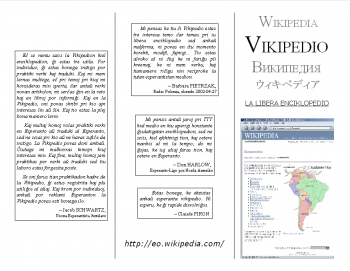
Part of the first Esperanto Wikipedia flyer

A week later, I gave my first lecture at the International Youth Congress of Esperanto in Pato Branco, Brazil. I remember that I was so not used to speaking Esperanto that I occasionally had to ask the audience to help me out with unfamiliar words. However, they seemed really interested in the revolutionary project and were very patient in listening to this beginner Esperanto speaker. I made sure to have flyers to pass out, so the project wouldn’t be forgot when participants returned home to their native country.

I tried to lecture about Wikipedia at the World Congress of Esperanto in Fortaleza, Brazil a week later, but was informed that only member organizations of the Universal Esperanto Association (UEA) may speak there. I’ll never forget having to look on as I saw the group of katamantoj (cat lovers) meet, but yet I wasn’t allowed to speak formally about the project. How frustrating! However, in hindsight, I imagine UEA gets the full gamut of requests to speak about pet projects which they politely and appropriately need to turn down. I’d guess that the Esperanto Wikipedia only had about 3,500 articles at the time, so not a very big project indeed.

I then went on to speak at the Konferenco pri Aplikoj de Esperanto en Scienco kaj Tekniko (KAEST, Conference about Applications of Esperanto in Science and Technology). I still to this day remember that the first question from the audience was about a grammar error in my presentation. Some things never change I guess. The second question started with, “Now, I have a question about the content.” Nice. In any case, the older crowd was mostly skeptical about this young beginner Esperanto speaker trying to create an encyclopedia.

Thank you for joining me on this whirlwind tour of the early months of the Esperanto Wikipedia. As of this writing, the Esperanto Wikipedia has over 140,000 articles. Did you know that today, Jan 15, 2010, is the 10 year anniversary of the entire Wikipedia project? I still can’t believe how far it’s come. Celebrate with a friend by reading and editing some Wikipedia or attending a local Wikipedia party in your city today!

If you’ve enjoyed this series, you would also enjoy this post: Czech Wikipedia translated from Esperanto?