Archive for February, 2011

Five Periods of Esperanto Literature

Posted on 25. Feb, 2011 by in Literature, Uncategorized

When I lived in Rotterdam, I remember taking the trip to visit the Internacia Esperanto-Instituto for an Esperanto literature seminar. It was most helpful for recognizing important authors, but when I think back on that seminar, I remember being impressed by how Esperanto literature can be divided into different periods based on different styles of writing. I also remember sitting in offices of the Universal Esperanto Association and reading the Fundamenta Krestomatio and being amazed at how the style of the language felt so old… in a planned language, incredible! Now, I’ll let Amelie Ambrus show you how the Concise Encyclopedia divides Esperanto literature into periods. Also, see her first post about an Introduction to Esperanto Literature.

This article is a quick sketch of the literary periods of original Esperanto literature, as presented by Geoffrey Sutton’s Concise Encyclopedia of the Original Literature of Esperanto, reviewed previously on this blog. More information on individual authors will follow in later articles. All quotes are from the Concise Encyclopedia.

The First Period: 1887-1920. Primitive Romanticism and the Establishment of Style

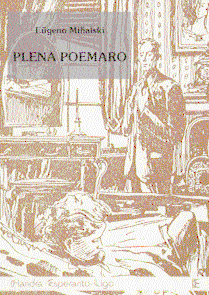
Cover of Plena Poemaro [Complete Poetry Collection]

In the first period, Lejzer Ludwik Zamenhof, the initiator of Esperanto, was particularly influential; however, he prioritized translation and rarely wrote original literature. The Concise Encyclopedia, focusing on original literature, says “the period’s most influential writer of prose was undoubtedly Kaziemierz Bein” and “the first generation’s leaders were the five writers: Antoni Grabowski, V. N. Devjatnin, Leo Belmont, Abram Kofman, and Felix Zamenhof“. Nonetheless, most of the writing of that period tends to feel a little old-fashioned now, sort of like reading English from the 1700s and 1800s. It’s easier than Shakespeare, and perhaps comparable to Dickens, in how far away it seems from modern language use. The second period onward tend to have authors who seem more contemporary; the rest of this article deals with those.

The Second Period: 1921-1930. Mature Romanticism and a Literary Flowering


The second period is exemplified by the original writing of Kálmán Kalocsay and Julio Baghy, of the Budapest School. “Kalocsay was to dominate the following decades of poetry. His influence up to and beyond the 1950s cannot be overestimated. Mondo kaj Koro [A World and a Heart] was later to be seen as inaugurating the Second Period of Esperanto literature. His second collection, Streĉita Kordo [Stretched String], was to inaugurate the Third”. Both authors were also very influential on prose styles. Eŭgeno Miĥalski also hails from this time; his poetry is sometimes judged superior even to Kalocsay’s; his highly experimental, yet highly readable, style merits serious attention. Also notably, Esperanto had already expanded beyond Europe. “Of the first generation of Japanese writers, two outstanding original poets continued working into the second generation: (Kenĵi) Ossaka and (Saburô) Itô“, publishing collections of poems as early as 1921. Other Japanese writers in Esperanto at this time were Masao Nisimura, Kisaku Tabata, and Koĵiro Nakagaki. Parody also started to appear; Raymond Schwartz is well-known for his humor, including lovingly lampooning excesses of the Esperanto community.

The Third Period: 1931-1951. Parnassianism and the Coming of Age


The third period contains many of the same authors as the second. It was also marred by tragedy, as many of the best Esperanto authors were systematically killed, and Esperanto was made illegal in several countries under various communist and fascist regimes. It was also filled with critiques of these regimes; Vladimir Valentinovič Varankin critiqued Stalinist Russia in Metropoliteno [Subway], Austrian Hans Weinhengst (a.k.a Johan Weinhengst) wrote the socially critical Tur-strato 4 [4 Tower Street], while Teru Hasegawa (a.k.a. Verda Majo) opposed Japanese military expansion. She spent time protesting it in occupied China, writing about it in Flustr’ el Uragano [Whisper out of a Hurricane]. Neither Varankin nor Weinhengst survived; Miĥalski was also among the many who perished.

The Fourth Period: 1952-1974. Post-Parnassianism and Modernism

Cover of Kolektanto de Ĉielarkoj [Collector of Rainbows]

In the fourth period, stories by Tibor Sekelj took the world by storm. The Scottish School also appeared, and William Auld wrote the epic poem La Infana Raso [The Child Race]. He was nominated three times for a Nobel prize in literature. Marjorie Boulton, the foremost female Esperanto poet, wrote Kontralte [In Contralto], published in 1955. Albert Goodheir wrote a poetry collection, Merlo sur Menhiro [Blackbird on a Menhir], and he has been compared to Wordsworth. A South African, Edwin de Kock, not content with his mastery of Xhosa, Afrikaans, and English, learned Esperanto. He soon published Ombroj de la Kvara Dimensio [Shadows of the Fourth Dimension]. His poetic style is highly controversial, clashing with Kalocsay’s theories, but he is often considered one of Esperanto’s top poets. This period was rich in excellent Esperanto poets; his contemporary, Icelander Baldur Ragnarsson, of Ŝtupoj sen Nomo [Stairs with No Name] and Esploroj [Explorations], was nominated for a Nobel Prize in Literature in 2007.

The fourth period also had increased literary output from Asia, India, and Brazil. Bengali Lakshmiswar Sinha wrote Hindo Rigardas Svedlandon [An Indian Looks at Sweden] and Jaroj sur la Tero [Years on Earth]. Geraldo Mattos, writing in Esperanto from Brazil, mastered the Japanese tanka poetry style in Miniaturoj [Miniatures]; in Arĉoj [Bows], “the suggestiveness of his language seesaws on the brink of untranslatability”. Roberto Nogueira, also from Brazil, wrote the significant Vojo kaj Vorto [Way and Word], reacting against Kalocsay’s Parnassianism. Masao Ueyama and Masao Miyamoto contributed original prose and poetry, and translations from Japan. Unfortunately, persecution continued in some countries; Armond Su wrote Esperanto poetry, first published in 1960, but was jailed during China’s Cultural Revolution, and never fully recovered, dying young. The memory of persecution lingered in others; Masao Miyamoto wrote La Morta Suito [The Death Suite], about Sakae Ōsugi, a Japanese Esperanto speaker who was killed by the Japanese government, along with his family. On a lighter note, Gaku Konisi of Japan, a professor of theoretical physics, wrote La Kosmoŝipo ‘Edeno n-ro 5 [The Spaceship Eden No. 5], a collection of short science fiction stories.

The Fifth Period: 1975-. Popularization of the Novel, Experimental Poetry, Postmodernism


The fifth period, from 1975 onward, merits an article of its own. Both due to the quantity of published material, and to being recent and ongoing, it is quite difficult to summarize as concisely as the earlier periods. Nonetheless, some notable authors from this period include Jorge Camacho, Trevor Steele, Claude Piron, István Nemere, Sten Johansson, Serĝo Elgo (a.k.a. Georges Lagrange), Abel Montagut, Mauro Nervi, Nicolino Rossi, Karolo Piĉ, Eli Urbanová, Timothy Carr, Krys Ungar, Gafur Gazizi, Alen Kris, and Mao Zifu. Poetry collections with too many authors to name continue to appear; Moskvaj Sonoriloj [Moscow Bells] has 36 authors. Notable fourth-period authors such as Reto Rossetti, John Francis, Albert Goodheir, Baldur Ragnarsson and Geraldo Mattos continue(d) to write. Popular literature, including crime novels, is flourishing. The first full novel in Esperanto by a native Esperanto speaker, Karuseloj [Carousels] by Sara Larbar, was published in 1987. More African authors are starting to appear; Togo’s Gbeglo Koffi was the first published sub-Saharan author in Esperanto other than Edwin de Kock, and Benin’s Jean Codjo has started producing notable stories.

In genres from popular fiction to postmodern novels and every sort of poetry, Esperanto literature is flowering. Start exploring it – it’s worth it!

Language Festival with Esperanto beer!

Posted on 23. Feb, 2011 by in Events

Have you heard of a language festival before? If you’ve never heard of that, think of what that could mean.

Bienvenu Sene presents the Lingala language

In 2004, I was invited to Russia to participate in a language festival in Volgograd. There was an introduction where they introduced all the speakers and the languages they were presenting. They took over a school for the day and dedicated each room to a different language. I still remember presenting Dutch there, quite an exotic language in Russia! They always invite foreign Esperanto speakers to lecture, so then they present in Esperanto and a local would interpret the lecture to Russian on the fly, so everyone could understand. I still find this to be a fascinating, natural way of introducing Esperanto to the general public. The participants then see Esperanto being used for a useful purpose and understand it (due to the interpretation). They also see that Esperanto speakers are interested in culture, since they organized the language festival after all!

On Saturday, I participated in such a festival in Leuven, Belgium. You can see the list of languages on the program from Bulgarian to Sinhala (spoken in Sri Lanka). The Irish lecture by Seán Ó Riain was particularly interesting since it was given in Esperanto with live interpretation into Dutch. I think everyone was surprised to discover that five of the attendees asked questions in Esperanto afterwards… which made all of us wonder how many Esperanto speakers were lurking in that crowd!

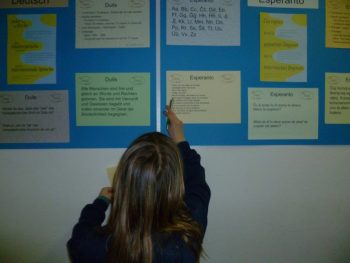
Child admires German and Esperanto posters

After this meeting, I attended the talk on the Kurdish language, which was given in Kurdish with interpretation to Dutch. Even though I can normally understand Dutch okay, the interpreter’s accent in Dutch was just too difficult to understand for me. After this, I headed to Judith Meyer’s lecture on German. She explained differences in Dutch and German mostly by using a German song with a Dutch translation.

Another surprise was that there were four Esperanto-speaking visitors from other countries, and we could all speak Dutch! Marek Blahuš (Czech) had previously lived in Leuven and I (American) had previously lived in Rotterdam, so that explains us well. The others, however, had a more interesting story to tell. Pete Lypkie (Canadian) and Judtih Meyer (German) had made a January Dutch Challenge to learn Dutch in six weeks. To raise the stakes, Judith decided that she would make her presentation at the language festival in Dutch at the end of these six weeks, which she did! Also, be sure to check out Pete’s report of the language festival from his perspective.

Esperanto beer brewed in Leuven just for this Language Festival!

So, what can top a lecture in Dutch about German? Well, I don’t think anything can, so I headed to the bar to get me some Esperanto beer. The organization Esperanto 3000 brewed a special beer that is sold only at this language festival using their own recipe. I have to say it had a bit of a fruity taste and was quite smooth. Downing some Esperanto beer while chatting with other attendees in the same language seemed a nice way to finish off the event. Afterwards, we went to an Indian restaurant at which point I was surprised to learn that many of the Belgians had never eaten Indian food before, so that definitely added to their cultural experience!

If you want to learn more about the history of this event in general, Wikipedia has a nice article: Language Festival. The largest language festival in the world takes place in Cheboksary, Russia every year in October and lasts eight days: two days of the festival and six days of the “international caravan” visiting a different school everyday. If there’s no language festival near you, organize one in your own city! It seems they work best in medium-sized cities around 50,000-300,000 since it’s large enough to have foreign speakers, but not too large that there’s too many competing events for everyone’s time. Last but not least, you can also attend a language festival online; Lingva Prismo was developed to let you explore foreign languages right from the comfort of your home. In any case, I hope you’ll find some way to join in the global celebration of language diversity!

Discover Esperanto Literature in English

Posted on 21. Feb, 2011 by in Literature, Uncategorized

Amelie Ambrus hits us again with another look at Esperanto literature from another point of view. I personally think this book belongs in every library worldwide, but that would be a bit expensive. However, it would be hard to argue that Esperanto has no culture when faced with the abundant diversity of works created in this planned language. I’d say this book is as essential to a serious Esperanto library as the Plena Ilustrita Vortaro (PIV). You can also read her previous post with an overview of Esperanto Literature.

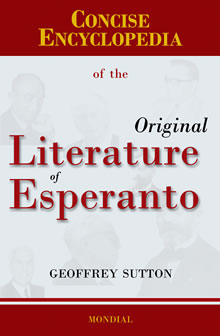
Concise Guide of Esperanto Literature (728 pages)

“It may be maintained that Esperanto has for some time been worth learning for knowledge of its original literature alone.” — Geoffrey Sutton’s Concise Encyclopedia of the Original Literature of Esperanto. I think he’s right – but I didn’t realize just how right he was until I read this book.

As I mentioned in the previous entry, it can be a little difficult to know where to get started reading Esperanto literature. Getting recommendations is useful, but it’s also amazingly nice to be able to read about a wider range of what has been written. Who wants to get a postmodernist novel when you’re seeking classical poetry or popular fiction? Also, sooner or later, an avid reader may well become curious about who the major authors are; it would feel weird to have read widely in English but to never have heard of Shakespeare.

The concise encyclopedia is a masterwork. It is the most up-to-date and comprehensive overview of original Esperanto literature. As the title says, it is principally concerned with original literature; translations are only mentioned if they’re relevant to an author who also wrote original literature. Both translations into Esperanto by authors of original literature, and translations from their Esperanto works into other languages, are covered.

The book is divided into literary periods. To get a quick overview of the most important Esperanto writers and their most important works, read the first few pages of each section. Doing so, you’ll learn some basic information about the major authors, periodicals, and major contemporary influences. The periods are:

  • The First Period: 1887-1920. Primitive Romanticism and the Establishment of Style.
  • The Second Period: 1921-1930. Mature Romanticism and a Literary Flowering.
  • The Third Period: 1931-1951. Parnassianism and the Coming of Age
  • The Fourth Period: 1952-1974. Post-Parnassianism and Modernism
  • The Fifth Period: 1975-. Popularization of the Novel, Experimental Poetry, Postmodernism

Within each literary period, there are articles on each author. Each article has a biographical sketch, mentions the original works (or the most important ones for particularly prolific authors), major translations done by the author and of the author’s works into other languages from Esperanto. Details are often given about the works. Geoffrey Sutton prioritizes well; major authors are given several pages, while rudimentary information is provided about merely notable ones. The main article texts are quite lively and readable; they often have translated excerpts of reviews, and mention major influences on and controversies surrounding various pieces.

Major literary schools, such as the Scottish school and Budapest school are mentioned. However, the author resists the tendency to group loosely-connected authors into schools, although he mentions when others do, and they are not an organizing principle of this work.

The book also provides perspective. Throughout Esperanto history, authors from Kálmán Kalocsay through Vladimir Varankin to István Nemere have used Esperanto to express thoughts that they cannot or dare not in their native languages. Their topics have ranged from erotic poetry to political commentary. In a few cases, especially under Stalin and Hitler, this daring cost them their lives; using Esperanto was punishable by death, and using Esperanto to say something sensitive was quite dangerous. In others, Esperanto provided a safe outlet for ideas that their cultures censored. The chronological nature of the book also documents Esperanto’s spread, from Russia and Poland throughout Europe, into Asia and Brazil, and the dawn of Esperanto-language writers from Africa. The influences of authors on each other are also clearly spelled out, heavily relying on quotations from major Esperanto authors and reviewers.

Fundamentally, it’s a reference work. It’s possible to read through it systematically, but quite demanding; doing so brings out the links between authors even more clearly, but the redundancy which make individual articles so useful can become a little tiresome. The introduction to each section, followed by dipping in and reading the articles on any authors who sound interesting, ends up delivering most of the benefit if you want lively overview. In use as a reference, it is incredibly valuable: it clearly and concisely provides relevant information in one source.

What does it actually say about each literary period? Stay tuned for the next blog entry on the Five Periods of Esperanto Literature.

I give this book 5 stars out of 5, and two thumbs up.

Thanks Amelie for reminding us of this great work! While a bit on the pricey side, I’d still say this book is worth every cent. You can get it today from many online booksellers.