Archive for September, 2011

10 years ago: Welcome to Esperantoland!

Posted on 30. Sep, 2011 by in Events, Uncategorized

Let’s go back in time back to 2001. Why? That was my first Esperanto meeting, in August 2001… To put things in perspective, I first heard about Esperanto in January 2001, then started learning Esperanto the next month, and founded the Esperanto Wikipedia in November 2001. Busy year! Well, I wrote an article about that first adventure which has since been lost, but now I’ve dug through my hard drive for your reading pleasure. So, enjoy the tempvojaĝo [time travel]!

Waiting at the Harrisburg Greyhound bus station, I meet a Japanese traveler who doesn’t know a word of English and I’m asked to help him since we have the same final destination: New York City. Even though I know five languages, I have great difficulty helping him, because he doesn’t even know the word for “language” in English and I am once again reminded of the world language problem. We can’t even talk to our fellow man across borders even though our own animals have no trouble communicating.

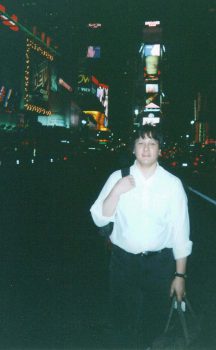
After arriving, I don’t know what happened to my new-found Japanese friend, but I found myself at gate 26 of the Port Authority looking for a phone. I call Jim Medrano and ask him to meet me by the stairs outside. In the meantime, I’m sitting in Time Square calling Kevin Joyce, another Esperantist, in Jersey City to set up my stay when I return from Oakland.

Time Square: la mezo de la universo

“Saluton!” I look up to see a smiling face with an outstretched arm welcoming me to the big city. I quickly finish my call as he offers to carry my bag, and we’re off to the Empire State Building via Time Square. “Ĉi tie estas la mezo de la universo.” (Here is the center of the universe.) He told me things I would never have learned from simply arriving and checking into a hotel for the night. I learned about his childhood growing up in New York, on which streets were safe to walk, how to calculate how long it takes to get somewhere in the city, etc.

But, we weren’t speaking English. All this was done in Esperanto. I was still marveling at the fact that after only six months of taking free lessons on the Internet, I was able to pretty much understand all of what he told me. After deciding not to go up the Empire State Building (how many people can say they’ve only been to the bottom of the Empire State Building?), we ate at a Korean restaurant and headed back to his Manhattan apartment to get some rest. Jim’s way of using Esperanto is to let the world come to him as he’s had guests from many different countries stay with him.

Beep, Beep, Beep. I wake up to the sound of my cell phone’s alarm clock going off to realize I had to rush to grab a taxi for the airport. After the usual close calls on a NYC taxi, I got on my flight for Oakland. I was completely taken aback by the beautiful scenery and mountains when I switched planes in Phoenix. This east coast boy almost didn’t know how to handle himself. After arriving, I took the airport shuttle to the BART subway, to a free bus called the Emery-Go-Round and after walking several blocks, I start looking for the central office of ELNA (Esperanto League of North America). [Editor's note: This organization is now called Esperanto-USA.]

I was greeted with a wealth of “Bonvenon” and “Saluton” from my samideanoj (people of the same idea). I gazed at the shelves and shelves of books lining one entire wall of the office. I had never seen so many Esperanto books in my life. Hung on the far wall was the large green Esperanto flag along with a map of the world beside it. When I was finished drooling over their library (or, ahem, bookstore), four of us left for lunch to head back to the house.

While I expected more of an urban adventure (considering none of us had cars), we found ourselves in a house in the midst of a forest on top of a mountain. At this point, we were very hungry, so amidst our international food choices, we finally decided to eat tacos, which Amanda made for us. With full stomachs, Amanda, Brian and I went for a walk. We enjoyed seeing the rich variety of houses built on the sides of the mountain, although Brian did not enjoy seeing the rich variety of dogs along the way, “Stultaj hundoj” he yelled. Of course, we had to wonder whether the dogs spoke Esperanto…

When we returned, we talked, laughed, listened to Esperanto music, and explored Govind’s interesting collection of books. We were fascinated by his books on language as well as his Esperanto books. It wasn’t until then that I realized that although we spanned across the country, we shared the knowledge of many books, websites, music and culture. With this, I also realized that these were also shared with our Esperanto friends scattered throughout the world. Also, since we were spread across the country, we were tired from the day’s journey and had a good night’s sleep.

The next morning we awakened to the sunlight pouring in the windows between the trees outside. We enjoyed our pankukoj together and saw how well each of us could speak Esperanto in the morning because of our tired state. Now, I’m mainly speaking of Brian and me, since we were the beginners still struggling with the language, but seeing great improvement even after only one day. After breakfast, we headed out to the office to help.

That day was a bit frustrating for Brian and I, since we were given tasks to complete in Esperanto, but in the long run, it has helped us considerably. Well, at least once I figured out what a skatolo was (a box). “Kio ili volas, ke mi faras kun la boxoj?” (What do you want me to do with the boxes?, the right word would be skatoloj), I asked Amanda who quickly helped me realize that box was skatolo and then things clicked and I remembered how much easier it was to learn a language in an immersed environment rather than a classroom.

JES-partoprenantoj en Sanfrancisko

We all rejoiced to see Ĵenja arrive, Amanda’s friend from college and I might add the only American with an undergraduate degree in Esperanto. Then, I met Don and Angela Harlow which really excited me because I had read Don’s online book, The Esperanto
Book.
. I was truly astonished to hear people all around me speaking this “artificial” language as though it was just another language to them. In fact, I don’t believe I ever heard Ionel say a word of English the entire weekend. Of course, Ionel and Joel have been using Esperanto as their main language for the past 16 years, so I guess that should not have surprised me.

After our day of volunteering was finished, Amanda and I headed off to a salsa dance club while the others went back to the house. On our bus ride, Amanda asked me to speak Esperanto with her when we were in public, because that was what she was used to during her 16-month excursion through Europe. It was quite an exhilarating feeling to be speaking a “secret language” even though we were natives to the land. After enjoying a night of listening and dancing to upbeat Spanish language songs, we enjoyed the same luxuries of our language on our taxi ride home.

The next morning we went into the office again to help. Even though you would think it would be boring sorting contents from disorganized clutter into periodicals, archives and other things, the materials we sorted through were incredibly interesting. These included invitations to come to the 1905 Esperanto conference in Boulogne, newspaper clippings, personal letters from all kinds of countries throughout the world, pictures and audio records. We were pleased to look at the neatly stacked boxes on the sides of the archive room and remember what they looked like just the day before.

With our work complete we had a toast to Zamenhof, “Al Zamenhof!” Amanda whipped out her mini-guitar and we sang Hejm’ sur la Step’ (Home on the Range) followed by Descendu, kara ĉaro (Swing low, sweet chariot). After this we celebrated by going out to an Ethiopian restaurant. When we were ordering, we got into an argument about how much food to get and then we realized we were speaking English (no wonder we got into an argument)! After our order was settled, we enjoyed conversation and decided to list the languages in which we could hold at least a five-minute conversation: American Sign Language, Dutch, English, Esperanto, French, German, Italian, Japanese, Kannada, Russian, and Spanish. Then we got a little bit carried away and listed all the languages we knew at least one word of:

Amharic, Basque, Bengali, Catalan, Cantonese, Danish, Finnish, Gaelic (Irish), Gaelic (Scots), Greek, Haitian Creole, Hebrew, Hindi, Hungarian, Ido, Klingon, Korean, Latin, Mandarin, Portuguese, Sanskrit, Swahili, Tagalog, Tamil, Telugu, Ukrainian, Volapuk and Yiddish.

When we returned, we took some pictures and continued to enjoy each other’s company, now speaking almost entirely in Esperanto (even us beginners). Even with as much fun as we were having, nothing could have prepared us for the party the next day. So, after making the necessary preparations, we fared each other “bonan nokton” and anticipated our last day together at JES. [Editor's note: then JES was known as Junulara Esperantista Semajnfino. Now it typically means Junulara Esperanto-Semajno. It is, however, also the Junularo Esperanta Svislanda!]

Our final day together began with us splitting up into two groups: one to see San Francisco and the other to stay back and relax. We enjoyed the day by playing Mamma Mia (an English translation of a German card game about making pizzas) with our new-found friend Jouko (from Japan). Jouko surprised all of us by completing 7 of her pizzas while the rest of us only completed 5, 4, and 3. After this, we cleaned up our stuff (which was scattered about) and got ready for our guests.

The San Francisco Esperanto club decided to join us for the night and my ears couldn’t believe that they were hearing fifteen people speaking Esperanto in the same house (thankfully not all at the same time). We also had some non-native English speakers, namely one from Russia, Jouko from Japan and another from China. Just try to imagine Esperanto speakers eating and hearing Russian spoken on the phone in the background. Of course, all of this is just normal activity in Esperantoland. We teased him about his krokodilemo, (tendency to speak his native language when Esperanto is more appropriate), but we understood that he was just speaking to his parents.

The night ended with games. To Brian’s delight we finally got around to playing Ridigilo, a hilarious game of questions and answers to which the best exchange I remember was when Don Harlow asked Charlie, “Ĉu vi ofte krokodilas?” (Do you often speak your native language when Esperanto is more appropriate?) to which he silently read his card, “ĉiam kaj ĉie” and said aloud, “All the time and everywhere!”

After a few rounds, most had to go home, but a few remained to play the german card game 6 Nimmt! (Take 6) I felt bad because it was my first time trying to teach a game solely in Esperanto, but everybody caught on fairly quickly. The winner of the game is the one who gets gored by the bulls the least (those silly Germans). After a wonderful game and hearing some trilingual cursing from those who suffered the fate of the bulls, we wished each other “bonan nokton” and “bonan vojaĝon” and headed off to bed.

…But my adventures in Esperantoland were not over! Waking up at 4am the next morning, Charlotte drove me to the airport for my flight back to New York City (Redankon, Charlotte). After a nice sleep on the flight, I connected up with Kevin Joyce and he started to show me the city. After eating dinner at a Cuban restaurant, we got dessert at Haägen-Dazs and then walked to the Brooklyn Bridge. What a view! Finishing the night with a beautiful view on all sides of monstrous skyscrapers was a great way to end the night.

The next morning, I took the PATH train back to Jim’s house and discovered that McDonald’s delivers in Manhattan! That’s a far cry from the memories of calling Pizza Hut and Dominoes Pizza in London only to be shocked to find out that they didn’t deliver (though we did eventually get some pizza delivered from a place called Joe’s Fish Bar). But anyway, I enjoyed a relaxing afternoon hanging out with his kids playing Kirby’s Dreamland 64 before having to take a taxi back to my bus.

So that, miaj amikoj, is my rakonto of my adventures in Esperantoland. After all of that it is nice to say as a famous Esperanto writer once said, “Mi estas mondcivitano!” or in English, “I am a citizen of the world!” Now, I just have to wait two weeks until the JES in New York City…

Be sure to catch my next article in the 10 years ago series about my first Esperanto event abroad in Germany!

TEAM: Biggest Slovakian band sang in Esperanto?

Posted on 22. Sep, 2011 by in Uncategorized

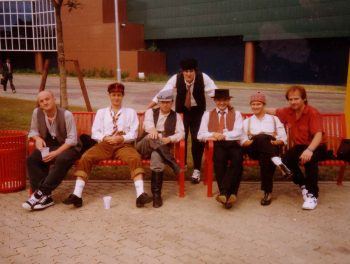
Stano on the far right next to TEAM.

Did you know that the current editor of the magazine Esperanto, Stano Marček, once was the manager of the most popular rock band in former Czechoslovakia? Listen to his story about how they got involved with Esperanto and what happened.

History of the Esperanto band TEAM’

The music group TEAM was founded in 1980. Three people, all from different bands, decided to use a common studio and share their equipment, since they were all low on money. Arriving at their studio, you could find their written rehearsal schedule as well as their names: Troll, Elektra A [and] Midd. One day, they decided to form a band together and the amusing coincidence of their initials decided their name: TEAM.

The band (four members plus two technicians) decided to join my Esperanto course, because our ideals seemed very close to theirs (music also being a kind of international language). The band leader, Dušan Antalík decided to combine their two ideals, convinced the others, and then they very actively started learning Esperanto and became likeable club members. I was a youth activist at the time organizing Esperanto courses, masquerade balls and youth conferences. I also founded and ran the Slovakian youth section of the World Esperanto Youth Organization.

Would you believe the first public concert of TEAM’ took place in Esperanto? At an international Esperanto youth conference in Dolny Kubin (Slovakia), they held a rock concert that lasted over an hour in Esperanto! Giorgio Silfer and Perla Martinelli also participated, which gave them TEAM’ the idea to record an album for LF-koop.

In the meantime, required military service extinguished their dreams, but two years later, the boys started up again and their music attracted more and more fans. They plowed their way to success through live concerts: the boys knew how to create a terrific atmosphere and their fame spread through the nation, eventually catching the interest of the state-owned record label OPUS. Then the group decided to take on two new members: a keyboardist and singer (Pavol Habera). Before the launch of their first big album (1987), the band persuaded me to leave my profession (head of a paper making factory) and “join the circus” as their manager. This was not too surprising considering that I had already worked with them before to help with technical and organizational details.

I accepted what turned into a exciting adventure. I was at the wheel (concerts, magazines, radio, television…) — probably down a good route, because a steep career followed: the first albums sold more than 300,000 copies. We filled the largest stadiums in Slovakia, later also in the Czech Republic – and we kept planting our seeds (our mission: a hundred concerts every year!). We then fulfilled our almost-forgotten dream — to record our first album completely in Esperanto. We produced it in co-production between OPUS and LF-koop, and I then organized an Esperanto tour: the Universal Congress of Esperanto in Brighton (England), International Youth Conference of Esperanto in Kerkrade (Netherlands), and the World Non-National Association Conference in Illertisen (Germany)… The group reached peak popularity in Slovakia, so stories about the Esperanto tour appeared in magazines, radio, television…

In Sanremo, TEAM held a concert during the famous music festival, representing the Czechoslovakian music scene of their time.

The problem was that the singer Pavol didn’t live through their common beginning and he only considered Esperanto as a certain (although rather strange) path to further successes… Before the recording and tour, I gave him a special crash course (podium Esperanto, he’s very talented and was even capable of speaking to the public, through some perfectly memorized sentences). The later career of TEAM kept growing: a hundred concerts every year, winning the most prestigious Czechoslovakian polls (it won the “Zlatý slávik” [Golden nightingale] contest three years in a row, in the last year even the singer won in the singer category, coming in second place was the long-time Czech star Karel Gott), everyday in radio and television for ten years, they sold more than a million records and performed a thousand live concerts.

Unfortunately, Pavol’s attitude toward Esperanto never changed. Despite my many attempts, I couldn’t succeed in convincing organizers of Esperanto meetings to invite TEAM. There were many projects, but they never came to be. In one case, we had carefully planned a tour of China, and then one day I never again heard back from my Chinese colleague, so the shame naturally crashed down on me. So, not only Pavol, but later also the rest of the band started little by little to become disillusioned toward Esperanto, when they saw their earlier dreams couldn’t be turned into reality. Yes indeed, how many Esperanto organizations can invite stars and propose to them, if not decent payment (they lived off their music), to cover at least their travel costs and maybe a small stipend…

Well, and what about now? Pavol’s egoism finally lead to the group falling apart: the star (yes, I’m not exaggerating, in the former Czechoslovakia and even now in the Czech Republic and Slovakia everyone knows him) kept demanded an even larger slice of the pie (as is common in similar bands), starred in films (during their production, the rest of the band made no money), started to compete with his own group through solo records… Well, after many conflicts, the band split up and the musicians worked separately: the singer continues to be a star, the rest now have their own studios and businesses.

[Original source: Esper-Inform discussion list (Jan 31, 2002)]

Note that what follows is my favorite song by TEAM “Eta ŝtormo nokta” (A small night storm). However, to my knowledge, TEAM didn’t actually create any music videos for their first album, but rather people pieced together pirated videos to make it look like something that could’ve appeared during that time period.

YouTube Preview Image

Wikipedia conference in Esperanto (Oct 26-30, 2011)

Posted on 14. Sep, 2011 by in Uncategorized

Pavla Dvořáková

[Legu ĉi tiun intervjuon en ĝia originala Esperanto ĉe Libera Folio]

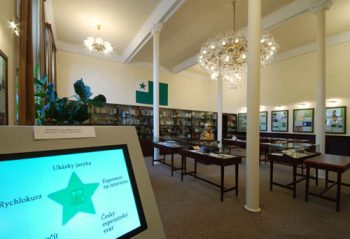
At the end of October, I’ll be flying to Svitavy (Czech Rupublic) to give the keynote address at the Vikimanio (Wikimania) conference. This will take place in their beautiful Esperanto museum. Now, without further ado, an interview with Pavla Dvořáková, the head organizer.

What is Vikimanio (Wikimania)?

By definition, Wikimania is an annual conference about wiki projects run by the Wikimedia Foundation. These projects help turn the revolutionary idea of free information for everyone into reality by giving people the opportunity to contribute to these resources. The first of these conferences took place in 2005 in Frankfurt am Main, Germany, and since then have always taken place in a different country. The previous one was in Haifa, Israel. Participants present studies and experiments about individual wiki projects, news relating to wiki technologies, discuss problems, exchange ideas and experiences as well as ideas of how to continue developing the entire system. It is not just a scientific meeting, but it also tries to informally connect people engaged in Wikimedia projects and inspire them in their volunteer work.

Svitavy Esperanto museum

Why do we need Wikimania in Esperanto?

Let’s say that when I came up with the idea and took over the name of the meeting, I was mostly thinking about Wikipedia, since it’s the oldest and most developed Wikimedia project. This year will be its 10 year anniversary. However, part of the program will also be about other the Wikimedia projects.

Something specific to the Esperanto Wikipedia is the sheer diversity of people from different countries contributing to it. Any national language Wikipedia will tend to have most of their contributors from countries that speak that language, whereas contributors to the Esperanto Wikipedia are more evenly spread around the world. That in itself is both an advantage and a disadvantage. You can communicate very quickly, easily and cheaply online, but I still don’t think that could ever completely replace face-to-face interaction. Face-to-face contact between people can get make it easier for people to get more excited. Also some discussions would be boring and time-consuming in writing, but come alive with people in the same room. For example, I confess that I don’t participate in online discussions myself, but would gladly chat about these topics in person.

I see that the conference takes place in Svitavy (Czech Republic) where there is also an Esperanto museum. Could you tell us what the museum is like and the nature of your collaboration with them?

Ottendorfer House

Svitavy’s Esperanto museum was inaugurated in September 2008, located on the ground floor of the beautiful romantic era Ottendorfer House, build at the end of the 19th century by the local philantropist (his history can be found in Wikipedia). Its goal is to present Esperanto to the public as well as Esperanto speakers. This is accomplished in its general section which is constantly being updated, and in special exhibitions which run for one year. Information is not only presented behind glass, but also through modern electronic means such as music, short films, etc. The museum also organizes various educational events with foreign guests staying overnight directly in the museum’s tower. Without a doubt, the city of Svitavy is itself worth visiting, right in the center of the country, easy to reach from all directions.

The museum has its concise website and starting in January 2011, it also has a virtual exhibition at ipernity. There is not only text, but also an abundance of photos, sound recordings and videos. Our network of friends has already passed 1,700 members in more than 80 countries, and we will soon reach 20,000 virtual visitors.

I’ve personally twice participated in the preparation of the museum exhibitions and this year was the main author of the new project “Spiritual traditions of the world and Esperanto” which will be presented for an entire year. Besides materials for exhibition panels, I’m also responsible for audiovisual materials for the interactive touch screen and computer as well as participating in promotional activities for the museum.

What is the main goal of the conference? What would you like it to accomplish?

The work of Wikipedians so far is certainly great and admirable. However – two years ago, the Esperanto Wikipedia had more articles than Czech. Now Czech has over 50,000 more than Esperanto! That’s disconcerting to me. Did the Czech explode so much or has Esperanto stagnated? What caused that? Did the beginning enthusiasm for the idea get cold? Is there a general crisis? Or does the WikiTrans influence this trend? Or is the very diversity of the Esperanto community at the heart of this issue? [Editor's note: I personally believe that Czech just has more speakers, so it was just a matter of time until the Czech Wikipedia got popular enough to catch up.]

I think we need to create a platform to research that together and stimulate and develop the project. For myself personally, the main reason to work for Esperanto is to create friendly relationships with interesting people. Unfortunately, among Wikipedians, many stay hidden behind their usernames. If we could take a step out of the virtual community and into the real world, maybe that would give it a much needed injection of energy as new ideas flow to push our community actions.

This event will be something along the lines of a technical conference, training, a work seminar and an informal meeting put together. So, quite a pretentious concept for such a short event. My husband and I are the main organizers, but the program will be handled by Marek Blahuš. We plan to work in parallel groups with theoretical and practical tracks. The real quality and final results will, of course, depend mainly on the consistency and activity of the participants themselves. We will strive to adapt as well as possible to the needs and wishes of the participants and contributors, so that everyone will be as content as possible.

Learn more and sign up on the Vikimanio’s official website!