Archive for 'Movies'

Esperanto sex trafficking?

Posted on 06. Oct, 2011 by in Interview, Movies

Photo courtesy of Persona Films

Today I’m talking with Yan Vizinberg who recently decided to add
Esperanto subtitles to his film. Before we get to that though, I’d
like to learn more about the movie. What is the main topic of the
movie?

“Cargo” tells the story of a young Russian woman who is smuggled into America by human traffickers. She is driven from Texas to New York by a notorious Egyptian transporter. The film is about two very different people, who are trapped together for several days in a cargo van. They start as enemies but slowly form a certain bond, and finally see one another as human beings. So I would say that the main topic of the film is communication and empathy.

What inspired you to choose such a controversial topic?

The reason we chose this story was because of the inherent drama in the script. It had an immediate conflict, two enemies with opposing goals, but at the same time there are no traditional baddies and goodies here. There’s a collision, but no winners. It’s more of a redemption story.

Normally, controversial topics make raising money difficult for film projects. How did you find that influenced financing the movie?

Raising money for a film with a first time director is always difficult. This is an American movie, where there are no government grants, no state money, no co-production schemes. The only source of financing for a film in the United States is private investment. It’s a business, like any other. You have to go and convince people with money — and they are often smart and practical people — that this endeavor will make money and it’s worth investing into. So if you don’t have any history or stars attached, all you can talk about is the story and your passion for it.

What organizations were critical in making Cargo possible?

There are several great non-governmental organizations working towards raising awareness of human trafficking who are helping us to bring “Cargo” to movie theaters: FAIR Fund, HTA Council, Freedom Week, Captive Daughters and COVA. We need all the help we can get to spread the word about “Cargo,” and having these organizations’ support is great because their members care about the issue and see our film as a vehicle to raise awareness about the problem.

Photo courtesy of Persona Films

From what I understand, you’re Russian. You’re working with a famous Egyptian actor. Your producers are English and American. Your publicist speaks Esperanto. What was it like working with such an international team in New York?

Well, if you think about “Cargo” — the story takes place in the United States, but there are no American characters in it. The lead is Russian, the transporter is Egyptian, the main trafficker is Polish… It’s a new world — the world where cultures collide on a daily basis, the world of misplaced people, permanent immigrants who are no longer attached to any land, the world that exists under the radar of regular Americans. So having an international cast and crew was only natural.

At the same time, it was very important to me to keep things authentic: the main character is Russian and she is played by a Russian actress, Natasha Rinis; the transporter is Egyptian, so we invited an Egyptian actor Sayed Badreya. They have their own accents, they bring their sensibilities to their roles, when they fight each other, they scream and swear in their languages.

How do you think the movie could benefit from a more international audience?

This story is about colliding cultures — and by cultures I don’t mean just Egyptian, Russian or American. It’s about a man who sees women as inferior and an ambitious woman who has more guts than most men. It’s about a religious person and a woman who doesn’t have faith. It’s about people who are forced to communicate to each other in a language foreign to both of them. It’s about a land that worships freedom above all and at the same time — about the slavery that is happening on a daily basis. So I think it’s not a film that is of interest to just one culture — we would love to show it everywhere.

Photo courtesy of Persona Films

What made you come to the decision to add Esperanto subtitles to your movie?

“Cargo” is in many ways a film about communication. Communication between two very different people: an older Egyptian man who is a devout Muslim and a young Russian woman who used to dance in a strip bar. They are so different that in the beginning they don’t even know how to talk to each other — as if they are different species. But when they do talk — there is one more barrier to overcome: they are forced to communicate in English, a language that is foreign to both. When they fight they scream at each other in Arabic and Russian — and in these instances we made the decision to not subtitle these lines for the English audience, because if our characters do not understand each other, the audience shouldn’t either.

So communication and language play a huge role in “Cargo,” and I think subtitling it in Esperanto, a planned language that is designed to help people from different cultures communicate, adds a new layer of meaning to this. What’s interesting about people is that despite all their differences and animosity, they actually desperately want to communicate with each other and understand each other.

As of this writing, there are now six days left to finish raising the money needed for its theatrical release. Please support the film on Kickstarter if you can!

Esperanto Film Festival to attract amateur authors

Posted on 07. Apr, 2011 by in Movies

Esperanto culture mostly lives in the world of text. Attempts to professionally produce Esperanto audiovisual and television materials haven’t really had much success so far. Copyright limitations also hinder the production of Esperanto versions of already existing content. However, in principle, modern technology levels the playing field, giving everyone the chance to produce their own short films. To encourage this kind of creativity, Aleksander Osintsev, the founder of the excellent website Verda Filmejo initiated the first Esperanto Film Festival, “Film Art Without Borders,” taking place in Brazil in June 2011. Here he tells the story of the background of the festival for Libera Folio, translated into English by Chuck Smith for Transparent Language.

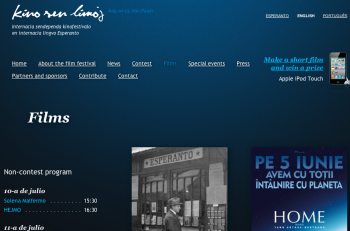
Current non-contest schedule

In the past few decades, the world has lived in audiovisual dimensions, where one conveys and perceives audiovisual information. Unfortunately, the audiovisual culture of Esperanto hasn’t really evolved, which gives the outside world every right not to notice the Esperanto movement, which still lives in a world of text. There are really only a few ways to enrich this part of Esperanto’s culture given conditions today.

In TEJO-Tutmonde, I already tried to analyze the current situation and concluded that the main barrier for Esperanto film production is not a lack of funding and skilled people capable of fluently and professionally speaking Esperanto, but rather a lack of original ideas, and it is less important that a small number of Esperanto speakers passionately make movies either as an amateur or professional.

Since Esperanto movies cannot hope to be broadcast on TV, that limits potential viewers to those who are willing to buy expensive DVDs or successfully watch questionably legal showings of films with subtitles at Esperanto events. Speaking about production, we can look at “Imagu-Filmoj” and “Internacia Televido.” These are companies who once intended to professionally create films or modern audiovisual culture. Unfortunately, they miscalculated the distribution channels for their works, badly dealt with specifics of the Esperanto community and in the end failed.

Copyright limitations are an important problem for Esperanto culture, as I declared in a Kontakto article: Ĉu kopirajto mortigas Esperanton? I pessimistically approached the current state of the Esperanto market from the viewpoint of external film production and distribution companies, the existing methods for distributing culture and the poor quality of the current audiovisual culture in Esperanto, so that the “cruel world” will be indifferent to the Esperanto community in this context.

But we would be giving up twice, if we let ourselves keep complaining in Esperanto blogs and websites, not trying to use the most modern distribution methods for culture and to stimulate its creativity, which are now becoming more and more popular. I believe Esperanto speakers are not right to give up self-expression through video and I would like to propose an absolutely new format for a cultural event, which hasn’t yet existed in the Esperanto community. At the same time, it’s one of the rarest possibilities to adapt and show modern internationally-renowned films in Esperanto.

An Esperanto film festival could stimulate creating Esperanto audiovisual culture and show the world a wonderful demonstration of international communication without limits, through resources which are currently used to advertise and spread valuable ideas. This kind of cultural event could show the practical and useful side of Esperanto usage and present it in a dignified way to the non-Esperanto public.

The first film festival of its kind will take place on July 10-13, 2011 in Sao Paulo, Brazil during 3 large Esperanto congresses: Esperanto Congress of the Americas (TAKE), Brazilian Congress of Esperanto and the Brazilian Esperanto Youth Congress. From the beginning, I’ve had many requirements for the film festival. The event format must be open to every Esperanto speaker and be based on participation from amateur authors, because modern technology lets everyone who has a cell phone camera, ordinary camera, videocamera and a computer with an Internet connection to become known to large social groups which distribute information along through their social networks, blogs and websites.

YouTube Preview Image

The event must be presented with dignity online to give it as much chance to promote it as possible. Films produced must exclude the need for expensive proprietary programs for editing, so films should be short. Short films which have significant amounts of written text (subtitles, etc.) or spoken (dialogs, monologs and separate words) must be in Esperanto, which pushes people to start learning the language or at least become interested in using it as a creative tool.

Every non-Esperanto speaker may participate, by hearing about it in another language than Esperanto (the website is currently also in English and Portuguese). The festival must use modern distribution methods, so that short films must be attributed with one of the Creative Commons licenses. The prizes for winners must certainly be worth winning. Finally, the amount of videos from a single author cannot be limited due to their short length.

Only time and the enthusiasm of coordinators and participants will tell whether the project becomes popular to let us participate in such a rich cultural event. But already now, anyone can follow the preparations and participate in the contest at kinofestivalo.org and win prizes, such as an iPod Touch.

–Aleksander Osincev, creator of Verda Filmejo and coordinator of Film Without Borders