


Archive for December, 2011
German tenses in use: Futur II Posted by Sandra Rösner on Dec 27, 2011
The Futur II is used on different occasions. a) You use Futur II to refer to actions that will take place in the future and that will have been completed in the future. You form sentences with the conjugated form of the auxiliary verb werden (will), the past form of the verb, and the…
German tenses in use: Futur I Posted by Sandra Rösner on Dec 22, 2011
a) The Futur I is used to express that an action will only begin after the moment of speaking, especially when you are planning something or making prognoses. You form sentences with a conjugated form of the auxiliary verb “werden” (will). Singular Plural 1st person ich werde(I will) wir werden(we will) 2nd person du…
German movies: Good-Bye Lenin! Posted by jan on Dec 20, 2011
Today I want to introduce a German movie to you that satirizes some aspects of the German Wiedervereinigung (reunion). The film is called Good-Bye Lenin and the story goes something like this: In 1989, Alex Kerner and his mother Christiane are living in East Berlin. Shortly before the Mauer (wall) falls, Alex`s Mother, who is…
German tenses in use: Plusquamperfekt Posted by Sandra Rösner on Dec 19, 2011
The German Plusquamperfekt tense is equivalent to the English Past Perfect tenses (both the simple and the progressive form). Thus, you use this tense in order to refer to an action or actions that had happened before another action in the past. But the German Plusquamperfekt is seldom used in independent statements. It is rather…
Der Weihnachtsstollen – German Christmas cake Posted by Sandra Rösner on Dec 18, 2011
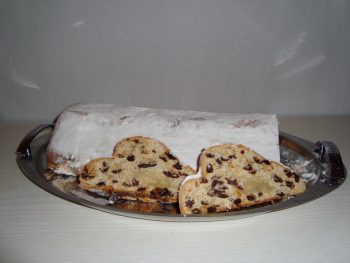
This post is part of my Advent calendar on Facebook where I publish a post every day that shows a particular German Christmas candy or decoration. I realized that I have much more to say about the “Stollen” than just a few words, thus, I decided to dedicate myself to this topic. The “Stollen” is…
German tenses in use: Perfekt Posted by Sandra Rösner on Dec 16, 2011
The Perfekt is commonly used in spoken German to refer to the past. Formation: You generally form active sentences in the Perfekt by using a conjugated form of the auxiliary verbs ‘sein’ (to be) or ‘haben’ (to have) and the past participle of the verb. Here are the conjugations of sein and haben…
German tenses in use: Präteritum Posted by Sandra Rösner on Dec 14, 2011
The Präteritum is equivalent to the English Simple Past tense, so to speak. But usually, the Präteritum is not used in everyday language in German. It is rather used as a literary language. Germans commonly opt for the Perfekt in their speech in order to refer to the past – which will be discussed in…