Archive by Author

Valentinstag – Valentine’s Day

Posted on 12. Feb, 2012 by in Culture, Folklore, Traditions

"Le Printemps" (1873) by Pierre Auguste Cot

Only two days until Valentine’s day! Have you already sent out your greeting cards, prepared your presents, planned the evening with your loved one?
The custom to celebrate St. Valentine’s Day as the day of lovers was introduced to Germany by US soldiers after WWII, and then got popularized among the general public by marketing campaigns for flowers and sweets. So even if the day has a slightly commercial feel to it in Germany, I figured it would be the right time to teach you some love-related vocabulary – thereby hopefully taking the focus from the commercial aspect to the interpersonal.

So, first things first! How do you tell someone that you love them in German? Ich liebe dich! Or, in the more old-fashioned / polite writing style: Ich liebe Dich! By the time you tell someone that you love them, you’re probably familiar enough that you’ve already switched to adressing each other as “du”. So, just for completeness’ sake, here’s what you say to someone with whom you’re still on “Sie”-level: Ich liebe Sie! (Not to be confused with “Ich liebe sie” = I love her!)

Maybe you also want to tell your friends how much you like them. In German, you’d probably not tell your friends that you ‘love’ them, because that’s usually interpreted as romantic love. Instead, one might say “Ich hab dich gern” (something between “I like you” and “I’m fond of you”). If that sounds too intimate for the occation, go with
Du bist ein guter Freund. / Du bist eine gute Freundin. = You’re a good friend (to a male person / to a female person). Or
Du bist mein bester Freund. / Du bist meine beste Freundin. = You’re my best male / female friend.
Ich bin so froh, dass es dich gibt! = I’m so glad that you exist! This you can tell everyone: lovers, friends and family.

But back to the core of Valentine’s. So you want to write a Valentine’s card to your loved one. Here are a couple of phrases that you might find useful:

    Du bist der Mann, mit dem ich alt werden möchte. / Du bist die Frau, mit der ich alt werden möchte. = You’re the man / the woman I want to grow old with.
    Dein Anblick bringt mich um den Verstand. = Your looks make me lose my mind.
    Ich habe Schmetterlinge im Bauch. = Literally: I have butterflies in my stomach; but in German it’s only used for the feeling of being in love!
    Ich kann mir ein Leben ohne dich nicht mehr vorstellen. = I can no longer imagine a life without you.
    Wann werde ich dich endlich in meinen Armen halten? = When will I finally hold you in my arms?
    Ich möchte in einem Meer deiner Küsse ertrinken. = I want to drown in a flood of your kisses.

Happy Valentine’s everyone!

As a special bonus I promise to correct the first ten love poems or letters or texts of any sort in German that get posted in the comments! So if you need some last-minute advice, this is your chance!

Deutsch lernen mit Liedern – Learn German with songs

Posted on 08. Feb, 2012 by in Culture, Language, Music, Practice

Songs are a great way to learn a language. By listening to native speakers, you get a feel for the sound of the language. By listening to the same text repeatedly, you get a feel for the structure of the language, for its word order; and you’ll be remembering phrases, words, and articles. Just listen to Perfekte Welle by Juli twice, and you’ll know forever that it’s “die Welle” and “der Tag”. You’ll learn even more if you sing along. Plus, it’s fun anyway! Anything that enters your brain through as many sensory channels as possible has a bigger chance of staying there. So, listening to the song while reading the lyrics while singing along is as much fun as it is intense language practice.

To get started (or to further your studies of German songs), let me point you to two popular German songs with great lyrics!

The first song is by the German rock-pop-band Juli. The band was formed in 2001, and reached international fame in 2004 when they published their first single “Perfekte Welle” and album “Es ist Juli”. That was at a time when other German language bands – like Wir sind Helden or Silbermond – were being very successful, too. A compilation of German language pop songs was named after their song: “Perfekte Welle – Musik von hier”.

Juli: Perfekte Welle (2004)
-> the song on youtube, and on mtv.de

Mit jeder Welle kam ein Traum,
Träume gehen vorüber,
dein Brett ist verstaubt,
deine Zweifel schäumen über,
hast dein Leben lang gewartet,
hast gehofft, dass es sie gibt,
hast den Glauben fast verloren,
hast dich nicht vom Fleck bewegt.

Jetzt kommt sie langsam auf dich zu,
das Wasser schlägt dir ins Gesicht,
siehst dein Leben wie ein Film,
du kannst nicht glauben, dass sie bricht.

Das ist die perfekte Welle,
das ist der perfekte Tag,
lass dich einfach von ihr tragen,
denk am besten gar nicht nach.

Das ist die perfekte Welle,
das ist der perfekte Tag,
es gibt mehr als du weißt,
es gibt mehr als du sagst.

Deine Hände sind schon taub,
hast Salz in deinen Augen,
zwischen Tränen und Staub,
fällt es schwer noch dran zu glauben,
hast dein Leben lang gewartet,
hast die Wellen nie gezählt,
du hast das alles nicht gewollt,
hast viel zu schnell gelebt.

Jetzt kommt sie langsam auf dich zu,
das Wasser schlägt dir ins Gesicht,
siehst dein Leben wie ein Film,
du kannst nicht glauben, dass sie bricht.

Das ist die perfekte Welle,
das ist der perfekte Tag,
es gibt mehr als du weißt,
es gibt mehr als du sagst.

Stellst dich in Sturm und schreist,
ich bin hier, ich bin frei,
alles was ich will ist Zeit,
ich bin hier, ich bin frei,
Stellst dich in Sturm und schreist,
ich bin hier, ich bin frei,
ich bin hier, ich bin frei.

Das ist die perfekte Welle

Das ist die perfekte Welle,
das ist der perfekte Tag,
lass dich einfach von ihr tragen,
denk am besten gar nicht nach.

Das ist die perfekte Welle,
das ist der perfekte Tag,
es gibt mehr als du weißt,
es gibt mehr als du sagst.

Das ist die perfekte Welle,
das ist der perfekte Tag dafür.

Das ist die perfekte Welle,
das ist der perfekte Tag.

With every wave came a dream,
dreams go by,
your board is dusty,
your doubts are frothing over,
you’ve been waiting all your life,
been hoping it exists,
almost lost the faith,
haven’t moved from the spot.

Now it(the wave)’s approaching you slowly,
the water hits your face,
you see your life like a film,
you can’t believe it(the wave)’s breaking.

That’s the perfect wave,
that’s the perfect day,
just let it(the wave) carry you,
best don’t think at all.

That’s the perfect wave,
that’s the perfect day,
there’s more than you know,
there’s more than you say.

Your hands are already numb,
there’s salt in your eyes,
between tears and dust,
it’s hard to keep believing,
you’ve waited all your life,
you’ve never counted the waves,
you didn’t want all that,
you’ve lived much too fast.

Now it’s approaching you slowly,
the water hits your face,
you see your life like a film,
you can’t believe it’s breaking.

That’s the perfect wave,
that’s the perfect day,
there’s more than you know,
there’s more than you say.

You place yourself in the storm and shout,
I am here, I am free,
all I want is time,
I am here, I am free,
You place yourself in the storm and shout,
I am here, I am free,
I am here, I am free.

That’s the perfect wave

That’s the perfect wave,
that’s the perfect day,
just let it carry you,
best don’t think at all.

That’s the perfect wave,
that’s the perfect day,
there’s more than you know,
there’s more than you say.

That’s the perfect wave,
that’s the perfect day for it.

That’s the perfect wave,
that’s the perfect day.

The second song is by the German punk-rock-pop-band Die Ärzte from Berlin. The band was founded in 1982, and can without doubt be called a German cultural phenomenon. Most of their concerts for this year are already sold out. The songs by Die Ärzte range from absurd and silly to serious and political. Almost all of them are fun, and many exhibit a masterful use of language. One of the more political songs is “Schrei nach Liebe” (1993), which opposed the sprouting Neo-Nacism in reunified Germany.

Die Ärzte: Schrei nach Liebe (1993)
-> video on the band’s website, on youtube

Du bist wirklich saudumm, darum gehts dir gut
Hass ist deine Attitüde, ständig kocht dein Blut
Alles muss man dir erklären, weil du wirklich gar nichts weißt
Höchstwahrscheinlich nicht einmal, was Attitüde heißt

Deine Gewalt ist nur ein stummer Schrei nach Liebe
Deine Springerstiefel sehnen sich nach Zärtlichkeit
Du hast nie gelernt dich zu artikulieren
Und deine Eltern hatten niemals für dich Zeit
(Ohoho) Arschloch!

Warum hast du Angst vorm Streicheln? Was soll all der Terz?
Unterm Lorbeerkranz mit Eicheln, weiß ich, schlägt ein Herz
Und Romantik ist für dich nicht bloß graue Theorie
Zwischen Störkraft und den Onkelz steht ’ne Kuschelrock-LP

Deine Gewalt …

Weil du Probleme hast, die keinen interessieren
Weil du Schiss vorm Schmusen hast, bist du ein Faschist
Du musst deinen Selbsthass nicht auf andere projizieren
Damit keiner merkt, was für ein lieber Kerl du bist

Deine Gewalt …

Du hast nie gelernt dich artizukulieren
Und deine Freundin, die hat niemals für dich Zeit
(Ohoho) Arschloch! Arschloch! Arschloch!!!

You are really dumb, that’s why you’re doing well
Hate’s your attitude, your blood’s boiling constantly
Everything has to be explained to you, because you just don’t know anything
Most likely not even what attitude* means
* in German, Attitüde is a very uncommon word

Your violence is just a silent cry for love
Your combat boots long for tenderness
You’ve never learned to articulate yourself
And your parents never had time for you
(Ohoho) asshole!

Why are you afraid of caressing? What’s all the fuss about?
Under the laurel wreath with acorns, I know a heart is beating
And romance is for you not just dull theory
Between Störkraft and the Onkelz* is a Kuschelrock-LP**
* extreme right / nazi bands
** “cuddle rock”, a compilation of soft rock songs

Your violence …

Because noone is interested in your problems,
Because you fear snuggling, you’re a fascist
You don’t have to project your self-hate onto others
So that noone notices what a lovely lad you are

Your violence …

You never learned to articalute* yourself
And your girlfriend, she never has time for you
(Ohoho) asshole! asshole! asshole!!!
* word’s twisted in original German

What is your favorite German song?

Die Sendung mit der Maus – The Program with the Mouse

Posted on 31. Jan, 2012 by in Culture, Film

When searching for German language learning resources online, I discovered this wonderful website: Sachgeschichten aus der Sendung mit der Maus. Sachgeschichten means “non-fictional stories”, and Die Sendung mit der Maus is, I’d say, Germany’s most famous TV program after the crime television series Tatort (english title: Crime Scene), so I am dedicating a whole article to it.

Briefmarke "Die Sendung mit der Maus"

Briefmarke "Die Sendung mit der Maus" 1998-06-10 by Deutsche Post AG (public domain)

Die Sendung mit der Maus started out on German national TV in 1971 under the title Lach- und Sachgeschichten für Fernsehanfänger (stories to laugh at and to learn from for TV beginners), being renamed to Die Sendung mit der Maus one year later, and is still ritually being watched by families once a week. The show, which only lasts for about half an hour, always starts with a quick presentation of its topics, which then repeats in another language or dialect.
Then there are the Sachgeschichten, which explain everyday objects and processes in a very comprehensible language, often showing slow-motion shots of what happens in a factory line or using metaphorical images to explain things that can’t be seen. Things that “the mouse” has explained so far, include how the holes get into Swiss cheese, Archimedes’ principle, and how the Internet works.
Between the amusing and the educational stories, there are short cartoons featuring the mouse and/or her friends the elephant and the duck. Watch the mouse and the elephant play memory!
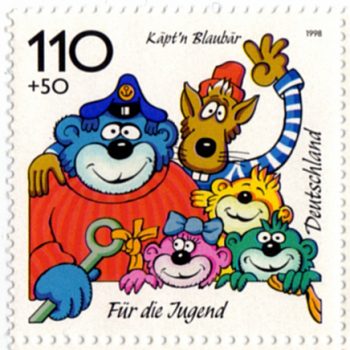
The Lachgeschichten, the amusing stories, can be anything from a cartoon of Zdeněk Miler’s Little Mole to songs to a puppetoon of Walter Moers’ Käpt’n Blaubär, telling a cock-and-bull story to his grandchildren.

Brierfmarke "Käpt'n Blaubär"

Briefmarke "Käpt'n Blaubär" 1998-06-10 by Deutsche Post AG (public domain)

Although the program was primarily aimed at young children, it is very popular with people of all ages. As Christoph Biemann, one of the moderators of the show, points out in an interview: Children like watching the show until they’re 10 or 12, then feel they are “too old” for it, then start watching it again when they’re 18.

The Sachgeschichten are especially full of charm. I know of no other show that explains things, most of which even we grown-ups don’t really understand, so well and in such an entertaining fashion. Go and have a look for yourself!

When asked about the huge success “the mouse” is having in countries other than Germany, Christoph Biemann explains this by the German honesty and straightforwardness it displays, and also by the diligence and love he and his colleagues put into the production. Have you watched Die Sendung mit der Maus before? How do you like it? Was it easy to understand?