Archive for April, 2012

Ayurveda

Posted on 27. Apr, 2012 by in Hindi Language

Do you know that the majority of Indian still uses some traditional medicines for variety of ailments? India has a very long tradition of treatment of ailments using alternative medicines.

The whole tradition is very ancient and systematic. It dates back to more around 4000 years, when the Vedas (र्वेद – ancient books of Indian knowledge, wisdom and culture) where supposedly written. The traditional medicines comes under one of four Vedas called Atharvaveda. Under Atharvaveda comes Ayurveda (आयुर्वेद) means the knowledge for long life. The account of traditional medicines are found in Sanskrit works such as Suśruta Saṃhitā and the Charaka Saṃhitā. These two works laid the foundation of Ayurveda. Since then, diagnosis of new diseases and healing methods were added.

In the early works, Ayurveda had considered that Universe including Human body is made of five elements. The five elements are Pṛthvī (पृथ्वी – earth), Jala (जल – water), Agni (अग्नि – fire), Vāyu (वायु – air) and Ākāśa (आकाश – Sky). It stresses a balance of three elemental energies such as Vāyu Vāta (वायु वत – air & space – “wind”), Pitta (पित्त – fire & water – “bile”) and Kapha (कफ – water & earth – “phlegm”).

Ayurveda is considered as the science of following eight components.

1.Internal medicine (काय चिकित्सा – Kāya-cikitsā)
2. Paediatrics (Kaumārabhṛtyam)
3. Surgery (Śalya-cikitsā)
4. Eye and ENT (Śālākya tantra)
5. Bhūta vidyā or in modern terms, Psychiatry.
6. Toxicology (Agadatantram)
7. Prevention of diseases and improving immunity and rejuvenation (Rasayana)
8. Aphrodisiacs and improving health of progeny (Vajikaranam)

It is well known that people in ancient India were well versed with highly systematic systems of the alternative medicines and surgery. Many disease such as fever, cough, consumption, diarrhea, dropsy, abscesses, seizures, tumours, and skin diseases (including leprosy) etc. were classified. Treatment of complex ailments, including angina pectoris, diabetes, hypertension, and stones were also found and documented. Early works of Ayurveda such as Charaka Samhita, is dedicated to Charakas. Plastic surgery is documented as well in these ancient Indian texts. Plastic surgery of nose, ear lobes, lips for restruction of nose, ears, lips etc were given by an ayurvedic physician called Sushruta, who is now considered the father of rhinoplasty.

The works of Ayurveda were later become known to Chinese and Arabs through trade and pilgrim from these regions. Further, Arabs subsequently transmitted the ayurvedic knowledge to Europe. The knowledge of Ayurveda might be known by some another name outside India but we can imagine how it has shaped the understanding and use of alternative medicines across the world.

Mountain trains in India

Posted on 26. Apr, 2012 by in Hindi Language

India is not only the land of diverse languages and cultures but also terrains. She is blessed with many picturesque mountains, most notably the Himalayas. The mountains are adorned with diverse flora and fauna. Some of the places are accessible with some mode of transportation such as railways.

Today, I would like to present you some of the famous mountain trains operating in India. These trains offer a wonderful traveling experience as they pass through numerous tunnels, over bridges, roll over curly tracks amid spectacular scenery. Some of the these railways which offer mountain trains are:

Darjeeling Himalayan Railway
Darjeeling Himalayan Railway offers a toy train which rolls way over the steep and difficult foothills of the Himalayas. This train is very famous among tourists. The total time of journey is around six hours which includes a route of 83 km distance from the cities of New Jalpaiguri to Darjeeling. This route was completed in 1883 and now is one of the UNESCO World Heritage Sites. The railway employs an unique way to navigate the steep climb. This includes traveling in loops like a snake, gradually climbing a hill. One of the best part of entire route is Batasia Loop, located at a tor point near Darjeeling near the town of Ghoom as it offers some spectacular views.

Darjeeling Himalayan Railway

Darjeeling Himalayan Railway

Kalka-Shimla Railway
Kalka – Simla Railway provides a total route of 93 km. The route offers some of the breathtaking scenery of Shivalik Hills, which offers a combination of valleys and high mountains. The train passes through 107 tunnels and 864 Roman viaducts like stone bridges! This route was completed in 1903 and now is one of the UNESCO World Heritage Sites. It was used by British to travel to Shimla. In pre-independence times, Shimla was the capital of India in summers.

Kalka-Shimla Railway

Kalka-Shimla Railway

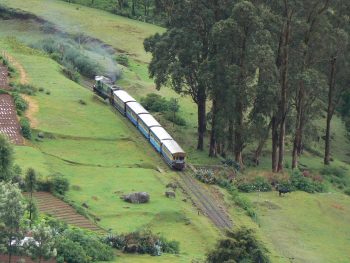
Nilgiri Mountain Railway
Nilgiri Mountain Railway is the steepest mountain railway in India. The train climbs about 6159 feet from the cities of Mettupalayam to Udhagmandalam over a distance of 46 km. The gradient in some of stretches are as high as 1:12. This is the only railways in India which use a rack and pinion system to climb the steep slopes. The train passes through 16 tunnels, over 250 bridges and around 205 sharp curves, with the magnificent scenery of the Nilgiri Hills along the way. It was completed in 1899 and is also one of the UNESCO World Heritage Sites.

Nilgiri Mountain Railway

Nilgiri Mountain Railway

Identification of Grammatical Gender

Posted on 25. Apr, 2012 by in Hindi Language

Hindi language may be hard in one thing, that is the identification of grammatical gender. There are no article in Hindi unlike many other languages such as German which has the article der, die and das which explicitly define the grammatical gender to the reader. As the noun declension depend upon the grammatical gender, a learner usually get confused about it.

In my region (North), people from the other parts of India usually migrate because of their job assignment or to settle. Sometimes, they have no knowledge of Hindi and they start learning it. And I must tell you that the mistakes that they make are usually related to the wrong grammatical gender.

We, native Hindi speakers usually learn the gender of a noun through social learning. This process starts right after we develop our senses for cognitive learning. I will not describe the process but will come back to the actual topic. I come across some of the rules that I will describe here. These rules will help you to quickly identify the grammatical gender or / and right verb for the noun.

Most of the feminine nouns in Hindi usually end in आ (aa) , ई (i) , इया (iyaa), इन (in) , आनी (aani), आइन (aain), इका (ika), नी (ni), अती (ati), वती (vati), त्री (tri) as in बाला (Girl), देवी (Goddess), बिटिया (Daughter), धोबिन (Washwoman), देवरानी (Sister in law), पंडिताइन (Female Scholar), लेखिका (Authoress), मोरनी (Peahen), श्रीमती (Mrs.), अभिनेत्री (Actress) respectively.

The verb associated with a feminine noun usually end with ई (i) such as खाती (khati) , पीती (piti), सोती (sauti), करती (karti), जाती (jati), रोती (rauti), हँसती (hansti), चलती (chalti), उडती (udati), लिखती (likhti), सीखती (sikhti) etc. Quite simple, isn’t it? All verbs ends with “i”, right? If you notice the verb as such, you know the associated noun has to be feminine otherwise masculine.

The masculine verb have a similar pattern, it ends with आ (aa) such as खाता (khata), पीता (pita), सोता (sauta), करता (karta), जाता (jata), रोता (rauta), हँसता (hansta), चलता (chalta), उड़ता (udta), लिखता (likhta), सीखता (sikhta) etc.

Now, practice some Hindi and see if the rules described above offer any help.