Tag Archives: aimsir

Beagáinín Eile faoi na Séasúir (A Little More about Seasons)

Posted on 03. Oct, 2012 by in Irish Language

(le Róislín)

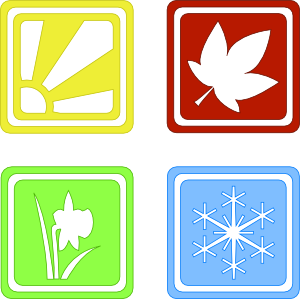
Na Ceithre Shéasúr

Sula bhfágfaidh muid an t-ábhar seo inár ndiaidh, seo roinnt frásaí eile faoi na séasúir.  Le bheith beacht, seo na focail (geimhreadh, earrach, samhradh, fómhar) i bhfrásaí réamhfhoclacha.  Sa chéad bhlag eile, is dócha, cuirfidh muid na focail seo sa tuiseal ginideach, mar bíonn claochclaithe ansin freisin. 

For this blog, by the way, I’ve inserted some mini-glossaries, closer to the specific words under discussion.  You’ll see four of them.

Gluais (1) don alt sin: ábhar, topic, subject; beacht, specific; claochclú, mutation (here in the linguistic sense); fágfaidh [FAWG-hee], will leave; inár ndiaidh [in-awr NYEE-uh OR in-awr NYAY]; réamhfhoclach, prepositional; roinnt [rintch], some; sula, before (used with verbs); tuiseal ginideach, genitive case

Frásaí Réamhfhoclacha (Prepositional Phrases) le “sa” / “san” (in the)

sa gheimhreadh [suh YEV-ruh], in the winter

san earrach [sun AR-ukh], in the spring

sa samhradh [suh SOW-ruh], in the summer

san fhómhar [sun OW-irzh], in the autumn/fall

And here are some dialect variations you may well encounter: sa ngeimhreadh (sung YEV-ruh], sa bhfómhar [suh WOH-irzh], and sa tsamhradh [suh TOW-roo], the latter being fairly specific to Irish as spoken in the North (Dún na nGall, Béal Feirste, srl.).  And yes, that prefixed “t” is applied in Donegal Irish, even though “samhradh” is grammatically masculine.  If you use that Donegal pronunciation, the sound for the end of the word will change slightly from “uh” to “oo.”

So how exactly do we use “sa” and “san“?  Why the two different forms (± the “n”)?

roimh chonsain agus roimh “fhl” nó “fhr”: we use “sa,” as in “sa bhosca,” “sa Spáinn,” “sa fhliúiteog” [suh LyOOTCH-ohg], or “sa Fhrainc” [suh rank], (before consonants, including “fh” in a consonant cluster, like “fhr”)

roimh ghutaí agus roimh “fh”: we use “san,” as in “san uisce,” “san Iodáil” [sun ID-aw-il], “san fhaopach” [sun EEP-ukh], “san fhásach” [sun AWSS-ukh], or “san Fhionlainn“[sun IN-lin]” (before vowels and before “fh,” which is silent, creating an initial vowel sound for these words)

Gluais (2) don méid sin thuas: an Fhrainc [un rank], France; fásach, desert, wilderness, empty place, overgrown place–take your pick, de réir comhthéacs, of course; san fhaopach, in dire straits.  Also, NB maidir le “fliúiteog” (piccolo), the phrase “sa fhliúiteog” would imply that something was stuck inside the piccolo, or that somehow, something was in the piccolo, admittedly not all that likely a scenario.  But there aren’t really that many choices to demonstrate lenited “fl”–the others would include “sa fhlumaire” (in the flummery–actually …  I like that example), “sa fhloscmhéadar” (that would imply, I suppose, that some loose part is in the fluximeter), and “sa fhliuchbholgán” (now there’s a nice mouthful of consain chiúine [suh LyUKH-WOL-uh-gawn], meaning “in the wet bulb of a thermometer”).  There’s maybe a dozen or so more nouns that start with “fl,” but, altogether, not a lot.  Anyone care to send in sampla eile?

Getting back to the word “sa,” it can also be followed by eclipsis, instead of lenition: sa mbosca, sa bhfliúiteog, srl.  For the odd word “faopach,” though, I’ve almost always seen it lenited in this phrase (“san fhaopach“).  So Ghoogláil mé é, and this is what I found:

san fhaopach: 126 amas.  Google didn’t try to suggest any alternatives for this search (cuardach i gcomharthaí athfhriotail)

sa bhfaopach: 30 amas, when Google wasn’t trying to get me to read about either a spa or the SPA (School of Planning and Architecture) in Bhopal, India, for which it would have given me 25,300 hits (at first cull) in the “unquotation-marked” search.  A bhuí le Dia go bhfuil comharthaí athfhriotail ann!  Not that I knew offhand, prior to this jaunt down mórbhealach an eolais, that SPA actually stood for “School of Planning and Architecture” — I just kept wonder as I searched why there were so many spas in Bhopal!

And, actually, there wasn’t as great a difference between na hamais for “san fhaopach” and “sa bhfaopach” as I expected.  Healthy, yes (126 vs. 30), but totally one-sided, no.

I guess Google would be very good at “anagraim.”  GnáthGhaeilgeoir in éadan Google i gcomórtas anagramSmaoineamh suimiúil!  Déjà vu de Garry Kasparov in éadan Ghorm Dorcha à la 1996 nó 1997?  Not that “spa Bhopal” is a very exact anagram of “sa bhfaopach,” since there are ceithre litir left over, but I guess that’s the way Google works.

And finally, here’s a ceistiúchán beag to practice the seasonal phrases, using activities typical for each season.  Of course, linnte snámha faoi dhíon and tithe gloine could change the scenarios, but let’s go for the most basic, predictable answer.  Freagraí thíos.

1. Téim ag snámh.  Cathain? ____________

2. Téim ag sciáil.  Cathain? ____________

3. Bíonn daoine ag bualadh an arbhair.  Anois déantar sin in innill bhuailte.  San am fadó dhéantaí le súistí é.  Cathain? ____________

4. Tagann na bláthanna i mbláth (or, to say pretty much the same thing another way: “Bláthaíonn na bláthanna,” or yet again, “Tagann bláth ar na bláthanna” — hmmm, dóigh ar bith lena rá nach bhfuil chomh hathráiteach?).  Pé scéal é, cathain? ____________

Gluais (3) don méid sin thuas: arbhar, corn, in the UK and Ireland “corn” means edible grain such as barley, oats, rye, wheat; athráiteach, repetitive; bualadh, threshing, also “hitting” in general ; chomh, so, as; dorcha, dark, or, in this case, deep, as in Deep Blue; faoi dhíon, indoor, lit. “under roof”; gorm [GOR-um], blue; snámh, swimming; súiste, a flail; teach gloine, greenhouse, lit. house of glass; teacht i mbláth, coming into flower

Cad é an rud is fearr leat faoin séasúr atá ann anois (an fómhar)?  An aimsir?  Oíche Shamhna?  Dathanna an duilliúir?  Lá Náisiúnta na gCantalóirí (ar an 15ú Deireadh Fómhair i Meiriceá)?  Titim an chearlamáin?  Please write in, i nGaeilge más féidir, and let us know.  And, yeah, that latter will probably require a blog of its own, lá den tsaol, ach lá san fhómhair, más féidir!  And so, no doubt, will Lá Náisiúnta na gCantalóirí, ach mar a dúirt mé go minic cheana, blag éigin eile.

Go dtí sin, SGF, Róislín

Gluais (4) don alt deireanach: aimsir, weather; cantalóir, grouch, grumpy person; cearlamán, droning beetle; cheana, previously, before; Oíche Shamhna, Halloween (just slipping in under the wire to be consider “Fall” or “Autumn,” since “Samhain” (November 1st), traditionally marked the beginning of the New Year and of Winter

Freagraí do cheisteanna 1-4: 1) sa samhradh, 2) sa gheimhreadh 3) san fhómhar, 4) san earrach 

Taking “uain” by the “urla” (agus focail eile ar “time”)

Posted on 27. Apr, 2012 by in Irish Language

(le Róislín)

OK, so what’s that hybrid title all about?  The last blog discussed how the word “aimsir,” usually meaning “weather,” can also mean “time” in certain phrases like “aimsir na Cásca” and “in aimsir na bhFiann.”  That got me thinking, how many other ways are there to say “time” in Irish?

So I figured I’d carpe the old diem, since there’s no time like the present, and strike while the iron of vocabulary intrigue is hot.  In other words, I’d take “time” (“uain”) by the “forelock” (“urla”).  Hmm, that’s as opposed to what, a hindlock? Ah, in Irish, that would have to be the “cúilín” (hair on the back of the head, ach sin, once again, ábhar blag eile, especially considering all the rule and regulations pertaining to hair in medieval Ireland).  Not that I’ve ever actually heard “cúilín” translated as “hindlock,” in fact, I’ve hardly ever heard “hindlock” in English but Googling gives me about 300 samples of it online, mostly pretty obscure stuff.  It’s not in any of my hard-copy dictionaries, though, English or Irish.  As for taking time by the hindlock, well, …

Anyway, back to the question, how many ways are there to say “time” in Irish?  This blog will briefly describe a baker’s dozen (that’ll be thirteen), wrapping up with at least a couple of phrases in Irish that are about some aspect of time, but which don’t actually include any of the Irish words for time, including the classic, “Time, gentlemen, please!” and phrases “like “seven times as,” regarding size or amount.

But let’s start at the beginning, with the word usually learned first in most Irish language programs, “am” (pronounced like “ahm,” not like the English verb “am” as in “I am”).  Here are a few key phrases for “am””

1a. Cén t-am é? or Cén t-am atá sé?  What time is it?  You might ask, “Where’d that “t-“ come from?”  The same place it came from when we say “an t-am” (the time), or for that matter, “an t-úll” or “an t-oráiste.”  Since “cén” is really a compound of “” + “an,” the same rules apply for “cén” as apply to “an” (cén t-am, cén t-úll, etc., also cén eilifint, cén bhean, etc.).

The usual answer to this is “Tá sé a haon a chlog,” or whatever time it is you wish to say.  As in English, we don’t tend to repeat the word “time” in the answer.

1b. Cén t-am ar tháinig sé?  What time did he come?  Note that this question phrase is followed by “ar tháinig,” not “a tháinig,” which can be used elsewhere.  We have the same basic set-up for other verbs, that is, the dependent verb form, with “a” in the present and future tenses (Cén t-am a bhfuil …?  Cén t-am a mbeidh …?), with “ar” for most past tense verbs (Cén t-am ar ith sé?  Cén t-am ar ól sé?) and with “a” for some of the past tense irregulars (Cén t-am a raibh …?  Cén t-am a ndeachaigh …?).  There are various interpretations of this rule, but my understanding is that the idea is “at what time did he come,” triggering the dependent form, as opposed to a question such as “Cén t-am atá sé?” (where “” equals the time) or “Cén t-am atá feiliúnach?” (where the adjective “feiliúnach” describes the time).  Those two examples use “atá,” the independent form of the verb.

Now, how about the other twelve words for time?  Here goes, in alphabetical order,  which means that “aga,” probably the most obscure of them, happens to come first.  I’m sure there are more possibilities but this should be go leor for now:

2. aga, a period of time, an interval, as in “Caith aga leis!” (Take your time with it!)

3. aimsir, time, as in this proverb in slightly archaic Irish , “Do b’fhéidir do luchóig le haimsir cábla do ghearradh ar a dhó” (In time, i.e. given enough time, a mouse may bite a cable in two).  Also means “tense” for verbs and “time of year.”

4. cian, a length of time, an age, as in “ó na ciantaibh” (from time immemorial) or ”ó chianaibh” (a while ago), both still used but featuring the archaic dative plural (–ibh ending)

5. faill, time, occasion, opportunity, chance,  as in “ag feitheamh na faille” (playing for time) or “nuair a bheidh faill agam” (when I have a chance/the time)

6. linn, a space or period of time, as in “idir an dá linn” (in the meantime, lit. between the two time periods)

7. , portion or period of time, as in “i ré Iorua” (in the time of Herod); “” also means “space” and “moon” (although “moon” is more typically “gealach”)!

8. saol [seel OR sayl], time, as in “ar na saolta seo” (in these times, nowadays); also means “life,” “world,” and “all creation” in different contexts

9. seal [shal], time, spell, stint, as in “do sheal a chur isteach ar na báid” (to do your stint of time on the boats)

10. tráth [traw], time, hour, occasion, as in “i dtrátha na Nollag” (around Christmas) or “Tráth na gCeist” (Question Time, a quiz show)

11. tréimhse, period or term of time, as in “sa tréimhse a bhí dlite” (in the time that was allotted).  Sometimes, more specifically, “a three-month period of time.”

12. uain, time, interval of time, opportune time, as in “ar uainibh” (by turns, at times, occasionally; with the old dative plural ending, -ibh) or “breith ar an uain ar an urla” (to take time by the forelock)

13. uair, time, hour, season, as in “an uair seo den bhliain” (this time of year) or “baois na huaire” (the folly of the times).  This is probably the most commonly used of all of these twelve examples, occurring in widely in expressions such as “Cén uair …?” (When …?) and “trí huaire” (three times).  Occasionally it can also be used for “weather,” in a neat reversal of the “aimsir” time-weather continuum.

Well, sin trí fhocal déag ar “time.”  So, which of these do we use in Irish for “Time, gentlemen, please!”  Well, at least according to standard lexicography, none of them.  The phrase “Caithigí siar iad!” (lit. drink them back/down) suffices.  Of course, these days, the phrase shouldn’t be limited to “gentlemen,” but should instead perhaps be phrased as “gentlepeople,” or, perhaps more colloquially, as “folks.”  Or drop out the vocative, and just leave the imperative (in Irish) or the noun with verb implication (“time,” i.e. “drink up”)

We could ask, though, is this phrase even needed these days, now that pubs have all kinds of hours?  And how did it come about anyway?  Well, the origins probably go back to beginnings of the registration of drinking hours (whenever that was), but I did discover one new piece of the puzzle, albeit a very English one.  Time, Gentlemen, Please! was the name of a 1952 movie, set in the fictitious village of “Little Hayhoe” (no less!) and starring Eddie Byrne (the Dublin actor) as an archetypal boozy but sly old codger who gets the “luck of the Irish” in this quintessentially English setting, half-timbering and all.  The movie also features Hermione Baddeley, Raymond Lovell, and Sid James, in case you’re interested.  How the Irish character ends up in Hayhoe is never stated but the story is mildly amusing, if we can forgive the stereotyping.

Another “time” expression in English, which is “time-less” in Irish is “seacht n-oiread an méid sin,” where both “oiread” and “méid” mean “amount.  So the full phrase would be translated as “seven times as much” or “seven times that amount.”  More literally, but a bit awkwardly, I’d say, “seven amounts of that amount.”

Well, that’s thirteen ways to say time in Irish, plus a couple of extra expressions, and I’m sure there are more.  Keep in mind that most of these words have multiple meanings, and may well be translated in other ways than “time.”  But that’s all we have time for in one blog.  Maybe we’ll return to this topic am éigin eile (some other time).  SGF, Róislín

An Focal “aimsir”

Posted on 23. Apr, 2012 by in Irish Language

(le Róislín)

A little while ago, there was a query in our Facebook site about the word “aimsir” (http://www.facebook.com/learn.irish, on 8 Aibreán).  And truly, I think it is surprising when one finds out that “aimsir” not only means “weather,” but also “time” (including “tide” for holiday times) and, regarding verbs, “tense.”

Actually, it’s less surprising when one reflects that in French and Spanish, at least, the basic words for “weather” and “time” are the same (Fr: temps, Sp: tiempo), and perhaps this is true in other languages as well.  While Irish does have the word “aimsir,” (weather, time, tide, tense), it also has many other words for time, including, “am” (probably the most basic) and “uair” (also “hour,” etc.) and “tráth” (also “occasion,” etc.) and another few for more specialized purposes (ré, linn, saol, seal, tréimhse, srl.).  I would estimate that about 90% of the time, if you see the word “aimsir,” it refers to the weather, but if it’s used in reference to holidays, grammar, or certain stretches of time (in aimsir na bhFiann), it’s time-related (time, tide, tense).

So if we go back to http://blogs.transparent.com/irish/laethanta-na-seachtaine-laethanta-aimsir-na-casca/ (the blog of 4 Aibreán ), we can understand the word “aimsir” as “tide,” in the calendrical sense.  “Laethanta Aimsir na Cásca” would mean “the days of Eastertide.”  An bhfuil Gearmáinis agat?  Má tá, tá “leg up” agat leis seo mar tá “tide” (mar “time”) agusZeit” (mar shampla sa bhfocalZeitgeist”) gaolta mar fhocail.  Not all holidays seem to have “tides” in English, and all the English “-tide” phrases seem a bit dated to me, albeit charmingly so, but nevertheless, here are all the most common ones using “aimsir” that I’ve been able to round up, in English and Irish.

aimsir na Cásca, Eastertide

aimsir na Cincíse, Whitsuntide (beginning the seventh Sunday after Easter)

aimsir na Nollag, Christmastide

Less typically, we have “aimsir na Páise” (Passiontide, the last two weeks of Lent), but a caveat re: usage, I only found two examples of this, total, both of which were online.  Each had a few copies of itself, generating a few more hits, but sin é.  Not very widespread.  Terms for this time period do exist in other languages (Tempo di Passione, Passionszeit, etc.), but it doesn’t seem all that applicable in Irish.

For “All-Hallowtide” or “Hallowtide” (more commonly called “Hallowe’en”), the words “oiche Shamhna” and “Samhain” seems to suffice, without “aimsir (na)” as a preceding phrase.  Perhaps this is because this holiday predates Christianity in Ireland and also predates the formal notion of a liturgical calendar with specially designated weeks.  And how about “Hollantide” (i.e. Old Hallowe’en, Nov. 11)?  Well, there is Nos Calan Gwaf  in Cornish for Hollantide (aka Allantide), though this is quite entangled with Hallowe’en itself, etc.).  In fact, Allantide, Hollantide, Hallowtide, and All-Hallowtide probably deserve a mblag féin (their own blog)!

Bringing up Hallowe’en actually opens a Pandora’s box of “péisteanna” (worms) here, because we can say “um Shamhain” for “at Hallowtide.”  The preposition “um” will be described further below.  So is Hallowe’en simply an evening, or is it the beginning of a “tide”?  And what was Samhain, back in aimsir na bhFiann, when most people didn’t have access to calendars as such?  Well, we might never know, so let’s move on.

But just one more note.  I know that that Pandora bit was a double metaphor but let’s just consider it Celticly intertwined, just like the calligraphic knotwork.  You learned the word for “worms” from it, right (if you didn’t know it before).

As noted above, there’s another way to indicate the time period connected to a holiday, that is to use the preposition “um.”  This “um” is not pronounced like “um,” the American English pause word or “rum” or “drum,” but more like the “um” in “Kumbaya” or “Tumbalalaika” (at least as I know them).  In other words, it’s like the “u” of “put,” not like the “u” of “putt.”

Actually all this “um” business is getting me more “trína chéile” than when I started out, because now I’m wondering what exactly the parameters of phrases like “at Easter” or “at Christmas” are, and how did I live to adulthood without having a firmer understanding of these.  That’s when we’re contrasting them to “on Easter” or “on Christmas,” which would refer to a single day.  Hmm, errmm, or just good ole ‘um.” That’s the “schwa um” (/əm/), not the “/um/ um” of “um Cháisc,” etc.

At any rate, we can say the following, “um Inid,” “um Cháisc,”  “um Chincís,” “um Shamhain,” and “um Nollaig” for “at Shrove,” “at Easter,” “at Whit (Pentecost),” “at Hallowtide,” and “at Christmas.”

With “um,” we get to ditch the genitive case.  You did notice that above, right?  Like keeping “Nollaig” (instead of “Nollag” in “aimsir na Nollag”) and “Cháisc” instead of “Cásca” (lenition after “um” explains the “h”).

How did “Shrove” (Inid) get in there?  Well, we don’t seem to need “aimsir” for “Inid,” since “Inid” (from “initium’) already means a three-day time period, hence a “tide.”  I didn’t mean to give it short shrift, of course, it’s just that “Inid” works separately from the holidays that take “aimsir.”

Generally speaking, of this selection, from an English perspective, I think Shrovetide, Eastertide, Whitsuntide, and Christmastide would be somewhat more widely used than Passiontide or Hallowtide/Hollantide.  In summary, here are the “tides” I’ve found in English, chronologically: Shrovetide, Passiontide, Eastertide, Whitsuntide, Hallowtide/Hollantide, Christmastide.  And here are the ones that seem to be able to take the word “aimsir” in front of them: aimsir na Cásca, aimsir na Cincíse, aimsir na Nollag, and occasionally, “aimsir na Páise.”  Beyond that, this whole topic is probably the bailiwick of some sort of theological calendarian.

As for “aimsir” as “tense (of verb),” you may well have already seen it: an aimsir chaite (past), an aimsir láithreach (present), etc.

And one final thought, how would one say, “O Tempora, O Mores!” in Irish?  I’ll have to ponder/hunt for that.  Fáilte roimh mholtaí!  Hmmm, now what I need is an Irish-Latin, Latin-Irish dictionary.  An ann dó?

Getting back to ceist Ghráinne (about the phrase “laethanta aimsir na Cásca”), hope that helped!  SGF, Róislín