Tag Archives: beer

Beoir: Uaine nó Glas nó Ceachtar? (Beer: Green/Uaine or Green/Glas or Neither?)

Posted on 22. Mar, 2013 by in Irish Language

(le Róislín)

uaine nó glas?

Our last blog primarily covered the actual history of St. Patrick and his name.  This blog will take a lighter-hearted look at some St. Patrick’s Day imagery, namely the much-maligned-but-nevertheless-consumed green beer.   I’m refraining from value judgments on the topic (unlike many of the online commentators!), but am primarily interested in whether people say the beer is “uaine” or “glas,” two different Irish words for green, “uaine” usually for manmade things and “glas” for things in nature.  Soon I hope to probe the depths of green bagels (mostly limited to the New York metropolitan area) and green rivers (found in various locations in the United States, most famously Chicago, but also San Antonio, Texas, and Tampa, Florida).  For both of these, I’ll also search online for a future blog to see how much cibearbhús they have attracted.

Ar aon chaoi, in this blog, we’ll look at the terms “beoir uaine,” “beoracha uaine,” “beoir ghlas,” and “beoracha glasa,” to see what kind of cibearlorg each one leaves.

a) beoir uaine: I got a grand total of 80 hits, of which many (21) were advertisements for t-shirts, beer steins, or other products with “beoir uaine” slogans on them, mostly “Ní ólfaidh fíor-Ghael beoir uaine.”  Most of these sites translate the phrase as “Real Irishmen don’t drink green beer.”  Which is more or less correct, except that the slogan is written in the singular and uses “Gael,” not “Éireannach.”  And it’s written in the future tense, not the present habitual.  So it really translates to “A true Gael will not drink green beer.”   But the sentiment is the same and the grammatical differences are relatively minor.

I suppose “the real men” trope stems from the “Ní itheann fíorfhir quiche” phenomenon started by Bruce Feirstein in 1982.  Of course he started it in English.  I simply translated it here to add to the Irish mix.  There could be a slight Celtic connection if Feirstein was inspired by the “No True Scotsman” fallacy, which dates to at least 1975 in Andrew Flew’s classic, Thinking about Thinking.  But pursuing that is definitely ábhar blag eile, and perhaps beyond even the scope of this blog go ginearálta.  Maybe more relevant to some sort of a “guy thing” blog.  Ní i mo “bháillcheantar” atá sé sin.

Out of the 80 hits, another 8 are basically tangential sites that just seem to use the phrase “beoir uaine” to generate web traffic.  From the looks of most of them, I don’t even dare cliceáil on them, since they look pretty bogus.  Another couple are simply very passing references in a long thread about drinking in general.  Interesting to note, but not particularly insightful.  Then we have a healthy 35 links to the Transparent Language Irish blog, many of which are cross-references in a side bar column at The Hidden Ireland (http://galltacht.blogspot.com/).

Some of the 80 are hits for the St. Patrick’s Day blog on www.transparent.com dating back to 2009 (Yay!).

So overall, we could say that there aren’t that many hits in general for “beoir uaine,” and of them, only about half of them shed any real insight into how people use the word.  Of course, these results only reflect what Google shows me, but I think they do establish a useful pattern.

b) beoracha uaine (“green beers”): I tried “beoracha uaine” as well, even though the phrase wouldn’t typically be used (in favor of “piontaí beoir uaine,” “ceaigeanna beoir uaine,” or perhaps even “oigiséid beoir uaine“).  I was a little surprised that my search yielded absolutely no results, not that I expected much.  Even “beoracha” itself, never mind the “green” part, only yielded a paltry 6 hits.  But again, the whys and wherefores of “beoracha” vs. “beoir” will have to remain “ábhar blag eile.”

c) beoir ghlas: I changed the adjective to “glas,” (usually referring to green growing things) and modified it to “ghlas” to match the feminine noun.  This got a total of 8 hits, 6 if we eliminate two that are simply quotes or duplicates of other hits.   Not a big number, but, interestingly, most showed the phrase used in realistic contexts, albeit mostly brief, like chat forums, and also mostly negative, like “Is fuath liom beoir ghlas” (I hate green beer).

And then, I tried, for thoroughness’s sake, a search for “beoir” followed directly by “glas,” as such, i.e. without the agreement of “beoir” (a feminine noun) and “ghlas” (a feminine form of the adjective “glas“).  So, yeah, I searched for an incorrect grammatical form, just to see what it would yield.  An pota óir — 83 amas.  So much for grammar and for gender agreement, is dócha.

So, 83 hits, for the grammatically incorrect form!  Actually the top of the list started out, probably unintentionally, with “glas” modifying “lá,” which would be ceart go leor de réir na gramadaí.  But it looks like the author intended to say “Green Beer Day” so “Lá Glas” doesn’t really make much sense.  The adjective almost always follows the noun in Irish, so for beer, “glas” should change to “ghlas,” bringing us back to “beoir ghlas.”

Another interesting twist is that occasionally (in at least one of these hits) we can have “beoir” followed by “glas.”  That is when “glas” is a predicate adjective, not part of the noun phrase.  So “duchessinaustin” is correct when she says “Níl beoir glas” (Beer is not green;  http://twicsy.com/i/4scFrd)

But most of the other 83 hits fell into the typical trap, look up “beer,” look up “green,” force them together regardless of word order, gender or tradition in the language.  But that got the most hits <osna!>.

d) beoracha glasa: This search (the plural), got me no hits, though it sure made eBay and Etsy try to sell me some beach glasses!  Must be the “minus o, minus r, add ses” algorithm, or however they intuit what they think you meant to say.  I’m somewhat comforted that I also got no hits for some searches with deliberately incorrect spellings with “beoracha” followed by “ghlas,” “glas,” or ghlasa.”

So what does all this tell us?  Probably that “glas” is more widely understood as the Irish word for “green,” and that a lot of people try to use it to say “green beer.”  A handful get it correct, and actually have something to say about the topic.  “Beoir uaine” is also used, although it is more often channeled into commercial applications or cibearbhruscar (*bruscarlíne, if I do say so myself).   The plural, using “beoracha,” just doesn’t seem to be happening.  In fact, “beoracha,” as such, without “green,” only got 6 hits.  But then we are more likely to use the word “beoir” in the singular, even if the quantities imbibed are plural.  Because we pour it into containers (piontaí, gloiní, ceaigeanna, oigiséid, srl.), which can then be plural, even though the word “beoir” stays singular.

For what it’s worth, the English search, “green beer,” generates 1,830,000 hits but the plural, “green beers,” drops significantly to about 79,300.  The plural introduces also the idea of “green beers” meaning beer produced in an ecologically friendly manner, as in “8 Great Green Beers: Eco-friendly brews that won’t turn your tongue green,” by Maryse Chevriere (http://www.thedailymeal.com/great-green-beers)

And a final note, even the people who do talk about green beer doesn’t seem to like it much.  I found a fitting “focal scoir” from Beauregard in Gaeltacht Minnesota (https://twitter.com/AsGaeilge/status/181107959907106816, dated 3/17/12): Beoir uaine a ól, d’anam a dhíol don Diabhal, which translates to “To drink green beer (is) to sell your soul to the Devil.”  Which should put the kybosh on the subject for now!

Next up, béigil uaine (or “ghlasa”) and aibhneacha uaine (or “glasa“).  SGF, Róislín

Gluaisín: ceaig, keg; oigiséad, hogshead; pota óir, jackpot, pot of gold.  Also, my newly coined contribution to Irish portmanteaus, bruscarlíne, from “bruscar” (rubbish) + “ar líne” (online)

Sula bhFágfaidh Muid Na Liúdair …

Posted on 18. May, 2012 by in Irish Language


Faoitín agus Liúdar

(le Róislín)

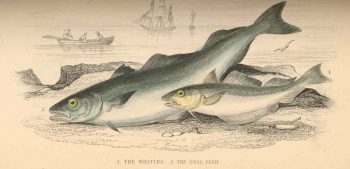
I ndáiríre, is é ábhar an bhlag seo ná “ainmneacha teangacha,” ní na liúdair iad féin.   Why’s that?  I found the word for “coalfish” in quite a few languages, so I figured we could do another match game.  Several  of the languages have more than one word for “coalfish” so please expect to find several languages mentioned more than once.

So, really, this blog is more an exercise in tíreolaíocht than in bitheolaíocht mhuirí.  In almost all cases, a language name in Irish more or less matches the country or region that it comes from, as also happens in English and most other languages.  A few prominent exceptions that come to mind are: Gaeilge/Éire, Béarla/Sasana, Sanscrait/an India (ainm na teanga ón bhfocal saṃskṛtāvāk, “caint chaoin“), and Svaihílis, Ciosvaihílis/an Afraic Thoir (ainm na teanga ón Araibis sāḥil, a chiallaíonn “teorainn” nó “cósta”), and I’m sure there are some others.  To some extent, “Laidin” follows suit, but that’s really only because we don’t talk much “Latium” (Lazio in Iodáilis an lae inniu) these days.  But the names of most teangacha are based on logainmneachaFreagraí can be found thíos, mar is gnách.

Ainm an Éisc Ainm na Teanga
1) sei a) Béarla
2) swarte koolvis b. Gaeilge na hAlban
3) glasag c) Danmhairgis
4) levneg d) Gaeilge na hAlban
5) ufsi e) Fraincis
6) gloshan f) Ollainnis
7) ucsa (nó “ucsa” nó “ugsa”) g) Briotáinis
8.) saithe h) Íoslainnis
9) carbonero i) Béarla
10) colin j) Spáinnis

I thought I had found the Welsh for “coalfish,” namely “chwitlyn glas,” but looking further into that one I find “chwitlyn glas” also means “blue whiting” so now I have my doubts.  Is a blue whiting the same as a coalfish?  An ionannchwitlyn glasagus “liúdar”?  Eolas ag Breatnach ar bith ar an liosta?  A blue whiting sounds like a contradiction in terms to me, anyway, but who am I to say?  As long as we keep the blue whiting out of the bluing, I guess all will be well.

With all of these terms available, I suppose we could translate the folk expression “ag breith liúdar go Toraigh” into lots of languages, if we wanted to.  But for now, let’s leave the liúdair to Irish, and bid at least a temporary adieu to this topic.  Maybe at some future point we can revisit expressions of futility in Irish and/or other languages.  But somehow, I keep finding more, even since the last blog,  mar shampla “dátaí go Hajar” (for more on this date-growing town in the al-Hasa oasis in eastern Saudi Arabia, see http://www.saudiaramcoworld.com/issue/200404/.carrying.dates.to.hajar..htm).  And perhaps one’s mind wanders back to all that beoir which is being sent “go München.”  Since they have a ndóthain beorach, how ’bout scattering cúpla ceaig here and there so we can all partake in its “iarmhairt mhúchta” (quenching effect; I haven’t been able to find an exact equivalent to the compound adjective “thrist-quenching,” aon bharúil agat?).

Pé scéal é, tá na freagraí thíos, and I hope you enjoyed this joint geographic-linguistic undertaking.  I’ll certainly look even more carefully next time I’m in a bialann looking at the bia mara on the biachlár, especially if it’s in coalfish territory.  SGF, Róislín

Freagraí: 1c) sei, Danmhairgis (+ Ioruais, Sualainnis); 2f, swarte koolvis, Ollainnis; 3d) glasag, Gaeilge na hAlban; 4g) levneg, Briotáinis; 5h) ufsi, Íoslainnis, 6i) gloshan, Béarla (bunaithe ar an nGaeilge, is dócha, Gael-Bhéarla nó Béarla Éireannach, mar sin?); 7b. ucsa et al., Gaeilge na hAlban; 8a) saithe, Béarla (ón SeanLochlainnis, seithr, marsei“); 9j) carbonero, Spáinnis; 10e) colin, Fraincis (+ Spáinnis), agusgobergei bhFraincis Cheanada.

Does this mix need adding to?  Terminology never ceases, it seems.  While this fish is marketed in the U.S. under the official name “pollock” (presumably also as “pollack”),  in Canada it is marketed as  ”Saithe,” “Pollock,” “Coalfish,” “Boston Bluefish,” and “Big-Eye” (according to http://www.tradexfoods.com/fish-species-encyclopedia/saithe)


Na Focail “Beoir” agus “Leann” i nGaeilge (Beer and Ale)

Posted on 16. Mar, 2012 by in Irish Language

(le Róislín)

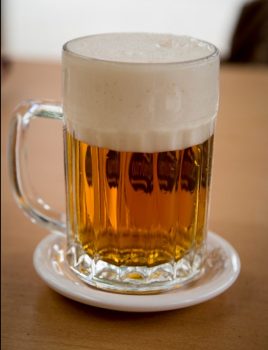
muga beorach lán go béal

I’m sure lots of people have lots of thoughts about beer and ale at this festive time of year.  Probably most folks aren’t “declining” those nouns at the moment.  That’s “declining” as a grammatical term, of course, not literally turning down or rejecting.  But if you’re reading this blog, that’s what we’re in for.  It’s not so bad, really – it’s just specifying the subject and possessive forms in the singular and plural.  “Plural” quite likely sounds appealing at this point!  If you’re actually talking to your beer or ale (it can happen!) you would technically have one more set of forms, but the dea-scéal here is that while we do have a direct-address concept for these beverages (and all nouns, animate or inanimate), in the case of beer (hmmm! unintentional!), there’s no separate spelling or ending, just the routine lenition at the beginning of the word.

So let’s go ahead and decline these nouns, then double back and accept, imbibe, indulge in, or otherwise consume them!

beoir, beer, f5 (a 5th-declension feminine noun so we decline it similarly to its cohorts, like cathair/cathrach or litir/litreach)
an bheoir [un VYOH-irzh], the beer
beorach [BYOH-rukh], of beer: buidéal beorach, canna beorach, muga beorach, ceaig beorach
na beorach [nuh BYOH-rukh], of the beer: blas na beorach (the taste of the beer), cúr na beorach (the foam of the beer)
beoracha [BYOH-rukh-uh], beers (again, we tend to say “bottles of beer,” “mugs of beer,” etc., but there are times when “beers” works!)
na mbeoracha [num-YOH-rukh-uh], of the beers
A bheoir! [uh VYOH-irzh], O, beer! (in direct address)
A bheoracha! [uh VYOH-rukh-uh], O, beers! (in direct address, plural; your context is as good as mine!)

Leann, ale, m3 (a 3rd-declension masculine noun so we decline it sort of similarly to its cohorts, like rud/ruda or droim/droma, although admittedly, the “-ta” plural ending isn’t very typical for this declension).  It is worth noting that “leann” isn’t declined like “ceann” or “peann,” which are 1st-declension, or “beann” (regard) or “beann” (antler), which are both 2nd-declension and declined accordingly
an leann, the ale (and of course, an leann dubh, the stout, i.e. stout porter)
leanna, of ale: buidéal leanna, a bottle of ale
an leanna, of the ale: blas an leanna
leannta, ales
na leannta, the ales
na leannta, of the ales

As for one likely accompaniment when discussing beoir, this one is probably fairly transparent, dare I even say it, clichéed: scidilí, which could either refer to an actual “cluiche scidilí” or imply the abstract (where skittles = pleasure).  Let’s not forget “dairteanna.”  Of course that’s not talking about edible accompaniments, for either beoir or leann.  That would more likely be brioscáin phrátaí (or to cut to the chase, not chaser, btw, just chase), Taytos.  “Criospaí,” can also be used, based on the word “crisps,” as opposed to “potato chips,” in both Irish and British English.  “Criospaí” may also occur with “ríse,” though, referring to the rice-based breakfast cereal.  What else might you munch?  Piseanna talún, peanuts aka ground-nuts, lit. here “peas of the ground.”  Céard eile?  Uibheacha picilte?  Cén sneaic* is fearr leatsa nuair a bhíonns tú ag ól beorach (at the drinking of beer)?

As for “an leann dubh” (stout), it doesn’t really need an edible accompaniment, does it?  After all, as they used to say, “There’s a sandwich in every glass.”  If there’s a “hunh?” factor there, bhuel, please hang on for blag eile.  Slán (dare I say “sláinte” there?) go fóill!  Sláinte, as well, anyway. – Róislín

*Maidir le hinscne an fhocail “sneaic”: it’s feminine, so technically we should have an initial “t” before “sneaic,” but I’m letting precedence rule here and going with the flow, which is to treat it as masculine and not add the “-initial “t”.  Fáilte roimh bhur mbarúlacha agus “incoming.”

Gluais: dubh, black; inscne, gender; rís [reesh], rice (ríse [REESH-uh], of rice); talamh, ground, land (talún, of ground, of land)