Tag Archives: cluas

The Nuts and Bolts of, well, Boltaí agus Cnónna (agus Scriúnna agus Tairní, for good measure!)

Posted on 30. May, 2012 by in Irish Language

(le Róislín)

cnónna cluasacha (nó eiteacha)

In the last blog, about “cluasa” (ears)  I happened to mention the phrase “cluaisín scriú” (the wing of a screw), since it’s based on the word for ear.  “Cluaisín” [KLOO-ish-een] literally means “little ear.”  That got me thinking about how such items are made and categorized.  This blog will just be skimming the surface of an amazingly complex world out there of nuts, bolts, nails, screws and the like.  And it also sets one wondering — how did people fasten things before the days of mass manufacturing of such small metal products.  I’ve seen hand-forged nails but haven’t heard of anything like hand-forged nuts or bolts, etc.  And I’m sure that at one time in history, all such items had a greater value per piece than today.  Adam Smith, in The Wealth of Nations, even refers to an unnamed Scottish village where nails used to be used as currency.  At any rate, this blog will simply introduce some of the basics.

bolta, a bolt, and this can be used for a sliding-bolt, a rifle-bolt, and in general for mechanical engineering (but not for a bolt of lightning, which would be “splanc thintrí” or “plimp thintrí“)

scriúbholta [SHKROO-WOL-tuh, note the lenition of the "b"], a screw-bolt (I guess the meaning of that one was fairly self-evident!)

bolta cró, an eye-bolt, lit. a bolt of eye or socket or bore.  “Cró” can be used for the eye of a needle (cró snáthaide), but not ever, at least per my experience and research, for the “eye” we see with; it can also be used for the holder of an electric lightbulb (cró bolgáin).  In addition, “cró” can also mean “shanty” or, with various animals, their dwelling place, as in “cró muice” (pig-sty), cró madra (dog-kennel), or  ”cró cearc” (hen-house).  What a word!

How about the “nut” part?   Well, cnó and behold (or could that be “cró” and behold?), it actually is “cnó,” the ordinary word for a “nut” as in “gallchnó” (walnut) or “cnó coill” (hazelnut).  That, of course, is one of the most intriguing and sometimes the most frustrating features of language learning — one can never really assume that a metaphoric usage in one language will translate well in other.  But sometimes they do.   For example, I was actually surprised to find out how many languages allow you to say your skill in something (like language proficiency) is “rusty.”  But it’s always good to check before assuming anything vocabulary-wise.

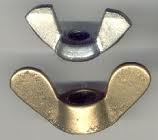
Diving back into the “ear” world, we have “cnónna cluasacha” (wing-nuts).  As for “wingnuts” personified, sin definitely “ábhar blag eile,” since this one already looks like it’s going to be fada go leor, if not rófhada.  A “wing-nut” can also be a “cnó eiteach,” using a word closer to “wing” (which can be “eiteog” as well as “sciathán“).

Not all nuts are square, though I believe most are.  We also have “cnónna heicseagánacha” (hex or hexagonal nuts), and I’m sure there are many other specific types.

So that takes care of the basics of nuts and bolts (saving such specifications as knurled, milled, self-locking, and clamping, and, omg, eventually a discussion of “washers”).  But before we end this blog, just a few more terms, and then, I’ll try to read One Good Turn: A Natural History of the Screwdriver and the Screw (by Witold Rybczynski) before proceeding further.  I actually have a copy somewhere in the house, waiting to be a birthday gift for my unsuspecting husband (Sis! [pronounced "shish," that means "Shhh!" -- at least, I've found it used in one well-translated children's book, not really beyond that ... yet!).  So here's just the tip of the iceberg for a few more terms: .

scriú, screw (bet you already figured that one out)

scriúire, a screwdriver

tairne, a nail (not on the hand or foot, that's an "ionga")

casúr, a hammer; a "large" hammer being an "ord"

And since I went and brought the subject up:

leicneán, a washer (it can also mean a "wedge," though that, i mo thaithí féin, is more typically a "ding")

Bhuel, not sure whether I managed to hit the nail on the head for this topic, or to get anywhere near the brass tacks, but buailte nó a mhalairt, tacóidí práis nó gan iad, sin é don bhlag seo.  SGF, Róislín

Iarsmaoineamh re: fuaimniú "cró" agus "cnó": Come to think of it, if we have the n/r variation in pronunciation with words like "cnoc" [knok OR krok], mná [mnaw OR mraw], and the Luimneach/Limerick situation, it seems we might have some confusing situations with “cnónna” [nuts] and “cróite” [sockets, etc.]  At least the plural endings would be different, to help differentiate the sound.  But normally, I’ve never really found myself discussing a “cnó” and a “cró” in the same context, so there’s never been a problem.

Iarsmaoineamh eile: suim agat sa leabhar faoi scriúirí? Seo nasc: http://authors.simonandschuster.biz/Witold-Rybczynski/652589/books

Iarsmaoineamh deireanach re: ord na bhfocal sa bhfrása “nuts and bolts”: in English the word order is almost always “nuts” first, then “bolts.”  In Irish, in the limited examples I can find of the phrase, the two possible word orders are about neck in neck, with “cnónna agus boltaí” (like English) somewhat in the lead.  I’ve been trying to pinpoint why “boltaí agus cnónna” (bolts and nuts) sounds more natural to me in Irish.  Innealtóirí?  Saoir?  Cad a deir sibhse?

Cuir Cluas Ort! Listen Up! (but where’s the “up”?)

Posted on 27. May, 2012 by in Irish Language

Bíonn cluasa ar na claíocha ... clathacha ... fallaí ... ballaí (srl.)

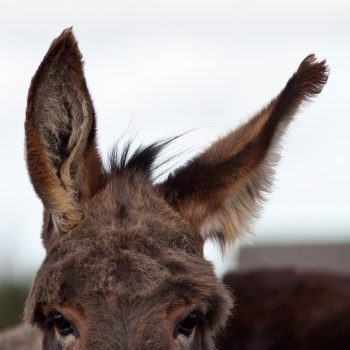
Before we completely leave the topic of ears, eaves, and eavesdropping, let’s look a little closer at the word for “ear” itself — cluas [KLOO-uss].

First a pronunciation note, “ua” in Irish is pronounced as two syllables [oo-uh].  You may well have heard the sound in other words, such as “rua” [ROO-uh], “nua” [NOO-uh], or, a relatively new feature in the Dublin cityscape, “an Luas,” the light-rail tram system, based on the word “luas” (speed, pace, velocity, etc.)

And back to na cluasa.  Here are na bunfhoirmeacha:

cluas [KLOO-uss], ear, also “handle” as in “cluas cupáin” (a handle of a cup)

an chluas [un KHLOO-uss], the ear, also, the handle

cluaise [KLOO-ish-uh], of an ear, as in “curca cluaise,” an ear-tuft (of a bird!) or “dallán cluaise,” an ear-plug

na cluaise [nuh KLOO-ish-uh], of the ear, as in “maothán [MWEE-hawn] na cluaise,” the ear-lobe, lit. the soft part of the ear

cluasa, ears, as in the seanfhocal: Bíonn cluasa ar na claíocha, translated as “Walls have ears” but remember these “walls” (claíocha) are probably outside walls, as of stone or sod, for marking fields or boundaries.  But “cúléisteacht” or “cluasaíl” could as easily happen outdoors as in, as long as there is some way for the “cúléisteoir” or “cluasaí” to remain out of sight.  This proverb may also show up as “Bíonn cluasa ar na clathacha,” with the same meaning, or with “ar na fallaí” or “ar na ballaí,” which would be indoor walls.

na cluasa, the ears

cluas, of ears, as in “cosaint cluas” (ear muffs, lit. protection of ears)

na gcluas, of the ears, as in “clinic na gcluas” (audio clinic, lit. clinic of the ears) or “seamróg na gceithre gcluas” (a somewhat old-fashioned phrase for “the four-leaved shamrock”)

The diminutive form “cluaisín” [KLOO-ish-een], lit. “little ear,” has several interesting usages as well:

cluaisín caipín, ear-flap (on a cap).  A Arailt, sin ceann duit!

cluaisín scriú, wing of a screw (an chuid eile, dála an scéil, an “lorga,” the shank).

Cluaisín” on its own can also mean “auricle,” regarding the ear, although “auricle” for the heart is “copóg“, which also means “large ear,” “large leaf,” and “dock” (the plant).

A few more expressions with “cluas“:

Cuir cluas ort féin! Listen attentively, lit. “put an ear on yourself,” or, as we might say, “Listen up!” (though there’s no “up” in the Irish)

Cuireann sin cluas orm.  That causes me to listen attentively, lit. That puts ears on me

Tá mo chluasa bodhar acu.  I’m tired of listening to them, lit. my ears are deaf at them.

Bhuel, hopefully, níl bhur gcluasa bodhar agam!  Although we’re really talking about léamh an bhlag, not éisteacht leis an mblag, so I suppose the phrase should be based on dubh dóite, or some such idea.  SGF, Róislín

Gluais: bodhar [bohr or baur or bower, the "d" is silent], deaf; curca [KUR-kuh], crest, tuft, topknot, cockade; maothán cluaise [MWEE-hawn KLOO-ish-uh], earlobe

P.S. Dála an scéil, kudos do na daoine a rinne an suíomh idirlín don Luas.  Tá sé ar fáil i nGaeilge (http://www.luas.ie/ga/chomh maith le seacht dteanga eile.  Is féidir leat an teanga a athrú ó Bhéarla go Gaeilge agus ó Ghaeilge go Béarla ag barr an leathanaigh le cnaipe scoránaithe (toggle button) agus arís ag bun an leathanaigh, áit a bhfuil na bratacha (the flags).

P.P.S. For a little more “hands-on” practice with the word “cluasa,” you might want to look back at the blog from 23 Meán Fómhair 2009, translating “Head, Shoulders, Knees, and Toes” (http://blogs.transparent.com/irish/what-comes-after-%E2%80%9Cceann-gualainn-gluin-is-cos%E2%80%9D-%E2%80%9Csuile-cluasa-beal-is-sron%E2%80%9D/).   A little aclaíocht never hurt anyone!

P.P.P.S. btw, remote as the word “cluas” may seem from anything immediately recognizably as Indo-European, it is a distant relation to the word “listen.”  Think Welsh “clust” (ear), Old Norse “hlust” (ear) as well as “hlystan” (listen, hear), Sanskrit “çrotra” (hearing, ear, cf. shruti regarding “revelation” and Hindu sacred texts) and going as far east as one can go in the Indo-European range, Tocharian A “klots” and even Tocharian B “klautso.”

That’s The Way The Easter Bunny Goes – Cluas i ndiaidh Cluaise (using the Irish verb “to eat”)!

Posted on 09. Apr, 2010 by in Irish Language

(le Róislín)

coinín seacláide

Some of you might still have your chocolate Easter bunnies, or part of them left.  To celebrate the gradual eating of such chocolate bunnies, which usually starts with the cluas (ear), let’s continue our relative clause series with the irregular verb “ith” (eat).  As you’ll see, some forms of “ith” look regular, such as “ithim” (I eat) and “d’ith mé” (I ate).  You’ll see the irregular stem (íos-) in the future-tense form, though (íosfaidh mé / I will eat).

If we were including the oft-dreaded modh coinníollach in this series, you’d also see the irregular stem there (d’íosfainn, I would eat), but the good news is that we haven’t been including the conditional mood in this series so far, so I don’t see any reason to start now!  Our main purpose, remember, is to contrast how the direct relative clauses use séimhiú (b->bh, srl.) and the indirect relative clauses use urú (b->mb, srl.).  Since today’s verb (ith) begins with a vowel, we won’t have séimhiú as such, but we will introduce the particles “d’” and “ar” for the past-tense examples.  We’ll also have eclipsis of the vowel by prefixing “n-.”

So here goes, and so goes the coinín seacláide (chocolate bunny)!  We’ll start with the simple sentences (no relative clause), then do the direct relative, and then the indirect, for present, past, and future.  We’ll also go partly through the anatomy of chocolate rabbits!

1) An aimsir láithreach:  Itheann an páiste cluas an choinín seacláide (the child eats the ear of the chocolate rabbit).  An itheann an páiste cluas an choinín seacláide?

Direct relative: Seo é an páiste a itheann cluas eile an choinín seacláide (This is the child who eats the other ear of the chocolate rabbit)

Indirect relative: Seo é an páiste a n-itheann a dheirfiúr súile an choinín seacláide (This is the child whose sister eats the eyes of the chocolate rabbit). 

2) An aimsir chaite: D’ith an páiste ruball an choinín seacláide (The child ate the tail of the chocolate rabbit).  Ar ith an páiste ruball an choinín seacláide?

Direct: Seo é an páiste a d’ith lámhóideanna an choinín seacláide (This is the child who ate the forelegs of the chocolate rabbit).

Indirect: Seo é an páiste ar ith a dheartháir cosa deiridh an choinín seacláide (This is the child whose brother ate the hind legs of the chocolate rabbit).

3) An aimsir fháistineach: Íosfaidh an páiste guaillí an choinín seacláide (The child will eat the shoulders of the chocolate rabbit).  An íosfaidh an páiste guaillí an choinín seacláide?

Direct: Seo é an páiste a íosfaidh cabhail an choinín seacláide (This is the child who will eat the torso of the chocolate rabbit).

Indirect: Seo é an páiste a n-íosfaidh a chol ceathar na blúirí seacláide atá fágtha sa bhosca a raibh an coinín seacláide ann. 

“A thiarcais!” you might exclaim, checking out that last sentence, which actually has three relative clauses (not unusual for an Irish sentence).  Here’s the translation:

This is the child whose cousin will eat the crumbs of chocolate that are left in the box that the chocolate rabbit was in.

One last point you may have noticed: “the ear of the chocolate bunny” is “cluas an choinín seacláide,” with séimhiú on the word “coinín,” to indicate possession.   Also, the definite article “an” in the middle of the phrase applies to both “ear” and “bunny.”  In Irish, the definite article is only used once per phrase showing possession (unlike English, which can say “the ear of the bunny”).  And yes, at some point we could discuss why English has two systems for showing possession (the ear of the bunny, the bunny’s ear) and how Irish simply (!) uses an tuiseal ginideach for both structures, but, mh’anam, sin ábhar blag eile!

Nótaí: a thiarcais! [uh HEER-kish] my goodness!; cluas [KLOO-uss] ear; d’íosfainn [DJEESS-hin] I would eat; íosfaidh [EESS-hee] will eat; ith [ih, silent “t”]; itheann [IH-hun, silent “t”] eats; seacláide [SHAK-LAWDJ-eh] of chocolate

P.S.  Perhaps if Mike Tyson could have read this blog in advance of the famous “Bite Fight,” all the hullaballoo about that ear-biting incident could have been avoided.  Surely “cluas an choinín seacláide” would have been a better choice!