Tag Archives: lá

Beoir: Uaine nó Glas nó Ceachtar? (Beer: Green/Uaine or Green/Glas or Neither?)

Posted on 22. Mar, 2013 by in Irish Language

(le Róislín)

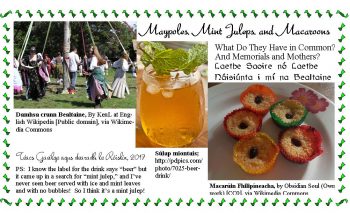
uaine nó glas?

Our last blog primarily covered the actual history of St. Patrick and his name.  This blog will take a lighter-hearted look at some St. Patrick’s Day imagery, namely the much-maligned-but-nevertheless-consumed green beer.   I’m refraining from value judgments on the topic (unlike many of the online commentators!), but am primarily interested in whether people say the beer is “uaine” or “glas,” two different Irish words for green, “uaine” usually for manmade things and “glas” for things in nature.  Soon I hope to probe the depths of green bagels (mostly limited to the New York metropolitan area) and green rivers (found in various locations in the United States, most famously Chicago, but also San Antonio, Texas, and Tampa, Florida).  For both of these, I’ll also search online for a future blog to see how much cibearbhús they have attracted.

Ar aon chaoi, in this blog, we’ll look at the terms “beoir uaine,” “beoracha uaine,” “beoir ghlas,” and “beoracha glasa,” to see what kind of cibearlorg each one leaves.

a) beoir uaine: I got a grand total of 80 hits, of which many (21) were advertisements for t-shirts, beer steins, or other products with “beoir uaine” slogans on them, mostly “Ní ólfaidh fíor-Ghael beoir uaine.”  Most of these sites translate the phrase as “Real Irishmen don’t drink green beer.”  Which is more or less correct, except that the slogan is written in the singular and uses “Gael,” not “Éireannach.”  And it’s written in the future tense, not the present habitual.  So it really translates to “A true Gael will not drink green beer.”   But the sentiment is the same and the grammatical differences are relatively minor.

I suppose “the real men” trope stems from the “Ní itheann fíorfhir quiche” phenomenon started by Bruce Feirstein in 1982.  Of course he started it in English.  I simply translated it here to add to the Irish mix.  There could be a slight Celtic connection if Feirstein was inspired by the “No True Scotsman” fallacy, which dates to at least 1975 in Andrew Flew’s classic, Thinking about Thinking.  But pursuing that is definitely ábhar blag eile, and perhaps beyond even the scope of this blog go ginearálta.  Maybe more relevant to some sort of a “guy thing” blog.  Ní i mo “bháillcheantar” atá sé sin.

Out of the 80 hits, another 8 are basically tangential sites that just seem to use the phrase “beoir uaine” to generate web traffic.  From the looks of most of them, I don’t even dare cliceáil on them, since they look pretty bogus.  Another couple are simply very passing references in a long thread about drinking in general.  Interesting to note, but not particularly insightful.  Then we have a healthy 35 links to the Transparent Language Irish blog, many of which are cross-references in a side bar column at The Hidden Ireland (http://galltacht.blogspot.com/).

Some of the 80 are hits for the St. Patrick’s Day blog on www.transparent.com dating back to 2009 (Yay!).

So overall, we could say that there aren’t that many hits in general for “beoir uaine,” and of them, only about half of them shed any real insight into how people use the word.  Of course, these results only reflect what Google shows me, but I think they do establish a useful pattern.

b) beoracha uaine (“green beers”): I tried “beoracha uaine” as well, even though the phrase wouldn’t typically be used (in favor of “piontaí beoir uaine,” “ceaigeanna beoir uaine,” or perhaps even “oigiséid beoir uaine“).  I was a little surprised that my search yielded absolutely no results, not that I expected much.  Even “beoracha” itself, never mind the “green” part, only yielded a paltry 6 hits.  But again, the whys and wherefores of “beoracha” vs. “beoir” will have to remain “ábhar blag eile.”

c) beoir ghlas: I changed the adjective to “glas,” (usually referring to green growing things) and modified it to “ghlas” to match the feminine noun.  This got a total of 8 hits, 6 if we eliminate two that are simply quotes or duplicates of other hits.   Not a big number, but, interestingly, most showed the phrase used in realistic contexts, albeit mostly brief, like chat forums, and also mostly negative, like “Is fuath liom beoir ghlas” (I hate green beer).

And then, I tried, for thoroughness’s sake, a search for “beoir” followed directly by “glas,” as such, i.e. without the agreement of “beoir” (a feminine noun) and “ghlas” (a feminine form of the adjective “glas“).  So, yeah, I searched for an incorrect grammatical form, just to see what it would yield.  An pota óir — 83 amas.  So much for grammar and for gender agreement, is dócha.

So, 83 hits, for the grammatically incorrect form!  Actually the top of the list started out, probably unintentionally, with “glas” modifying “lá,” which would be ceart go leor de réir na gramadaí.  But it looks like the author intended to say “Green Beer Day” so “Lá Glas” doesn’t really make much sense.  The adjective almost always follows the noun in Irish, so for beer, “glas” should change to “ghlas,” bringing us back to “beoir ghlas.”

Another interesting twist is that occasionally (in at least one of these hits) we can have “beoir” followed by “glas.”  That is when “glas” is a predicate adjective, not part of the noun phrase.  So “duchessinaustin” is correct when she says “Níl beoir glas” (Beer is not green;  http://twicsy.com/i/4scFrd)

But most of the other 83 hits fell into the typical trap, look up “beer,” look up “green,” force them together regardless of word order, gender or tradition in the language.  But that got the most hits <osna!>.

d) beoracha glasa: This search (the plural), got me no hits, though it sure made eBay and Etsy try to sell me some beach glasses!  Must be the “minus o, minus r, add ses” algorithm, or however they intuit what they think you meant to say.  I’m somewhat comforted that I also got no hits for some searches with deliberately incorrect spellings with “beoracha” followed by “ghlas,” “glas,” or ghlasa.”

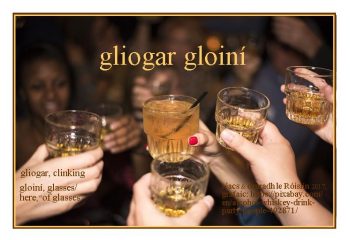
So what does all this tell us?  Probably that “glas” is more widely understood as the Irish word for “green,” and that a lot of people try to use it to say “green beer.”  A handful get it correct, and actually have something to say about the topic.  “Beoir uaine” is also used, although it is more often channeled into commercial applications or cibearbhruscar (*bruscarlíne, if I do say so myself).   The plural, using “beoracha,” just doesn’t seem to be happening.  In fact, “beoracha,” as such, without “green,” only got 6 hits.  But then we are more likely to use the word “beoir” in the singular, even if the quantities imbibed are plural.  Because we pour it into containers (piontaí, gloiní, ceaigeanna, oigiséid, srl.), which can then be plural, even though the word “beoir” stays singular.

For what it’s worth, the English search, “green beer,” generates 1,830,000 hits but the plural, “green beers,” drops significantly to about 79,300.  The plural introduces also the idea of “green beers” meaning beer produced in an ecologically friendly manner, as in “8 Great Green Beers: Eco-friendly brews that won’t turn your tongue green,” by Maryse Chevriere (http://www.thedailymeal.com/great-green-beers)

And a final note, even the people who do talk about green beer doesn’t seem to like it much.  I found a fitting “focal scoir” from Beauregard in Gaeltacht Minnesota (https://twitter.com/AsGaeilge/status/181107959907106816, dated 3/17/12): Beoir uaine a ól, d’anam a dhíol don Diabhal, which translates to “To drink green beer (is) to sell your soul to the Devil.”  Which should put the kybosh on the subject for now!

Next up, béigil uaine (or “ghlasa”) and aibhneacha uaine (or “glasa“).  SGF, Róislín

Gluaisín: ceaig, keg; oigiséad, hogshead; pota óir, jackpot, pot of gold.  Also, my newly coined contribution to Irish portmanteaus, bruscarlíne, from “bruscar” (rubbish) + “ar líne” (online)

Cé Mhéad Lá? Cé Mhéad Paorach?

Posted on 11. May, 2012 by in Irish Language

(le Róislín)

A recent blog in this series on figurative speech in Irish mentioned  “na laethanta go léir a bhí ag na Paoraigh.”  Some of you probably recognized this as a reference to the well-known seanfhocal (proverb):  Beidh lá eile ag an bPaorach (Mr. Power will have another day).

So how does this seanfhocal break down as far as vocabulary and grammar go?  And if you’re new to Irish, you might be wondering where the verb “to have” is.

Let’s start with the “to have” question.  The short answer is that there isn’t really a verb “to have” as such in Irish, but instead things are generally “at you,” using the prepositionag(at).  Naturally this can be extended to all three “persons” (1st, 2nd, 3rd), so the paradigm starts out like this: Tá carr agam (There is a car at me), Tá carr agat, Tá carr aige, Tá carr aici, Tá carr ag Seán, Tá carr ag an Domhnallach, etc.   Literally, the proverb would be translated as “There will be another day at Mr. Power.”   There are some other ways to express possession, such as “Is liomsa é” (It is with me) but that, of course, will have to be ábhar blag eile.

beidh [bay]: will be

lá eile: another day, with the adjective (eile) in second place, the usual word order in Irish

ag an bPaorach: at Mr. Power (or the Power fellow, or as an another form of the surname “Power,” Mr. de Paor)

Paorach vs. bPaorach, and occasionally Phaorach:  Paorach is the basic form of the name [PWEER-ukh or PWAYR-ukh].  In the prepositional phraseag an bPaorach,” the letter “b” is used to show eclipsis and the word is pronounced [BWEER-ukh or BWAYR-ukh].   This form is used in standard Irish and in some dialects.  Curiously, even though in Donegal the form would normally beag an Phaorach,” there’s very little evidence of this usage online.  That, of course, doesn’t mean some Donegal speakers wouldn’t make the conversion, but in this case, it seems tradition may sometimes trump dialect andag an bPaorachmay show up sometimes, even in Irish in the North, where lenition would normally occur.  The few examples I did find online ofag an Phaorachwere mostly from Donegal, as one would expect.

How about the-achending?  It’s a way of saying the “Power” man, i.e. the man with the surname “Power.”  Similarly,an Domhnallachis “the O’Donnell man” (or in Scotland, the MacDonald man) andan Flaitheartachis “the O’Flaherty man.”  The proverb is usually translated as “Mr. Power,” but technically, of course, “Mr.” would bean tUasal” (an tUasal de Paor).  Wouldn’t have quite the same ring, though.

The proverb is believed to date to 1798, when Edmund Power was about to be hanged for his role in the Rebellion at Waterford (Dungarvan).  That would give us over 200 years of the namePaorach being invoked to encourage people to struggle on for future success.  So while we can’t actually answer the questions in the title of this blog,Cé Mhéad Lá?  Cé Mhéad Paorach?,” we can at least translate them: How many days?  How many Messrs. Power? (How many Power men?).  The nounsandPaorachstay singular in Irish, even in the questionCé mhéad?(How many?, lit. What amount?) which implies a plural answer.

Bhuel, sin é don lá inniu, cé nach lá an Phaoraigh é.  So that’d be the genitive case ofPaorachbut that’s ábhar blag eile.  SGF, Róislín

Nóta: the original blog in this series on figurative speech is: http://blogs.transparent.com/irish/between-a-rock-and-a-may-day-fire-or-life-on-the-horns-of-a-dilemma-as-gaeilge/

Time Is of the Essence, except for “Eadra” and its Cohorts

Posted on 30. Apr, 2012 by in Irish Language

(le Róislín)

Thinking further about all the “time” words we’ve recently discussed, another thought struck me, with interesting vocabulary implications.  The following terms use the “-time” suffix in English, but not in Irish.

Daytime: there are several ways to express this, none using “-time” as such: an lá (as a noun) and, for “in the daytime, “sa lá,” “i rith an lae” (with the tuiseal ginideach), and “isló” (a bit literary, perhaps dated, but still in use)

Night-time: like “daytime,” we have the same basic idea, “oíche,” for both “night” and “night-time,” and similar prepositional phrases, with “san oíche” or “istoíche” for “at night-time,” and “d’oíche” or “de shiúl oíche” for “in the night-time.”

For the four seasons, we can either use just the basic noun, or add “ráithe” (three-month period, season, quarter), which means we also switch to the genitive case.  None of the words for seasons typically take any of the usual Irish “time” words as a suffix or to make a compound word as such.

Springtime: “an tEarrach,” with “san earrach” for “in the spring(time).”  Less commonly, we have “ráithe an Earraigh” [… un YAR-ee]  with a total of 6 Google hits.  For “san earrach,” though, we have at least 620 hits, with ca. 17,600 before duplicates, etc. are eliminated.  A substantial difference either way!

Summertime: usually just “an Samhradh.”  There is also the phrase “ráithe an tsamhraidh” [… un TOW-ree].  Total hits online for “ráithe an tsamhraidh” – four!  For “sa samhradh,” about 609, out of 11,600 (before sorting out the duplicates).  Plus another 554 for the Northern dialect version, “sa tsamhradh” [suh TOW-roo] (out of 1,770 before sorting)

Wintertime: “an Geimhreadh,” with occasional use of “ráithe an gheimhridh” [… un YEV-ree].  Total hits for the latter?  Eight, including four duplicates, so five, really, in, erm, essence.  Simply using “sa,” we have two variant phrases to track: “sa ngeimhreadh: gives us 158 (out of 637 pre-sorting) and “sa gheimhreadh,” which yields 469 (out of about 13,100 pre-sorting)

But no “fall-time” or “autumn-time,” i mBéarlaDiabhal a fhios agam cén fáth!  Irish, though, more consistently has occasional uses (trí amas ar líne, sin an méid) of “ráithe an fhómhair.”  That comes from “Fómhar” (autumn, fall, harvest).   “In the fall/autumn” gives us 629 hits for “san fhómhar” (out of ca. 7750 pre-sorting) and 449 for “sa bhfómhar” (out of ca. 2580).

Clearly the phrases with “sa”: are more widely used than the phrases with “ráithe.”  Not that these Google searches are absolute, and they will also change constantly, but they do establish a pattern – that including the element of “time” is just not that critical for these “season” terms.

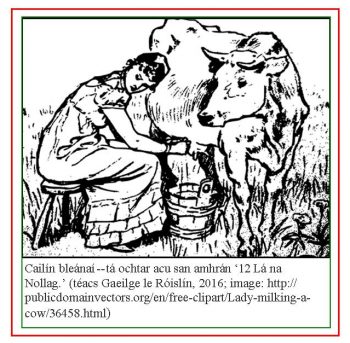
A final interesting word in this regard is “eadra,” which has fascinated me since I first learned it.  “Eadra” means “late morning milking time,” “the time spent by cattle as they wait to be milked” (hmm, are they aware they’ve got their own word for this?),  or, in an even further extension, “late morning” (without milking),“dinner-time,” “noon,” or “an idle interval.”  The word “” (cow) can be added for clarity but the term is understood without it.

Somewhat contradicting my general point in this blog, about “time” words without the “time” element, we do also have “eadarlinn” (milking-time) or “eadarlinn na mbó,” where “linn” has been added, a slight spelling change has been made, and we now have a time-related suffix.  The exception that makes the rule?

Here’s an intriguing seanfhocal to wrap up the “eadra” discussion, “Déanann na ba seasca féin an t-eadra” (even dry cows take advantage of the milking-time rest).

That “seasca” is the plural of “seasc” (infertile, unfruitful, dry re: cows).  Nothing to do with the other “seasca” (60) in case you were wondering.  Another use of this “seasc,” and a great word for your next Irish-medium eco-cocktail party is “corr sheasc” (a sand-eel without milt or roe).  Just what I was planning to talk about with my friends tonight.

I hunted around on line and on the printed page for an exact equivalent to “Time is of the essence.”  I didn’t find any word-for-word translation (ní nach ionadh), that is, nothing that actually included the word “eisint” or “bunbhrí” or “éirim” (not “eírím,” the verb, with the “i-fada” but “éirim,” the noun, with two short i’s).  But I did find two interesting results.  Someone writing on Answers.com contributed the following “Ní tráth moille é, based on “This is no time for delay.”  (http://wiki.answers.com/Q/What_is_the_Gaelic_for_’time_is_of_the_essence’, which works as expressing the same basic sentiment.  And more formally speaking, I found the phrase “am ina bhuntréith sa chonradh” for “time of the essence of the contract.”  Literarily, it means “time in its ‘essential quality’ in the contract.”  You may know “conradh” from “Conradh na Gaeilge,” where it means “league,” but it also means “contract, agreement, or treaty.”

Bhuel, sin é don bhlag seo agus tá súil agam nach am amú é.  SGF, Róislín