Tag Archives: lenited

Ag Caint faoi Thuí agus faoi Thuíodóireacht (Speaking of Thatching)

Posted on 14. Apr, 2013 by in Irish Language

(le Róislín)

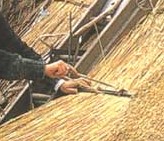
ag tuíodóireacht

Before moving away from tuíodóireacht to other topics, I thought it would be interesting to look at the tools used by a tuíodóir, and also to look briefly at the use of díonta tuí outside of Ireland and Britain.

You might have just noticed the phrase “díonta tuí” (thatched roofs).  And you might also remember that the typical phrase for a “thatch-roofed cottage” is “teach beag ceann tuí,” using “ceann” instead of “díon” for roof.  “Díon” (plural: díonta) appears more often when discussing thatched roofs as a roofing style and “ceann tuí” or its plural “cinn tuí” appears more often when describing the roofs of specific cottages.   At any rate, “díon” is the standard word for “roof.”  As you may recall, “ceann” normally means “head.”   Whichever term is used, the array of traditional tools used for tuíodóireacht is quite fascinating

Two of the thatching tools caught my eye because their names in English are so unusual, “spurtle” and “leggat.”  As you’ll see below, the Irish terms are more self-explanatory.

spurtle: sáiteoir, pl. sáiteoirí.  In Irish, this literally means a “thruster” or “pusher.”  The word “sáiteoir” is also used in engineering terminology, as in “sáiteoir pilí” (a pile-driver).   A “sáiteoir muc” is, as you may have guessed, a “pigsticker,” and more benignly, a “sáiteoir cuaillí” is a “pole-sinker.”  A “sáiteoir” can also mean a “meddler” or “intruder,” not too different from a “sáiteachán” (nagging person).  They’re all based on the verb “sáigh” (push, press, prod, stab, and, figuratively, nag, etc.).

In the thatched-roof context, the spurtle is an elongated tool with a smallish prong at one end, used for patching.

leggat or leggatt: cíor thuí (lit. a thatch-comb).  “Cíor” is the ordinary word for a “comb” (cíor mhín, fine-toothed comb; cíor gharbh, large-toothed comb; cíor chapaill, a curry-comb, etc.).  “Tuí” is lenited here because it is used as an adjective, and in this case, happens to modify a feminine noun (cíor, comb; an chíor, the comb).   “Cíor” is also a verb, with “cíoradh” as the verbal noun.   It can mean “to comb” literally (capall a chíoradh, to curry a horse; olann a chíoradh, to comb wool), but, like “sáigh,” it has its share of figurative meanings, such as “ag cíoradh ceiste” (examining a question minutely), “ag cíoradh na gcomharsan” (backbiting the neighbors, i.e. combing through their idiosyncrasies), and “ag cíoradh a chéile,” which might sound like some nice co-grooming/bonding activity but actually means “fighting” or “quarrelling.”

Come to think of it, though, nit-picking (piocadh na sneá?) really is a positive activity (as mutual grooming), isn’t it?  At least that’s the case when it’s practiced by babúin, meacaicí, and other animals — by participating in the system of grúmaeireacht shóisialta or comhghrúmaeireacht, you reinforce your place in the community.  As you groom, so shall you be groomed?  You may also get some other benefits best left to the “samhlaíocht” (imagination).

Some of the other thatching tools, with more ordinary names (sa Bhéarla agus sa Ghaeilge) are:

knife: scian [SHKEE-un], pl: sceana [SHKAN-uh]

thatching needle: snáthaid tuíodóireachta, pl: snáthaidí tuíodóireachta.  Even though “snáthaid” [SNAW-hidj] is feminine, there’s no lenition following it because of the d-n-t-l-s rule.  So “tuíodóireachta,” here functioning like an adjective, retains the ordinary initial “t” instead of changing to “th.”   In contrast, consider “snáthaid chléithe” (with lenition of “cléithe“) but “snáthaid dearnála” (with no lenition because of the d-n-t-l-s rule).  ”Snáthaid chléithe” and “snáthaid dearnála” both mean the same thing, a “darning needle.” “Snáthaid” is the general word for “needle” (sewing, etc.), but, always a vocabulary caveat, knitting needles are “bioráin” or “dealgáin.”  “The needle” (sewing, etc.) is the delightful-to-pronounce combo “an tsnáthaid” [un TNAW-hidj].

Thatchers also used knee-protectors.  I haven’t found a specific Irish word for them, but assume it would be “cosantóirí glúine” (protectors of knee).   Eolas ag duine ar bith eile?

scollop, rod, spar, squeeze-loop: scolb, pl: scoilb (as discussed in the previous blog and as in the well-known Irish proverb, “Ní hé lá na gaoithe lá na scolb.”  Why does the proverb say “scolb” and not “scoilb” at the end when the implication is plural (“The windy day is not the day of the thatching spars”)?  Because “scolb” (no “i”) is the genitive plural form for this masculine noun.  “Scolb” serves both as the singular form for the subject or direct object (Tá an scolb déanta as adhmad / The thatching spar is made of wood; Rinne sé scolb as adhmad / He made a thatching spar out of wood) and as the plural form, when showing possession (however abstract), as in “lá na scolb” (once again, “the day of the scollops” or thatching spars).

Another interesting English word connected to thatching is “yolm,” with variations such as “yelm” and “yealm.”  It means an armful or bundle of thatching material (straw, etc.) as laid out for the thatcher to use.   ”Yolm,” is documented from the Midlands of Ireland; the other spellings are mostly local to regions of England.   ”Fainneal” would appear to be the equivalent in Irish, but so far I haven’t found any sources that actually translate a “fainneal” as a “yolm, ” probably because “yolm” is more dialect than standard English (whatever “standard” English is these days!).

In England, the thatcher might work with a “yelmer” who prepared or laid out the material for the thatcher.  I haven’t found any equivalent term for the “yelmer” in Irish, but that doesn’t mean there isn’t one.  Eolas ag duine ar bith? 

Other thatching tools and equipment included deimheas (shears), various types of hooks, and of course, for any roof work, an dréimire (the ladder), perhaps the most useful of all these terms for our general purposes today.

Speaking of dréimirí, that brings us to an ábhairín machnaimh.  Thatched cottages didn’t have gutters as part of the roof, so the hours many suburban homeowners spend perched on dréimirí, ag glanadh na ngáitéar, would be avoided.  And that sounds like a good thing!

If you’re considering a díon tuí in the U.S., or are simply interested in reading more about them, here’s a link to Commonwealth Roofing Corp., located in Louisville, KY, which includes thatched roofs among other styles they offer: http://commonwealthroofing.com/roof-types/thatched-roof/ . I could, of course, list their roof types in English, but where would the dúshlán be then?   Here are some of them, in Irish: slinn, slinn adhmaid, “glas,” miotal, tíl, and “scannán.”  Can you figure them out?  Leid: “scannán” here isn’t translated the way you might expect, based on phrases like “Bord Scannán na hÉireann” (Film Board of Ireland) but instead we have here an older use of the word, dating back to laethe réamhdhigiteacha when films were actually made ar cheallalóid.  Aistriúcháin thíos, sa nóta.

In Commonwealth Roofing’s picture gallery, I found an article about “The Kerry Cottage,” a thatched-roof Irish gift shop in Maplewood (St. Louis), Missouri, which was named after the ancestral homeland of the proprietor Maura Lawlor:  http://www.kerrycottage.com/custom.aspx?id=1Suimiúil!

The Kerry Cottage, Maplewood (St. Louis), Missouri

And that opens up the discussion even more broadly.  Are there any thatched-roof cottages or other buildings in your area?  In Éirinn nó taobh amuigh d’Éirinn?  If so, are they part of an open-air museum or a historic site, or are they actual residences?  Ar mhaith leatsa a bheith i do chónaí i dteach beag ceann tuí, preferably one that is “in ascaill an ghleanna” (for full effect).  Nó arbh fhearr leat fanacht i dteach mar sin ar feadh seachtaine, b’fhéidir, ar laethanta saoire?  Either way, it’d be interesting to hear bhur mbarúlachaSGF, Róislín

Nóta faoi chineálacha díonta (slinn, slinn adhmaid, “glas,” miotal, tíl, scannán): in order, these are slate, shingle, “green,” metal, tile, and membrane.

Scannáin Nollag (Christmas Movies — na teidil i nGaeilge)

Posted on 09. Dec, 2012 by in Irish Language

(le Róislín)

fleasc Nollag agus treoraí scannáin leis an uimhir 3 -- dá mbeadh sé seo "beo," chloisfeá "bíp" ag an "3"

Seo rogha de scannáin Nollag a bhfuil clú mór orthu.  Fad m’eolais níl leagan Gaeilge díobh ann so rinne mé an chéad chéim — na teidil a aistriú go Gaeilge.  An aithníonn tú iad?  Agus an féidir leat iad a mheaitseáil leis na teidil i mBéarla?  Mar chuidiú, tá gluais leis na freagraí. 

As a quick reminder, here’s some basic Christmas terminology:

an Nollaig, (the) Christmas; it’s a feminine noun so adjectives following are lenited as in “Nollaig Shona!” (Merry / Happy Christmas)

na Nollag, of (the) Christmas

Nollag, of Christmas

Nollaig Shona agus Athbhliain faoi Mhaise duit: Merry (Happy) Christmas and a Happy New Year to You! (singular) [say: NUL-ik HUN-uh AH-gus AH-VLEE-in fwee WISH-uh ditch]

Nollaig Shona agus Athbhliain faoi Mhaise daoibh: Merry (Happy) Christmas and a Happy New Year to You! (plural, said to two or more people) [say: NUL-ik HUN-uh AH-gus AH-VLEE-in fwee WISH-uh deev]

Meaitseáil an teideal i nGaeilge leis an teideal i mBéarla (Match the Irish title with the English title; answers below)

An Teideal i nGaeilge   An Teideal i mBéarla
1. Sa Bhaile ina Aonar a. It’s a Wonderful Life (1946)
2. Nollaig Bhán b. The Nightmare Before Christmas (1993)
3. Is Iontach an Saol É c. Miracle on 34th Street (1947)
4. An Nollaig i gConnecticut d. The Bishop’s Wife (1947)
5. Nollaig Shéarlas de Brún e. A Christmas Story (1983)
6. An Tromluí roimh an Nollaig f. A Charlie Brown Christmas (1965)
7. Míorúilt ar Shráid Tríocha a Ceathair g. Home Alone (1990)
8. Bean an Easpaig h. The Polar Express (2004)
9. Scéal Nollag i. Christmas in Connecticut (1945)
10. Traein Luais an Phoil Thuaidh j. White Christmas (1954)

Ar bhain tú sult as?  Tá súil agam gur bhain!  SGF, Róislín

Freagraí:

1g. Home Alone (Macaulay Culkin mar “Chaoimhín Mac Alastair”); baile: town, home; aonar, alone, one person, lone person

2j. White Christmas (Bing Crosby); bán, white, lenited to become “bhán” [wawn OR vawn] because “Nollaig” is feminine

3a. It’s a Wonderful Life (James Stewart); iontach, wonderful; saol, life, world

4i. Christmas in Connecticut (Barbara Stanwyck); i gConnecticut: the “C” of “Connecticut” is eclipsed to become “gC” because it follows the word for “in” [say: ih gun-ET-ih-cut]

5f. A Charlie Brown Christmas (Peter Robbins mar ghuth Shéarlais); mar ghuth, as the voice; Shéarlais, of Charles, but note the slight difference in “Nollaig Shéarlas de Brún” (Christmas of Charles Brown — “Shéarlas” here doesn’t have the letter “i.”

6b. The Nightmare before Christmas (Danny Elfman); tromluí [trum-lee], a nightmare

7c. Miracle on 34th Street (Edmund Gwenn, Maureen O’Hara); míorúilt [MEER-oo-iltch], “sráid” (street} becomes “shráid” [say: hrawdj, the "s" is now silent] after the word “ar“; tríocha a ceathair [say: TRzhEE-uh-khuh uh KyA-hirzh, the "t" in "ceathair" is silent]

8d. The Bishop’s Wife (Cary Grant); easpag, bishop; easpaig, (of a/the) bishop; as for bishops having wives, please remember, ba easpag Easpagóideach é an t-easpag sa scannán seo.

9e. A Christmas Story (Peter Billingsley); to get the sense of “a” Christmas story, we drop the word for “the” in Irish, leaving us with simply “Scéal Nollag.”  If we said “Scéal na Nollag,” it would mean the story about “saolú Chríost.”

10h. The Polar Express (Tom Hanks); traein luais [tray-in LOO-ish] means “express train;” you might recognize “luais” (lit. “of speed”) from “Luas,” the new light rail tram system in Dublin.  There are actually two phrases for the “North Pole” in Irish: An Pol Thuaidh [un pol HOO-ee], and amazingly, but coincidentally similar, An Mol Thuaidh [un mol HOO-ee].  Here I’ve used the first one, and put it in the possessive form, with the initial “ph-,” which sounds like “f.”

Nóta: Iarsmaoineamh maidir le “A Charlie Brown Christmas” — le bheith cruinn, is dócha go mba chóir dúinn “Nollaig de Chuid Shéarlas de Brún” a rá.  Ach feictear dom gur lán béil d’fhocail é sin.  Barúlacha (Opinions)

Nóta a dó: Má tá tú fiosrach faoi na bípeanna seanstile mar a luaitear i bhfortheideal na grafaice, éist leis seo: http://www.youtube.com/watch?v=Y9KXPkhZSy0 (Comhaireamh síos do sheanscannán, úúps, as Béarla atá sé postáilte, “Old Film Countdown,” postáilte ag “OnYaFeet.”  Agus ná caoch do shúile — níl ann ach 20 soicind!  Go raibh maith agat, a OnYaFeet!


Pronunciation Follow-up to the “Cúig Fhocal gan Mhaith” Series

Posted on 17. Jan, 2012 by in Uncategorized

(le Róislín)

The last few blogs have dealt pretty intensely with meaning and slight differences among comhainmneacha (synonyms).  Here we’ll look at a much more down-to-earth aspect of some of the same words – how to say them.  We’ll look at a few of the longer and more complex ones (tláithíneacht, neamhghontacht, m. sh.) but we’ll also look at some shorter, more basic words that illustrate some major points of Irish pronunciation, some from the blogs and others from general vocabulary.  Some samples will involve the widespread Irish phenomena of lenition (séimhiú) and eclipsis (urú), but we’ll also look such specific issues as lenited sounds in the middle or at the end of words and also some vowel sounds.  Like most blog-length approaches to this topic, though, this is just barr an chnoic oighir (or rinn an oighearchnoic, or the “bior” thereof, if you prefer).

I. Lenition (séimhiú, lit. softening)

Lenition of initial consonants occurs for over a dozen reasons in Irish, so I’ll just focus on a few here.  Lenition is generally marked by the insertion of the letter “h” after the initial consonant (cat becoming chat, m.sh.)

a. After the numbers 2 through 6, except for, well, na heisceachtaí (the exceptions)

Ceithre fhocal [KyEH-ruh OK-ul], four words

Cúig fhrása [KOO-ig RAW-suh], five phrases

Exceptions include some (but not all) units of measurement: ceithre bliana, sé seachtainí

b. Directly after some (but not all) prepositions, some, but not all of the time (a chapters’s worth of issues there!)

Gan mhaith [gahn wah], useless, lit. without good, but “gan tús gan deireadh” (the d and t resistance)

Compare: ó Bhéal Feirste (from Belfast; lenition) but “go Béal Feirste” (to Belfast; no lenition)

Nóta: I say “directly” here because the entire set-up changes if words like “an” or “mo” are present.  Blag eile!

c. Marking nouns that are “possessed,” either literally (Jimmy’s coat) or more abstractly (often involving compound prepositions like “de réir” or “os cionn”)

Let’s start with some real workhorse examples, not from the recent blog series: cóta Shéamais, seomra Shiobhán, iníon Mháire, madra Chaitlín.  Some basic examples of the compound preposition “os cionn” are os cionn an bhoird (above the table, normally “bord“) and os cionn an gharáiste (above the garage, normally “garáiste“)

Looking at our recent blogs, we don’t have to go any farther than the title of the series for “de réir“:

de réir Fhionntán Uí Thuathail [… IN-tawn ee HOO-uh-hil, note that the “f” of “Fhionntán” is silent, as are the “t’s” of “Thuathail”]

Note that if we didn’t include the surname, the spelling and pronunciation of “Fintan” would change  slightly: de réir Fhionntáin [… IN-taw-in, with the “taw” and “in” running together very smoothly], this means “according to Fintan.”  Likewise: de réir Mharcais [WAR-kish], de réir Mhatha [WAH-huh] (according to Mark/Matthew)

Lenition also occurs after “” in surnames, which is also an aspect of possession, albeit very abstract:

carr Uí Thuathail [… ee HOO-uh-hil, as above], O’Toole’s car, the car of Ó Tuathail

Sráid Uí Chonaill [srawdj ee KHON-ill], O’Connell St.

Bean Uí Mhurchú [ban ee WUR-uh-khoo], Mrs. Murphy, lit. the wife/woman of Ó Murchú

There are many more situations in which lenition occurs, but that’s a sample, for now.

2. Eclipsis (urú, lit. eclipsing): adding a new initial consonant and obscuring the pronunciation of the original one

a. After the preposition “i” (in)

i gcrobhaing [ig-ROW-ing, the syllables more or less run together], in a cluster.  In this transcription, “row” is as in “row-boat,” not as in “a row” (the latter being the “row” often paired with “ruction,” thanks to Tim Finnegan)

i mbannaí [im-AHN-ee], bail, as in “ag dul i mbannaí air” (to go bail for him)

This also occurs, of course, with many place names, like

i mBaile Átha Cliath [im AHL-yuh KLEE-uh], in Dublin, with the middle word “Átha” basically swallowed into oblivion

i mBostún [im OST-oon], in Boston

b. With plural nouns in the genitive case, following the definite article “na

tráth na gcomhainmneacha [traw nuh GOH-AN-yim-nyukh-uh], the time of the synonyms (“Synonym Time,” structured like “Tráth na gCeist” [… nuh gesht], which some of you may recognize from the popular quiz name)

This structure also occurs in many widely used phrases like “leabhair na gcailíní” and in a lot of place names like “Dún na nGall” [doon ung awl], Donegal, and “Baile na mBacach” [… nuh MAHK-ukh], Ballynamockagh (Co. Galway).  In the latter, the anglicized version reflects what has happened to the initial “b” of “bacach” – it has been eclipsed and only the “m” sound is pronounced.

III. Lenited sounds in the middle of a word

One good thing about this feature of Irish pronunciation is that it rarely changes.  Once a word has such a sound medially, it will usually remain intact no matter what other changes may happen at the beginning or the end of the word.  Here are some examples from the recent blogs:

diabhal [DJEE-uh-wul OR djowl], devil, with the “bh” approximating a “w” sound

le haghaidh [leh hai], for.  The “-gh-“ in the middle is silent, serving simply to give us an /ai/ sound for the vowel, pretty much the same vowel as in English “I,” “eye,” “my,” “pie” and “guide” (and now you can see why none of these English words is a good basis for a pronunciation guide).  In other words, “haghaidh” is pretty much like the English greeting “Hi!”  And btw, the vowel sound in this “le” isn’t at all like the French “le” (the) but it’s like the short “e” of “let” or “pet”

neamhghontacht [NYOW- γON-tukht] non-pithiness, probably not as commonly used as the positive form of this word, gontacht [GON-tukht], pithiness, but certainly there are possible usages, and it’s a nice example of four consonants in a row, due to lenition.  The final “-mh” makes the “-ea-“ vowel an “ow” sound (as in “cow,” or “ouch”).  The “g” of “gontacht” is lenited after the prefix “neamh-“ (non-, un-); linguistically, it is the voiced velar fricative that I’ve discussed elsewhere (Treoir don Treoir: A Guide to the Guide (for Pronunciation), Cuid a 2 (27 Iúil 2010), which is dedicated to the voiced velar fricative sound, and An Ghaeilge sa Leabhar _Galway Bay_: “Guilpín,” “Grá” agus Go Leor Eile (2 Mí na Samhna 2009), which discusses this sound in a few terms of endearment, such as “A ghrá!” and “A ghrá mo chroí!

tarrtháil [TAR-haw-il], saving, bailout; the medial “th” is just pronounced “h”

tláithíneacht [TLAW-heen-yukht], mealy-mouthedness, soft-spokenness, wheedling, flattery, cf. tláith, weak; again, the medial “th” is just pronounced “h”

IV. Lenited sounds at the end of a word (usually very softened or silenced)

maith [mah], good, as in “gan mhaith” [gahn wah], without good (useless, etc.)

le haghaidh [leh hai], for.  We’ve mostly discussed this above, but note that the “-dh” of “haghaidh” is completely silent

V. Pronunciation of final “e’s” in Irish (as opposed to English)

In words like “déine,” the final “e” is never considered silent, although it may be barely audible or inaudible, if followed by another vowel.  For example, déine [DJAYN-yuh], austerity and déine an tsaoil [djayn yun teel], the harshness of life.  If one is articulating very carefully, the final “-e” and the “an” can be distinguished [DJAYN-yuh un teel]

VI. Which vowel is pronounced when there are two or three vowels in a row?

This could take several blogs to answer, but to pick just a few examples:

íobairt [EEB-irtch], sacrifice.  If one of the vowels has a long mark, only that one is pronounced.  Likewise,

Uí Thuathail [ee HOO-uh-hil], of O’Toole.  Again, just the long vowel of “Uí.”  Additional examples: déine, béal ([bayl], mouth, as in béalghrá), anróiteach [AHN-ROH-tchukh]

When neither vowel is long, the pattern sometimes has to be memorized, and there are noticeable variations:

deacair [DJAK-irzh], hard.  The “ea” is like English “bat” or “cat” (or like Irish bean, fear, or deas, but not like Irish “beag”).  The “ai” here is unstressed, because it’s the second syllable, so it’s not a very distinct vowel sound.  It could be considered a very short “short i” or almost a “schwa.”

mion- [min], mini-.  Basically a short “i” with the “o” mostly serving to keep the “n” broad.  Not like the “io” in “iontach” [EEN-tukh] or “iontas” [EEN-tuss], though.

In the case of “-ua” and “ia,” each vowel is pronounced, as in Ó Tuathail [oh TOO-uh-hil], crua [KROO-uh], diabhal [DJEE-uh-wul], and dian [DJEE-un]

Three vowels in a row?  Fadhb ar bith!  We’ve seen aoi [ee], a guest; faoi [fwee], under; and saoi [see], an expert, among others.

Bhuel, as noted above, that was just tip of the iceberg, but it’s a bit of a headstart.  If you have any specific pronunciation questions, please feel to write in.  SGF, Róislín