Archive for February, 2012

Korean Calligraphy—A Modern Perspective on a Traditional Art Form

Posted on 29. Feb, 2012 by in Culture, History, Holidays, Korean Art, Korean Culture, Korean Language, Uncategorized, Vocabulary

Korean Calligraphy—A Modern Perspective on a Traditional Art Form

If you are studying the Korean language, known as Hangul (한글), you may appreciate its simplicity. 한글 is a relatively new writing system with a scientific background; its 24 characters represent the features of the mouth when pronouncing each shape, letter. It was invented by King Sejong during the Joseon Dynasty in 1446, but was not fully recognized until Korea’s independence from Japan in 1945. Therefore, 한글 is closely tied to Koreans’ national pride. To further show an appreciation for 한글, “한글 Day” is celebrated on October 9th.

What better way to showcase 한글 and “한글 pride” than through calligraphy? The Korean word for calligraphy is “서예”;  transliteration: “seoyeh”. 서예 is considered a high art form in Korea, and it is taught as an elective at most Korean universities and cultural centers.

한글 서예 is unique, subtle, and elegant. Often written and read from top to bottom, it differs from Chinese and Japanese calligraphy because its lines are written differently. 한글 has a geometric-like “personality” with its scientific background, and the circular “O” stroke is exclusive to 한글 서예.

A few weeks ago, I met a modern day Korean-American Calligrapher named Myong-Won Kwong; his calligraphic “pen name” is Mook Jae. He exudes a deep appreciation for 한글 and 서예. His artwork can be found at the Library of Congress and the Smithsonian Institute in Washington, D.C.—to name a few. He has had numerous solo exhibitions in the U.S. and South Korea; you can read more about him via his website: http://mookjae.com . I also discovered a fascinating calligraphic performance by Mr. Kwon—a 150 foot scrolled message of “Let us pray for world peace and well-being.”— on YouTube: http://youtu.be/liaauEpSFuQ.

Mr. Kwon states that, “Calligraphy mirrors one’s mind [and soul]. The words I write reflect my personal thoughts and emotions. Through their meaning, shapes, images, and illusions of color, I hope to be able to write with a clean and clear mind, which I can share with those around me.”

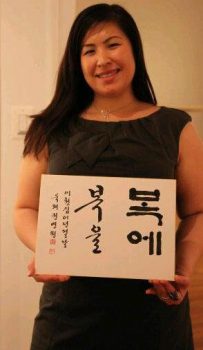
한글 서예 celebrates the beautiful simplicity of 한글, and Mr. Kwon’s messages are beautifully written. I appreciate the 한글 서예 painting he made for me, which says, “Luck on top of luck”.  My wish for everyone learning Korean, “Luck on top of luck“!
_____________________________________________________________________________________
Have you taken a class in 한글 서예? Care to share your experience by posting a comment?

Or, are you interested in learning the art of 한글 서예? Contact your country’s Korean Cultural Center, or check out this link: http://bit.ly/yCpo0p  for a list of books regarding in-depth study of the history and philosophies behind this traditional, yet strikingly modern art form.

In summary, here is a short vocabulary review:

Words:
Hangul
(한글) + calligraphy (서예) = 한글 서예 ;
(transliteration: hangul seoyeh)

A simple sentence:
I like Hangul calligraphy.” = “나는 한글 서예 좋아하다.” ;
(transliteration: “Naneun hangul seoyeh joh-ahada.”)

Celebrating the Year of the Dragon

Posted on 04. Feb, 2012 by in Culture, Grammar, History, Holidays, Korean Culture, Korean Language, Pronunciation, Uncategorized, Vocabulary

In Korea, Lunar New Year (설날; transliteration: “Sohl-nahl”) festivities have come and gone. It’s been more than a week since 설날, but since this traditional holiday’s essence is family and community, Koreans will continue to ask each other, “How did you celebrate Lunar New Year?” or, “How do you celebrate New Year’s Day?” (“당신은 어떻게 설날 기념하나요?”; transliteration: “Dangshin-eun eotteohge sohl-nahl ginyeomnayo?”)

당신은 어떻게 설날 기념하나요? I would love to hear how you celebrated 설날, especially if this was your first 설날 experience! I have heard from a lot of friendly Korean language enthusiasts via this blog and on Twitter. Specifically, last week, I received requests for how to say “Black Dragon” on our Twitter account (twitter.com/koreanlanguage). Also, I received requests for a list of Lunar New Year greetings and instructions for 윷놀이 (Yutnori) . Listed below are the answers to your questions:
  • Black dragon = 흑룡 (transliteration: heugl yong)
    Black dragon year = 흑룡 (transliteration: heugl yong hae)
  • A useful list of Korean Lunar New Year greetings is posted below and on my Scribd account: http://scr.bi/ApdZkF.
  • And, easy to follow directions for 윷놀이 are posted on my Scribd account: http://scr.bi/zVfWU0 . (Note: 윷놀이 is a traditional Korean game played on 설날. It is played with family, and is popular with kids and adults alike.  윷놀이 is played with four wooden sticks, four tokens, and a board. Playing this game ensures harmony with nature, as the sticks represent the four seasons.)

I hope you enjoyed 설날 as much as I did—I embed myself into as many 설날 activities as I could this year. On my quest to be “more Korean”, I did the following:

  • Cooked만두; duk mandu guk
    (Details & a recipe are listed in our previous blog article titled, Korean New Year: A Traditional Soup Recipe.)
  • Wore a new outfit
    (It is customary in Korea to wear a new outfit on 설날 for “new beginnings”!)
  • Cleaned my home
    (It is customary in Korea to clean your home on 설날 Eve.)
  • Brought my shoes indoors
    (Bringing shoes indoors on 설날 Eve prevents restless spirits from “filling shoes”.)
  • Played 윷놀이 with a group of adults and children!
  • Wore a Hanbok, i.e., tried one on!
    (Most modern South Koreans will not wear a Hanbok on 설날, but parents will often dress their young children in Hanboks on 설날.)

If you have any questions, or if you would like to share your thoughts or photographs with this community, please post them on this blog—or send me a “tweet” via Twitter. You might meet a new friend! : )

P.S.  Next week, I will write about Korean Calligraphy!