Archive by Author

Korean Sweets: Sukshilgwa

Posted on 03. Oct, 2011 by in Cuisine

There is a type of Korean confectionary called Sukshilgwa (숙실과) that refers to sweets that are made by using fruits that have been heated and then coated with sweeteners like honey or sugar. Sukshilgwa literally means ‘cooked fruits’, which is basically what sukshilgwa is. It is a traditional Korean sweet that used to be presented for grand feasts, but nowadays sukshilgwa can hardly be seen because of the arduous process in making it.

One type of sweet that falls under the category of Sukshilgwa is Joran (조란). Joran is a tasty Korean treat that involves boiling some jujubes in honey water until they are soft. Then the jujubes are cut open and the pits are thrown out. The rest of the jujubes are formed into the shape that you see in the picture. Then as a decorative measure a piece of pine nut is taken and pressed onto one end of the joran. This is a healthy treat to munch on when you have some time to kill!

Yullan (율란) is a type of sukshilgwa that uses chestnuts. The chestnuts are boiled until they are soft and later formed into the shape of a chestnut by hand. You can kind of cheat and shorten the process by just buying chestnut powder, which is powder that is made from grinding chestnuts. Whether you boil the chestnuts or buy the powder, remember to add some honey to the amount that you like. Then at the very end add some cinnamon powder at the base of the yullan to mimic the look of chestnuts.

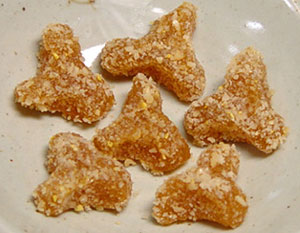
Sengran (생란) is a type of sukshilgwa that is made of ginger. The skin off the ginger is first peeled and boiled with sugar water until it is soft. Then the ginger is grinded in a mixer and shaped into a three sided star with some honey. Some people like to coat the outside of the sengran with some sugar or coconut powder to further sweeten the sengran. Sengran has that extra kick or spice mixed with sweetness, so it’ll definitely make an impact on your tongue!

Korean Butterfly Paintings

Posted on 30. Sep, 2011 by in Culture

Nam Gyeu (남계우) was a Korean painter from 1811 to 1888. He devoted his life to painting butterflies, so much so that his nickname was Nam Nabi (남나비) or ‘Butterfly Nam’. I personally love Nam Gyeu’s paintings because his paintings are always beautiful and graceful, and include butterflies innocently fluttering their wings while they hover around brightly colored flowers. Nam Gyeu is the master of painting butterflies. No one can paint them like he did, as the painting below shows.

How many butterflies can you spot in the painting on the left? There are five. Two are on towards the lower left side and three are towards the top. The two butterflies on the bottom may not have caught your attention because of the faded colors of their wings. That’s because Nam Gyeu intended the viewer’s eyes to look towards the upper part of the painting where the black and yellow butterflies are. There is so much detail and brush stroke in this painting. You can especially see it in the petals of the pink flowers.

One of the reasons why Nam Gyeu was obsessed with butterflies was because butterflies symbolized harmony in traditional Korean culture. If you look at Nam Gyeu’s paintings, the butterflies are always in a harmonious relationship with the flowers and shrubs in the painting. None of Nam Gyeu’s depiction of butterflies are ever attacked or eaten by predators. It’s as if his butterflies live in a celestial world where they live forever and are always beautiful.

This next painting was a part of a byeungpoong (병풍) or ‘folding screen’. A traditional folding screen contains several panels of hand drawn paintings that are placed behind the seat of the sitter. Can you imagine what this folding screen would have looked like in the mid 19th century? It would have drawn the viewer’s eyes upward, toward the sky where the prominent colored butterflies are. In Nam Gyeu’s perfect world, butterflies and humans never aged and lived in harmony with nature.

In a way Nam Gyeu allows viewers to attain immorality by imagining such a world, even if it’s only for a second.

Naengmyeon

Posted on 29. Sep, 2011 by in Cuisine

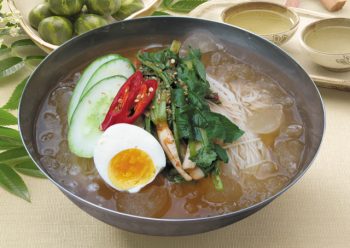
Sometimes you just get a craving for something light, refreshing but yet filling. Korean cold noodle is just the thing to satisfy that craving. One type of Korean cold noodle is Naengmyeon (냉면). Naengmyeon can be served with a cold broth, in which case the dish will be called Mul naengmyeon (물냉면). Mul naengmyeon is made from a broth made from chicken or beef. Usually mul naengmyeon is garnished with sliced cucumbers and a boiled egg.

Another type of naengmyeon is called bibim naengmyeon (비빔냉면). Bibim naengmyeon is a type of cold noodle without a broth. It’s basically just gochujang (고추장) or red chili paste, and noodles mixed together. Bibim naengmyeon is usually spicier than mul naengmyeon. Sliced cucumbers, a boiled egg cut in half are used to garnish the noodles. Sometimes some sesame seeds are added. Some people optionally add a little vinegar as well.

If you like a little seafood in your naengmyeon, then you’ll like Hoe naengmyeon (회냉면). Hoe naengmyeon is from the city of Hamhung (함흥) in North Korea. Hoe naengmyeon is a type of naengmyeon using raw fish. The fish is marinated with gochujang, seasame oil, vinegar and sugar. The noodles are made from potato starch, which is different from the buckwheat noodles usually made for mul naengmyeon.


Pyeongyang naengmyeon (평양녕면) is also a cold noodle dish that originated from North Korea. The broth of Pyeongyang naengmyeon is made from beef and dongchimi (동치미). Dongchimi is a cabbage, raddish, ginger, pear, spring onion, green chili type of watery kimchi popular in North Korea. Sometimes people add mustard oil to the broth to add some tangy flavor to the broth. Pyeongyang naengmyeon is usually garnished with radish and beef slices with a hard boiled egg.

There’s another type of naengmyeon called Yeolmu naengmyeon (열무냉면). Yeolmu naengmyeon is a variety of naengmyeon garnished with yeolmu kimchi (열부김치), a hard boiled egg, and sliced cucumbers. The yeolmu kimchi is a type of kimchi using only the leaves and stalks of a radish. The yeolmu kimchi contains a bit of hot pepper paste so this variety of naengmyeon can be slightly spicy. That’s why some people prefer to add ice to this cold noodle dish.