Tag Archives: Vegan

Japchae Recipe

Posted on 12. Mar, 2012 by in Cuisine, Culture, Hansik, Korean Culture, Korean food, Recipes, Uncategorized

Japchae (잡채) (Photo: Marc Matsumoto, 2012)

My roommate asked me for a vegan gluten free Korean recipe. I said to her quite enthusiastically, “That’s easy! Traditional Korean food doesn’t  include dairy or gluten. You can easily avoid meat and eggs too.” She was excited!

. . .

And then we hosted a Korean cooking party with a medley of friends, in our small apartment. Note: my next article will be titled, “Korean Cooking Party”. I’ll walk you through everything you need for a successful Korean cooking party, and we’ll discuss some useful vocabulary too!

But for now, here is my mom’s recipe for japchae (잡채), which is one of the easiest Korean dishes to make. It is traditionally made with clear sweet potato noodles (gluten free), vegetables, and beef. The recipe below is the vegan version (sans beef), which is no less tasty. This recipe substitutes beef with pungent dried shitake mushrooms.

Many of you are familiar with this classic Korean dish; one of our readers mentioned that 잡채 was eaten in the K-Drama, Full House. Have you ever eaten 잡채? Have you ever made 잡채? I am very curious to hear about your country’s availability of Korean food. Does your country or town have a Korean market? If not, here is a list of online markets that sell Korean food products:

www.amazon.com (Worldwide)

www.asiakauf.com (Germany)

www.hmart.com (United States)

www.orientalmart.co.uk (United Kingdom)

If you can’t locate a particular Korean product, or if the above websites don’t ship to your country—comment on this blog or send me a message on Twitter (@koreanlanguage). I am happy to help you find any Korean product, and ship it to your respective country!

_________________________________________________________________________________________________________________________________

잡채 RECIPE (Note: this recipe is for 8 large servings.)

Ingredients:

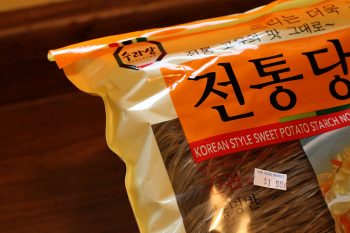
  • 1 large bag of Korean vermicelli sweet potato noodles— 1 kg. (2.2 lbs.)

    When shopping, look for "Korean style sweet potato noodles".

  • Vegetables:
    • 5 large carrots (or more according to your preference)
    • Green, red, and yellow peppers (1 of each)
    • 2 bags of pre-washed spinach (1 lb./16 oz.)
    • 1 pack of dried shitake mushrooms (1 oz.)
    • Button mushrooms (1 lb./16 oz.)
    • 1 large yellow or white onion
    • 1 bunch of green onions
  • Spices:
    • Sea salt
    • Black pepper
    • White sugar
    • Soy sauce
    • Vegetable oil
    • Sesame seed oil
    • Toasted/Roasted sesame seeds (black or white)

Directions:

STEP 1           Prepare the dried mushrooms.

  • An hour before you start cooking, prepare the dried mushrooms. You will need to soak them in lukewarm water for an hour.
  • Set aside; they will be “ready” once they double in size.
  • Once they double in size, squeeze all the water out of the mushrooms. (Using your hands and a paper towel, gently squeeze a few mushrooms at a time.)
  • Then, set to dry on a paper towel. (Pat them with a paper towel too, to ensure they are not soggy.)

STEP 2           Cook the vermicelli noodles.

  • In a large pot, bring water to a boil.
  • Once the water is boiling, add the vermicelli noodles. Ensure that all the noodles are submerged in the water.
  • Boil for 9 minutes. Then, pour the noodles into a large strainer over the sink.
  • Run HOT water over the noodles (rinse only once). Shake the strainer, toss the noodles, and let the noodles sit and drain/dry.
  • Note: leave the noodles in the strainer over a pot; set aside until STEP 6.

STEP 3           Prepare the spinach.

  • When the noodles are done, use the same pot and bring more water to a boil—to blanch the spinach. You will cook the spinach for 1 minute in boiling water.
  • Remove from heat immediately, and pour into a strainer over the sink.
  • Let the spinach cool off.
  • Using your hands, squeeze the water out of the spinach (do this is small bunches). Do this gently, and spread the spinach out on a paper towel (on a plate). Be gentle with the spinach, and let it air out.

STEP 4           Prepare/cut the other vegetables.

  • Julienne all the vegetables except the green onions.
  • You will chop the green onions into small 1 cm. slices.

STEP 5           Stir-fry the vegetables.
(Do not overcook the vegetables; they are supposed to be crunchy.)

  • In a large pan or wok, add 1 TBS. of vegetable oil.
  • Once the pan is hot, turn the heat down to medium heat.
  • First, add/cook the carrots.
  • Once the carrots are half-cooked (about 2-3 minutes), add the peppers. Stir occasionally for only 1 minute.
  • Add the fresh and dried mushrooms; cook for another minute.
  • Then, add the onions. Cook for another couple of minutes until the onions are cooked.
  • Add the green onions.
  • Then, sprinkle salt and pepper (to taste); mix well.
  • Drain the liquid from the pan.

STEP 6           Mix the noodles and vegetables.

  • Pour the noodles into a large serving bowl, and mix in 1 TBS. of sesame seed oil.
  • With gloves, using your hands, mix the oil and noodles. This is easier with 2 people; one person “massaging” the noodles; one person pouring the oil (gradually).
  • Then, add the soy sauce. Pour the soy sauce gradually, while still “massaging” the noodles with your gloved hands. (Note: the noodles may still be hot.) When the noodles turn a medium brown color, that is enough soy sauce.
  • Add 1-2 tsp. of sugar; mix.
  • Then, pour in the stir-fried vegetables.
  • Mix gently with your hands.
  • Then, add the spinach. You will see that the spinach naturally separates and blends in with the rest of the elements.
  • Add more soy sauce, salt, and pepper (to suit your taste buds).
  • The last step is sprinkling 1-2 TBS. of toasted/roasted sesame seeds on top!

ENJOY!

Most of the readers of our blog are actively trying to learn Korean at some level.  We’ve got many great free language resources to help you learn Korean, including our free vocabulary building software, Byki Express. Many other language learning programs start by teaching grammar, but research shows that’s not really the most efficient way for adults to learn a new language. Byki  leverages the fact that adults learn foreign languages best by collecting a pool of words and phrases to draw from. The bigger your pool, the better you can communicate in your foreign language.  It’s science.