Tag Archives: Nero

The “madness” of the emperors: Nero VI

Posted on 22. Jul, 2012 by in Roman culture

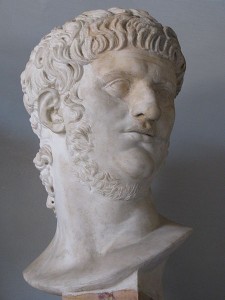
Nero would be considered by Christian historians as the precursor of the persecution of the followers of the teachings of Jesus of Nazareth. Without the insistence of literature and the Christian saints, which stimulated the legend of the evil Emperor, Nero may be just another emperor. However, it was an undeniable fact that, during the reign of Nero, a persecution of the “evil cult” (as roman historians called the first christians) began. Nero killed many of those Christian slaves, used as guinea pigs on which the accomplice of the Emperor, the poisoner Locusta, used to test the new poisons prepared continuously following orders from the Emperor.

Also during his administration the burning of Rome in year 64 took place. This fire was the best known of the history and perhaps the most falsely told, it seems that the alleged arsonist would not only set fire to the city but, once destroyed, he started the task of building it up again, but more monumental and extraordinary than it was before.

The fire began on 18 July in the year 64, Nero was enjoying his summer retreat in Anzio. At night, the Emperor was awakened by a mail informing him of the casualty, Rome burned after the start of the flames near the Circus Maximus. Concerned about the spread of the flames, Nero immediately mounted his horse, and rode the 40 miles that separated him from Rome to glimpse the splendor of the great fire which devoured the capital of the Empire. He even considered the possibility that the fire reached his mansion on the Palatine, and consumed their beloved artworks locked in the imperial residence. From a strategic viewpoint he appreciated the gravity of the disaster: more than 500 meters of flame spread and were advancing on that city of over one and a quarter million inhabitants.

The fire lasted five days and destroyed 132 private villae and four thousand houses of neighbors. It will be centuries later when the fathers of the Church put the blame of the fire on the Emperor, as Nero had blamed of the fire the subversive worshipers of Jesus.

The emperor held a policy to counteract the damage caused by the catastrophe. In this sense, he built up many huts to host the victims of the flames and even, at first he opened the doors of his palaces and gardens to welcome those who had lost everything. In addition, Nero imported supplies quickly and cheaped stock for a while. He intended to completely rebuild the city by removing the wood in the uprising of new houses and trying to build them with stone. Nevertheless, he began rebuilding his own properties, taking advantage of the pieces of land born of the disaster. Nero began building his new palace called Domus Aurea, a waste of marble columns, lush gardens, beautiful fountains and artificial lakes.

Nero was soon besieged by rumors and severe criticism to his government. He called the only woman that remained at the palace, the poisoner Locusta. Nero begged her to prepare a strong bilious tincture and save it in a golden box. More and more mad, he thought about scaping to Egypt, where he believed he would not find the soldiers of General Galba. The revolted General and de facto ruler had warned that he did not want to be named with the title of Emperor as it was very discredited, and he had enought with being the General of the Roman people.

Soon would be the end. Given the fact that Nero had nobody to communicate his escape plans, he decides to told his servant Faonte, who offered to hide Nero in his house, a cave. Nero accessed along with some of his supporters, but upon reaching a field he attempted suicide with a knife without success. Given the failure of suicide, Nero called his secretary and equerry, Epaphroditus, to take forward his arm with strength and cause him death, the order was fulfilled instantly. Before expiring, the Emperor still had humor to say: “Qualis artifex pereo“, meaning “What a great artist dies in me!”. The bright eyes of the corpse of Nero, terrified those around him. His body was wrapped in a white robe embroidered with gold. The funeral expenses were paid by his two nurses, Eclogue and Alexandria, and his humble ex-lover (maybe it was the only one that loved), Actea.

With the permission of Galba, the humble and sweet Acte, had access to the illustrious dead. Thus, stripped him, washed him and wrapped him in that white robe embroidered in gold that Nero was wearing. She moved the body to Rome and ordered him a discreet funeral. Then took the remains to the Domitian monument on the hill of Gardens, a place chosen by Nero to build a tomb of porphyry and marble. After preparing him on his way to eternity, she remained a full-time static and silent in the grave.

It is estimated that Nero’s desire for immortality through time had two examples: his desire to call the month of April Neronian, and his idea to give Rome a new name on the projected future times: Neropolis. At death time, Nero was 32 years old and and had  reigned during 14 years. Both contemporary and future historians would show no mercy with his reign. However, the Roman people refused to accept the disappearance of Nero, waiting for his return. This rather strange situation was not repeated with his predecessors. It was rumored that he had actually landed in Ostia and then travelled to Syria. From there, they said, Nero would return and regain his throne and rule the Empire again.

Nero’s life would also be recreated in films: in 1906 a film, entitled “Nero burning Rome,” another Italian film was “Nero and Agrippina,” and finally in 1930 Alessandro Blasetti filmed “Nero”. In all cases the role of the Emperor was a gift to the actors. But where this would be dramatically evident, to the point of identifying a character with the actor, was in the American film Quo Vadis  (Mervyn Le Roy) in 1951, in an overacting play by the actor Peter Ustinov.

YouTube Preview Image

The “madness” of the emperors: Nero V

Posted on 12. Jul, 2012 by in Roman culture

The emperor recovered the games and amusements for the people of Rome, after being banned in the previous stage of Tiberius. He gave himself fully to the attractions of the circus, without avoiding sometimes involving himself in the various games. He created a gladiator school where they trained these fighters who then fought in the sand with other gladiators or wild beasts.


It is known that under the rule of Nero there were more than 2,000 men trained and prepared perfectly to fight. Nero even imposed to senators and nobles, as kind of joke, to go down to the arena from time to time and fight against each other. These jokes ended the lives of 400 senators and a larger number of free men.

As noted in previous posts, the death of his mother made Nero even more upset, making him distrustful, and making him break any moral limits (no distinction between friends or enemies) mixing ones and others in a grim unreality. By then it was discovered the conspiracy of Gaius Piso, so carefully prepared that he had even fixed the day and month to carry it out: April 19th of year 65. But many people was aware of the plot (senators, members of the nobility, soldiers and even Nero’s tutor, the philosopher Seneca), news of what was afoot reached the ears of the Emperor, who cut the plot off immediately. The Legionnaires occupied the Temple of the Sun (chosen for revenge) preventing the action to take place. Shortly after the trial against the arrested people began, not only against them but against all the ramifications detected on the Palatine.

After this massacre, Tacitus stated that “the city was full of corpses.” In turn, this frustrated conspiracy made raise the fears of the Emperor, so he ordered the closure of the port of Ostia and closed the river Tiber, to prevent the entrance of those who wanted to destroy him. Surrounded by the only soldiers in which he trusted, the germans, Nero closed himself in the Palatine, and there he dedicated his time to all sorts of excesses, as if he felt he had little of life. Bored of common love, he met two new lovers: Sporus, a beautiful young man who had been sexually mutilated by Nero so while being dressed in female fine dresses Nero wanted to marry him publicly.

When Nero regained the will to live he decided to move to Greece, Rome had lost its charm and was no longer his city. Thus, in August 66 he launched a great caravan of artists who were bound for Brindisi and then Corinth. The mobile court accompanying Nero was formed by singers, dancers, musicians, singers and even fashion designers. In Greece, he married the young Sporus. The “outrageous love” with this beautiful young man, had its origin in its resemblance to Poppaea Sabina. When the emperor decided to end the life of his second wife, he ordered the castration of Sporus. Then he dressed him in female robes and organized the wedding ceremony. They held major celebrations in various parts of the Hellenic peninsula in honor of the couple.

The Delphic oracle warned him that on a specified date his life was in danger and was invited to be careful. The prediction caused an immediate return to Rome again unleashing all kinds of fears. Earlier, in another query to the oracle of Apollo, he interpreted the prophecy as a guarantee that would not die until the age of 73 years old. However, he brought from Greece a new show he had invented: the quinquennial Neronia, a playful mix of song, dance, music, poetry, gymnastics, horse and public speaking. Actually it was a kind of total show that the Emperor instituted to take place every five years. He, more spectator than participant, reserved the singing for him, he was convinced of being a great performer.


The “madness” of the emperors: Nero IV

Posted on 06. Jul, 2012 by in Roman culture

As we wrote before, Nero also killed his two wives, Octavia and Poppaea. Octavia had a dark life and away from active life, she lived out oof Rome. Poppea -the new caprice of the Emperor- demanded to share the throne with Nero, but obviously, the Empress interfered in Nero’s tasks. Nero was crazy for Poppea. She was a splendid redhead (she was considered one of the most beautiful women in Rome), the fate of Octavia was written. At first, Nero tried to divorce his first wife, but the reasons required by law were not very clear. It was then when he decided to take the final step, although killing her would not be easy, as people were with her, and the few times she went through the streets people cheered her with the affection of the masses. However, Poppaea was still urging , and Nero called again to the unconditional services of Anicetus, who repeated the crime (before he had killed Agrippina) and forced Octavia to open her veins and bleed to death.

Octavia quickly found death, virtually untouched by marriage, she had been banished to the island of Pandataria, and right there would be sacrificed. Her body was decapitated and her head carried by Anicetus as a trophy to the victorious Poppaea, who boasted. Once removed all the obstacles, Nero and Poppea began what appeared to be a stage of kindness that would never end.


Nero and Poppea were attending to absolutely all kinds of festivities and joys, draining every last drop of happiness’ nectar. Their festivals and orgies took them to wish to look like two splendid gods for which (it was an open secret) they consumed in extraordinary quantities all kinds of cosmetics and perfumes, consumed continuously and immediately replenished by suppliers. But the reign of Poppaea would not last very long, and ultimately would end up as its predecessor’s.

This feeling towards his new wife erupted after the death of the heir (Augustus), who died when he was few months old. However, Poppaea, became pregnant again, and the emperor went mad with joy, his parent-child feelings were reborn. But one night after returning from one of his interminable banquets, Nero was drunk and kicked the already bulging belly of Poppea, which caused an almost immediate death. Given these terrible events, the idea that everything had been a premeditated plan to eliminate Poppaea from his life was spread. However, many historians are inclined to think about a fatal crash with a result of an unexpected and accidental death, both the baby still inside and the Empress.

The long list of victims would continue. For example, his aunt Lepida, whom he visited in her bed wishing her a quick recovery, after that he ordered the doctor in confidence to kill her. In turn, Nero stole her will immediately, and seized all her possessions.

He also ordered the killing of a daughter of Claudius, Antonia, because he had promised to make her his wife but she had refused the Emperor’s wishes. Although in these cases Nero still suffered from conscience problems. However, very soon the monster would arise, the one that his father had prophesied.

Realizing his own statements, Nero ordered to eliminate Atticus Vestinus to marry his widow, Estatilia Messalina. Even getting to absurd extremes, he killed his stepson Rufus Crispitio because someone told Nero that the boy was having fun in his play calling himself  “the Emperor”, which for the abnormal mind of Nero meant that the boy would steal the throne one day.

Freed from the bonds his family’s presence, Nero began to live surrounded by courtesans and buffoons and organizing big parties and new games for the people and for himself. Considering that he considered himself a great versatile artist, no one questioned the authenticity of the art of the Emperor, if somebody dared to refuse it he would end up dead, as Petronius, the author of Satyricon.