Archive for December, 2010

Norwegian strong past tense verbs

Posted on 31. Dec, 2010 by in Grammar, Language

Yes, another verb post.  Boring as it may be, verbs are very important!  Strong verbs are a bit trickier than weak verbs because they do not follow a pattern-strict memorization is key;)  They are especially tricky because some of them involve a vowel change.

Some examples:


English Infinitve Past tense
to see å se
to receive å få fikk
to sleep å sove sov
to drink å drikke drakk
to become å bli ble
to partipate in or to do å drive drev
to go å dra dro
to understand å forstå forsto
to give å gi gav
to do å gjøre gjorde
to come å komme kom
to say å si sa
to write å skrive skrev
to stand å stå sto
to sing å synge sang
to take å ta tok
to meet å treffe traff
to be å være var

Note that most of these involve a vowel change.  If you can manage to memorize the 4 classes of weak verbs first, you will be much better off because then when you see a strong verb, you will pretty much know it because you will know that it doesn´t fit into the pattern of weak verbs:)

Try to use them in a sentence:

Jeg gav broren min en plakat til jul. I gave my brother a poster for Christmas.

Familien min dro til Florida tidlig i desember for å besøke tanta mi.  My family went to Florida in early December to visit my aunt.

Han en orm da vi var på parken. He saw a snake when we were at the park.

Jeg traff mora mi på kafe for å spise lunsj.  I met my mom at a cafe to eat lunch.

Mange drakk vin på festen.  Many drank wine at the party.

Vennina mi kom til Minnesota for å være med på nyttårsfesten.  My friend came to Minnesota to come to the New Year´s party.

Jeg forsto at han ville sove. I understood that he wanted to sleep.

Hun sang i dusjen. She sang in the shower.

Jeg skrev julekort i år. I wrote Christmas cards this year.

De ble sur da han sølte golvet.  They became (got) upset when he soiled (spilled on) the floor.

Vi gjorde alt vi kunne sånn at alle hadde det bra i går.  We did all we could so that everyone had a good time yesterday.

Han sto rett i veien. He stood right in the way.

I often wonder how these strong past tense verbs were formed in the first place.  It´s interesting for me to think about these kinds of things.  Why change the vowel?  Unfortunately, I have no clue.  Do you?

Norwegian weak past tense verbs

Posted on 29. Dec, 2010 by in Grammar, Language

Now that jul is over and the end of 201o is very near, I find myself thinking about things that have happened this past year.  You can never have too much practice with the past tense when you are learning a new language.  If you are like me, learning verb tenses is not your favorite part of learning a foreign language.  There is always a lot of memorization involved and Norwegian is no exception.  There are weak verbs and there are strong verbs and unfortunately, there really isn’t any rhyme or reason as to which verbs are weak and which are strong.  There are far fewer strong verbs, so it’s best to memorize those and learn the easily recognizable pattern that the weak verbs follow.  There are 4 classes of weak verbs and they each have a different suffix that is added on to the root of the verb.

The following is a chart that I used when I studied Norwegian at St. Olaf College of the 4 classes of weak verbs.  If you memorize what the four classes look like and how they are treated in the past tense, you will be good to go.  I will write a separate post on the Present Perfect verb tense, so for now, concentrate on the past tense.

Weak Verb Classes Infinitive Past Tense Present Perfect
The root ends in two consonants

ex.) vaske, snakke

-et (past tense)
-et (present perfect tense)

vaske
(wash)

snakke
(talk)

vasket
(washed)

snakket
(talked)

har vasket
(have washed)

har snakket
(have talked)

The root ends in one consonant, or in some specific two consonant combinations (ll, mm, nn, ng, nk)

ex.) like, spise
ex.) spille, svømme, kjenne, trenge, tenke

-te (past tense)
-t (present perfect tense)

like
(like)

spise
(eat)

spille
(play)

likte
(liked)

spiste
(ate)

spilte
(played)

har likt
(have liked)

har spist
(have eaten)

har spilt
(have played)

The root ends in v or a diphthong, such as “ei”.

ex.) prøve, leie, pleie

-de (past tense)
-d (present perfect tense)

prøve
(try)

leie
(rent)

prøvde
(tried)

leide
(rented)

har prøvd
(have tried)

har leid
(have rented)

The root ends in a long vowel

ex.) bo, kle

-dde (past tense)
-dd (present perfect tense)

bo
(live)

kle
(dress)

bodde
(lived)

kledde
(dressed)

har bodd
(have lived)

har kledd
(have dressed)

As I said, there is no rhyme or reason in the way verbs are categorized, but I do find that after you have learned them and used them for a while, you realize that if some of them had the suffix of another category, the word would sound funny.  Does anyone else know what I’m talking about?  For example, the 4th class (bo, kle…) would sound just wrong if they received the suffix “et.”  The same goes for the verb å snakke-it would sound really strange if it was “snakkte” in the past tense.  In my opinion, Norwegian grammar in general is fairly simple and straightforward compared to many other languages.  That being said, it takes time to learn the classes of weak verbs and memorizing the strong verbs and their different forms.

Study this chart and really try to understand it and you will be glad you took the time to do it.  Being able to make sense expressing yourself in a different language is far easier if you know verbs and their different tenses.  The subject and object of course are very important, but most important is being able to describe the actions of the subjects and objects.

Happy studying!  Next wil be strong verbs in the past tense:)

Fires in Norway

Posted on 25. Dec, 2010 by in Uncategorized

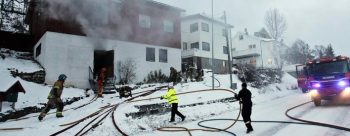
I have always been astounded by the amount of coverage branner (fires) get in the Norwegian media.  I swear in every Norwegian newspaper I open, there is an article about a brann.  I used to think that perhaps there isn’t enough other interesting stuff to share with the public, so stories about branner naturally get a lot of attention.  I don’t actually think this is true.  After a bit of research, I feel a little silly having not thought of this on my own.  There are so many branner (for such a small population) because so many buildings are made either partially or completely of tre (wood)!  Of course there are going to be more branner.

It wasn’t until the 19th century that large cities began to establish their own brann departementer.  The Oslo Fire and Rescue Services Department (Brann og redningsetaten), for instance, was founded in 1861 and protects over 500,000 inhabitants.  There are over 400 employees and 8 brann stasjoner within the department.  Oslo is a unique capital city with regards to firefighting.  Workers for the Fire Department can expect to be called to a small one story building in downtown Oslo or they could be fighting a forest fire within the 90+ mile radius of forest land.

Before the 19th century and even afterwards, Norwegians had to deal with highly flammable buildings (sometimes tre through and through), frost, significant heating to keep homes warm, etc.  The reason why I thought about writing about branner in Norway right now is because I recently saw an article in Aftenposten about branner and jul.  Jul is the høysesong (high season) for brann because of all the elektrisk belysning (electric lighting)and levende lys (literally ´living light,´AKA open flame) that people have in their homes to create the cozy Christmas feeling.  The time between lille julaften and nyttårsaften is statistically the highest risk for branner, but otherwise weekends in desember and januar during the winter are also very susceptible months for many branner.

In Oslo every year there are over 400 homes that are destroyed by branner, one quarter of which occur in desember or januar.  The more startling statistikk is that men living in Finnmark have the highest likelihood of not surviving a brann.  If you are interested in checking out the article and trying to decipher it and look at the graphs, click here!

Use caution especially during julesesongen whether you have a trehus or not!