Archive for 'Basic'

The Afghan Flag

Posted on 25. Apr, 2013 by in Basic, Uncategorized


The Afghan flag

Throughout history there have been many different flags in Afghanistan. It is probably the first country to have so many different flags since its establishment. One of the reasons that there have been so many different flags used by the government of Afghanistan throughout the history of Afghanistan is that almost every regime changed the national flag and shows the diverse ideologies of the people or the political groups. For example Habibullah Kalakani, also known as Bacha-e-Saqaw (son of a water carrier) who was the emir of Afghanistan in the year 1929, changed the flag during his rule which was less than a year. Looking back at the recent history of Afghanistan you can see a competation of flag changing.

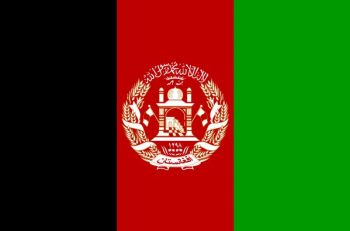
For this post, we will introduce you to the current official flag of Afghanistan. Based on the article nineteen of the constitution of Afghanistan, the current flag of Afghanistan is comprised of three equal strips of black, red, and green. This current flag was adopted in 2004 and is still in use. In the center of the flag is the national emblem of Afghanistan. At the top of the emblem is the Shahada or declaration of faith which is translated as “There is no God but Allah, Muhammad is his messenger.” In the center of the emblem is a mosque with two flags of Afghanistan. Below the mosque is the date in solar Islamic colander showing the year 1298 which is the year Afghanistan got its independence.

The color of the tree strips are interpreted as follow: The black strip means the ages of darkness when Afghanistan was not independent. The red stripe means fighting for independence and bloodshed that accord during all the years before achieving the independence. The last green strip means prosperity, and independence.

YouTube Preview Image

Five Tips for Reading Pashto Script

Posted on 28. Jan, 2013 by in Basic, language, Pashto Alphabet

Pashto

1. The unique letters: Pashto adopted the Arabic alphabet and added some extra letters to accommodate for the sounds that are unique to Pashto.  In order to read the Pashto script correctly you need to be able to pronounce these letters correctly. The following are the letters that are unique to Pashto. You can listen to the correct pronunciation and example words in the accompanying video: څ ځ ښ ږ ڼ ړ ډ ټ

 2. Diacritic Marks: Diacritic marks are used to show the short vowel sounds. In Pashto, the short vowel symbols are not normally writing, but if you are learning Pashto as a second language it is always a good idea to have your instructor write the diacritic marks on the letters to make reading and pronouncing easier. There are three diacritic marks you can use in Pashto: َ  zabar which represents a short “a” sound and appears above a letter; ِ kasra represents a short “e” sound  and appears underneath a letter: ُ Paikh represents a short “o” sound and appears above a letter. The little circles are placeholders; when these marks are used in a word the circle does not appear. Here are the examples: لړَم “larram”, مِلت  “melat”  مُبارزه  “mobareza”.

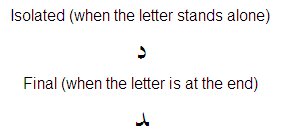
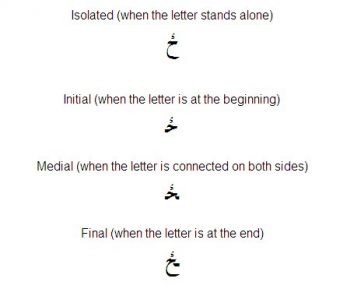
3. Shape of letters: In Pashto, the letters have different shapes depending on where they appear in a word. Most of the letters in Pashto have three shapes: initial, medial, and final. Some of the letters may have a fourth form when they are not attached. If you know the letter, usually, you can recognize all the different shapes it takes. But it is important to know that they change and remember their identifying characteristics such as the number of dots, and the position of dots. Here is an example of how the letter “ain” ﻉ  looks like in different position in a word: initial  ﻋ medial  ﻌ finalﻊ

4. Letters that don’t connect: Majority of letters in Pashto connect to each other in a word, however, there is a group of ten letters that only can be connected to the preceding letter in a word, they never can be connected to the letter following them in a word. For example, the in the word لرم  the letter “ray”, highlighted in red, is connected only to the letter preceding it, but not to the letter following it. Also remember that letters in this group can never be connected to each other. د ډ ذ ر ړ ز ژ ږ و ا

5. The letters alef and laam: When the letter “alef” ا, and the letter “ laam” ل  appear in a word they look very similar and can be mistaken for each other quite often. For instance, in the wordلپاره  (read left to right) the two letters highlighted in red look very similar . As mentioned, alef is one of the letters that does not connect to the following letter, therefore, in this case we can easily recognize that the second letter is alef because it is not connected to the following letter.

 YouTube Preview Image

Pashto Numbers 1 – 20 with video

Posted on 08. Nov, 2012 by in Basic, language

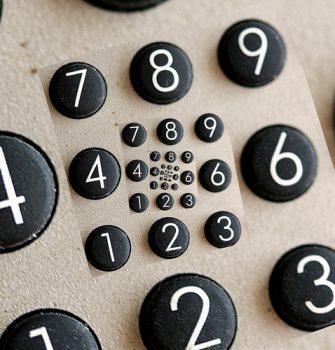
Numbers image by Irargerich via FlickrWe’ve created a simple table here with Pashto numbers through 20 for those of you who are new to learning Pashto. A video is included below with native speaker pronunciation. Listen to it a few times, and make sure to practice saying the words out loud too; this will really help you retain the information.

Once you’re ready for more, we’ve got you covered with Pashto Numbers 1 – 100.  Good luck, and keep on practicing!


Arabic Numeral Notation Pashto Numeral Notation Pashto Pronunciation
0 ٠ صفر Sifer
1 ١ يو Yaw
2 ٢ دؤه Dwa
3 ٣ درے Dray
4 ٤ څلور Celour
5 ٥ پنځه Penza
6 ٦ شپږ Shpeg
7 ٧ أوؤه Owa
8 ٨ أته Ata
9 ٩ نهه Naha
10 ١٠ لس Las
11 ١١ يو لس Yawo- Las
12 ١٢ دؤه لس do­- Las
13 ١٣ دىأر لس Dyar- Las
14 ١٤ څوأر لس Swaar- Las
15 ١٥ پنځه لس Penza- Las
16 ١٦ شپاړس Shparh-as
17 ١٧ أوؤه لس Owa- Las
18 ١٨ أته لس Ata- Las
19 ١٩ نو لس Noo­- Las
20 ٢٠ شل Shul


And here’s the video:

YouTube Preview Image