Archive for 'Uncategorized'

The Afghan Flag

Posted on 25. Apr, 2013 by in Basic, Uncategorized


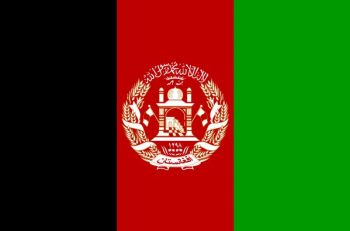
The Afghan flag

Throughout history there have been many different flags in Afghanistan. It is probably the first country to have so many different flags since its establishment. One of the reasons that there have been so many different flags used by the government of Afghanistan throughout the history of Afghanistan is that almost every regime changed the national flag and shows the diverse ideologies of the people or the political groups. For example Habibullah Kalakani, also known as Bacha-e-Saqaw (son of a water carrier) who was the emir of Afghanistan in the year 1929, changed the flag during his rule which was less than a year. Looking back at the recent history of Afghanistan you can see a competation of flag changing.

For this post, we will introduce you to the current official flag of Afghanistan. Based on the article nineteen of the constitution of Afghanistan, the current flag of Afghanistan is comprised of three equal strips of black, red, and green. This current flag was adopted in 2004 and is still in use. In the center of the flag is the national emblem of Afghanistan. At the top of the emblem is the Shahada or declaration of faith which is translated as “There is no God but Allah, Muhammad is his messenger.” In the center of the emblem is a mosque with two flags of Afghanistan. Below the mosque is the date in solar Islamic colander showing the year 1298 which is the year Afghanistan got its independence.

The color of the tree strips are interpreted as follow: The black strip means the ages of darkness when Afghanistan was not independent. The red stripe means fighting for independence and bloodshed that accord during all the years before achieving the independence. The last green strip means prosperity, and independence.

YouTube Preview Image

Gender in Pashto

Posted on 19. Dec, 2012 by in Uncategorized

sign

In Pashto the words have gender. They are either masculine or feminine depending on the letters of the word or the meaning of the words.  In order for a Pashto sentence to be correct it needs to follow the gender rule. The noun, the adjective, and the verb need to agree in gender and number.  In this post we will give you an overview of how the gender agreement works in Pashto.

In Pashto, there are rules that can help you understand whether a noun or a verb is feminine or masculine, for example, most of the nouns ending in the letter ه “a” in Pashto are feminine and the same goes with the adjective. So there isn’t a lot to worry about while determining the gender of a noun or adjective in Pashto and once your ears are familiar with the sounds then it will be easier to determine. Of course, there are more rules about determining the gender of the word but I am giving you a general overview.

As long as the gender of verbs is considered, I believe that it is not very challenging to change a verb from one gender to another because more often than not, the verb stays the same. It is mainly the past tense in Pashto that requires a gender agreement. In Present tense verb, the gender of the verb  does not change.  There are specific rules that make it very easy to change the gender of the verb. For instance, Maa waleeda-“I saw him.” vs Maa waleedala.-“I saw her. In the first example the verb is used for masculine and it is Waleeda and in the second sentence the verb is used for feminine and it is waleedala.  The only difference as you can see is that an la added to the end of the feminine verb.  The following are some words both in their masculine and feminine forms. Please pay close attention to the difference highlighted. Also, watch the video for further explanation.

Masculine                                           Feminine                             Meaning

بوډا  boodaa                                    بوډۍ  Boodai                           Old man/Old woman

کلک   klak                                         کلکه Klaka                                hard

جګ  jag                                              جګه jaga                                 tall

ولید   waleeda                                    ولیدله  waleedala                     saw him/saw her

لاړ    laarr                                        لاړه  laarra                                 he went/she went

راغلل  raaghlal                                راغللې     raaghlalay                 they (male) came/  they (female) came

YouTube Preview Image

Afghan Calendar and Months of the Year in Pashto

Posted on 25. Nov, 2012 by in Uncategorized

Afghans do not use a single type of calendar. There are three different types of calendars used in Afghanistan which are as follow:

  • Hijri Shamsi  (solar Islamic)
  • Miladi /Isawee ( Gregorian /Christian)
  • Hijre Qamari  (lunar Islamic)

Based on the Afghan constitution the official calendar of Afghanistan is Hijri Shamsi. Hijra means emigration and Shamsi means solar. The Hijrai Shamsi year starts from the year the Prophet of Islam Muhammad, peace be upon him, emigrated from the holy city of Mecca to Medina.  The Hijri Shamsi calendar has twelve months.

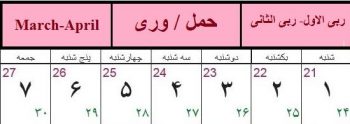
The beginning of the First month, Hamal, corresponds to the 21st of March in the Solar Christian Calendar. The government offices and official documents use the Hijri Shamsi calendar.  However, some of the official documents like passports, or correspondence that has to do with foreigners or foreign embassies in Afghanistan use the Christian Calendar. Also, majority of  Non-government Organizations use the Christian calendar.

The Lunar Islamic, Hijri Qamari, which also starts from the emigration of the Prophet Muhammad (pbuh) is used to calculate the religious holidays. The Lunar Islamic also has twelve months but is ten days shorter than the Solar Islamic year. The ninth month of the Lunar Islamic calendar, Ramadan, is the fasting month for Muslims all over the world.

The Christian year 2012 corresponds to the 1391 Hijri Shamsi year. As demonstrated in the accompanying video  a calendar poster or card usually shows all three calendar types and you can easily find out the dates for each calendar.  However if you want to convert the Christian year to Hijri Shamsi or  vise versa you subtract or add the year 622.

The following are the names of the Hijri Shamis months in Pashto:


Woray

March-April

Ghowayay

April-May

Ghbarghole

May-June

Changaskh

June-July

Zmaray

July-August

Wagay

August-September

Tala

September-October

Larrm

October-November

Leenda

November-December

Marghumay

December-January

Selwaga

January-February

Kab

February-Marc


YouTube Preview Image