Archive for June, 2009

Polish Possessive Pronouns – are they really that difficult?

Posted on 30. Jun, 2009 by in Grammar

Are Polish possessive pronouns really that difficult? I need an honest opinion here.

I have always thought they were one of those relatively straightforward bits in our convoluted language. But it turns out I might have been either mistaken or overly optimistic.

Yesterday I was asked this very complicated question:

Ok, so you say “moja książka” (my book) and “jej książka” (her book). But then you say: “On zgubił moją książkę.” (He lost my book) and because in this sentence “moja książka” is in the accusative (he lost kogo? co?) it became “moją książkę”. And when you say: “On zgubił jej książkę.” (He lost her book) only “książka” morphed into the accusative form, but not “jej”. Why is that?

And my answer: Because it’s Polish, that’s why.

But seriously, this is one of those instances when I realize that Polish possessive pronouns and their declensions can be totally incomprehensible even to the most dedicated learners (and to many Poles, too).

So, in order to make my life easier (because someone out there was bound to know the correct answer), I thought I’d ask this question to a couple of my native Polish friends. But ahem, their responses were not exactly all that helpful:

Friend #1: Dude, you’re right. This is weird. And how come I’ve never noticed this myself?
and
Friend #2: Because, duh, that’s how it is. Can’t you just tell your readers to memorize everything and stop bugging me?

I’ll ignore friend #2 for now, but yeah, friend #1 was right. We always tend to think about possessive pronouns as behaving kind of like adjectives. However, some of them think they’re special, or something.

Take a look:

  • my – mój (singular, masc.), moja (singular, fem.), moje (singular, neuter), moi (plural, masculine-personal), moje (plural, all other)
  • your – twój, twoja, twoje, twoi, twoje
  • his – jego
  • her – jej
  • our – nasz, nasza, nasze, nasi, nasze
  • your – wasz, wasza, wasze, wasi, wasze
  • their – ich

And see this? Those guys that have only one form – jego, jej and ich don’t decline. The nouns they describe decline as usual, but those pronouns themselves – don’t.

All others that have all the “adjective-looking” forms behave like good little adjectives should.

And to the question of “why is that?” my answer still stands – because it’s Polish, that’s why!

Seen in Poland – Picture Post

Posted on 27. Jun, 2009 by in Culture

As you know I’ve traveling around Poland a bit lately. It’s been fun. I got to see all sorts of very interesting things. Or not so interesting things, which for some reason stuck in my head anyway. And I dutifully took pictures of it all.

Actually, speaking of pictures, I realized that we’ve never had a classic photo post on this blog before. Hmmm… How did I manage to overlook THAT?

So for today, I prepared a selection of photos that though maybe not necessarily interesting for everyone (and especially not for native Poles reading this blog – I apologize in advance here for any hurt feelings), show a few things that I noticed during my Polish road trips. Things that made me chuckle, or say out loud “what were they thinking!”.

Here we go:

You know those big fonts of holy water you see when entering a catholic church? Those where people dip their hands and then make a sign of the cross. Have you ever thought how the holy water gets into those fonts? And what is holy water anyway? And what happens when the font becomes empty?

Now, this mystery has been solved. This is what I saw in one of the churches in Toruń.

The caretaker came over and poured some “Kropla Beskidu” bottled water into the font, and voila – problem solved. Then he poured some into a plastic cup and had himself a drink. And then left both the bottle and the cup by the font, presumably for future refills.

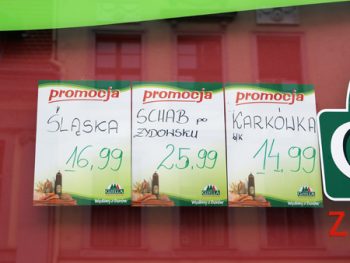
This is something else I saw in Toruń. Unfortunately, the shop was closed and I didn’t get a chance to investigate this mysterious “schab po żydowsku” up close.

Schab” – pork loin. “Po żydowsku” – Jewish style. Hmmm…

While driving around Warszawa, we saw this:

I don’t know about you, but if this was my company, I’d never let such an embarrassing typo roam the streets. Or maybe Victoria Group (yes, that’s the proper name of the company – I looked them up on the internet) was hoping that nobody would notice?

And speaking of company names… I have seen quite a few really strange ones around. I can forgive “Bizarro” (a restaurant by the E7 highway), because I’m guessing the idea was to name it after a comic book character. But this made my English speaking traveling companion spit his soda all over the car’s dashboard.

Yep. Blow.

And by the way, here’s something else that makes me chuckle. There is a major jewelry store chain in Poland. They specialize in wedding bands and engagement rings. The company’s name is Apart. I know that it’s just a pretty sound in Polish and doesn’t mean anything at all. 

Just imagine this firm expanding to the UK, for example. Their ads would be simply wonderful – “Apart – the best choice you can make for the rest of your life.”

Personally, if I were getting married, I’d prefer my guy to buy our rings at a place with a more auspicious name – like this one, for example:

By why does their logo look so much like GAP? From a distance it totally had me fooled.
Hmmm… The mysteries of modern Poland.

Midsummer – Polish Style

Posted on 24. Jun, 2009 by in Culture

This celebration technically took place yesterday, but I’ve been so busy celebrating Midsummer in all its many incarnations since last week, that the fact that I mentioned absolutely nothing about it on the blog has simply escaped my attention. I beg your forgiveness, and I promise we’ll do better next year, OK?

In the meantime, and better late than never, let me tell you about this, and incidentally – not so unique, Polish way of celebrating Midsummer.

First of all, we don’t call it Midsummer in Poland. It’s either “noc świętojańska” or “sobótki” (yes, in plural) or “sobótka” (yes, singular, take your pick). Some people claim it’s also known as “noc Kupały” but personally, I’ve never heard this expression until very recently.

The celebration is as old as the human civilization itself, and it turns out that different cultures in the northern hemisphere celebrate it not all that differently. Of course, as most celebrations these days, this one also has its origins in ancient pagan rituals. Then, when Europe adopted Christianity, in most places the occasion became known as “Feast of St. John the Baptist”*. New name, new image, yet the way it’s been celebrated throughout the centuries hasn’t really changed all that much.

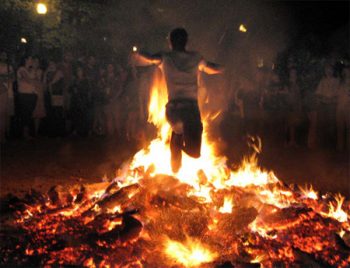
So, how do Poles celebrate noc świętojańska? With bonfires, of course! The bigger the better. And some crazy people even jump over them. Supposedly for good luck, but really… more like for a long stay in a burn unit of your favorite hospital.

My most fond memory of noc świętojańska was hunting (because if you have a bunch of kids doing it, it can’t be called “looking”) for a blooming fern (fern flower – kwiat paproci) when I was a child. Yes, I know, I know, ferns don’t bloom, never have and never will, but it’s tradition and all that. Luckily for the kids, and in the name of tradition, our parents had the good sense to decorate a mighty fern with paper flowers, candies, lollipops and hide it in the woods. Leave some clues around, let a bunch of kids loose and you have a full-blown treasure hunt on your hands. Oddly enough, nobody ever got lost during this activity, at least not for longer than a couple of hours.

After the fern flower hunt, it was time for wianki (singular – wianek)– flower wreaths with a candle stuck in the middle. You light the candle and let the whole thing float away on a body of water of your choosing. This is a strictly ladies (some even say – unmarried ladies only) activity. Depending on the region (or even the country – different Slavic lands have different interpretation of this) this has something to do either with getting a guy’s attention, or getting married, or finding out who you’re going to marry, or as my grandma claimed – wishing for a long, fruitful life (which I suppose has everything to do with who you’ll marry, after all).

Then you gather around the bonfire with a stack of sausages and cases of alcohol and party the night away. This one is an equal opportunity party – both guys and girls are welcome, in fact – the more the merrier. And this is when the jumping takes place.

I’ve always used to say that Midsummer depresses me – after all what’s there to celebrate? The fact that now the days are going to get shorter? But I remember those traditional celebrations very fondly and honestly, I’m kind of sad I’m too old for the fern hunt now. Ah, such is life…

* and yes, this is the origin of the Polish name as well – noc świętojańska. “Święto” comes from święty – saint (as in Saint John the Baptist) and “jańska” comes from Jan – John (as in John the Baptist). See? Same, same!

Image: wikipedia