Archive for April, 2011

Pan and Pani

Posted on 29. Apr, 2011 by in Culture, Grammar, Polish Language

In Polish language there is great complexity when dealing with forms of address. The forms of addressing people in one country are often different in another county. I wanted to explain some of these differences and the meanings behind them.

First, let’s look at the seemingly simple forms of address such as “Pan/Pani” (Sir/Madam) and “ty” (you). The distinction between these two is very important when you converse with Polish people. If you do not use the words in an appropriate manner you might receive “weird looks” from people or, if you are lucky, perhaps a bit of a laughter. If you are not, you can expect to get into trouble. And if you think this is a joke, trust me it’s not. Here is why.

Imagine asking an elderly person a simple question, such as “Where do you live”? (Gdzie ty mieszkasz?). If you are a foreigner who has a basic command of the Polish language and who is used to the form “you,” that’s what you would probably say. In Polish, however, we would say “Where does Sir/Madam live?” (Gdzie Pan/Pani mieszka?). The elderly person would probably take the word “you” literally – meaning “ty,” and since in Poland relationships with senior people are rather formal, he or she would much likely take it as an offense.

The same goes with any business situation while talking to your boss or any superior authority. Imagine coming to a polish job interview and saying for example “Jak się masz?” (How are you?) instead of “Jak się Pan/Pani ma?” (How is Sir/Madam/). I do not think you would have any chance to get that job unless the person knows you are a foreigner and you are excused to make mistakes like that.

As weird as it can be, these linguistic implications work both ways. In other words, Polish people struggle with “you” as well. Why? Since we are used to the form Sir/Madam, it is very awkward for us to use the word “you” when speaking English to people we meet for the first time as well as elderly people or someone superior to us. Every time we say it, it seems inappropriate and disrespectful at the same time. That is how I felt at first when I moved to USA…until I got used to using “you” with everyone…

In fact, the feeling of awkwardness is far-reaching for Polish people. For example, it is not common at all or, better yet, it is extremely rude and unacceptable in Poland to be on a first-name basis with one’s boss. Whereas, for example, Americans do not seem to have a problem with that. Unless our boss simply states, “Please call me Steve,” we will continue calling him Mr. Smith or simply Sir. The same goes with any other relationship in our country. Even relationships between peers usually start as formal and then they gradually change to being the “best friends” type of relationship.

While studying in college in Poland, all professors would address students as Pan/Pani as well. If they would talk to me, they would say”Pani Kasiu”. As far as I know – they still do it. I know that for a lot of students it means that now they are adults and they are respected more than for example in high school.

It is good to have basic knowledge of social differences straight before setting off on the trip to Poland. If you do not want to come across as weird or rude simply follow this old adage: “When in Poland do as the Polish people do.” :)

Do następnego razu… (Till next time…)


Sałatka jarzynowa

Posted on 28. Apr, 2011 by in cooking, food

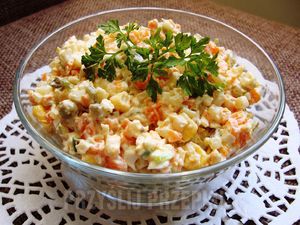
Sałatka jarzynowa is a great Polish salad, but not like the green leaf salad that most people in USA are used to. Polish salad has the ingredients cut very small and has a quite different appearance from leaf salad. It almost looks like a pasta salad with no pasta. Sałatka is one of my favourite Polish dishes and if you haven’t tried it yet, you should try to make it. It is really easy to make and very tasty!

In fact, it is traditionally made for all holidays in most of Polish homes. And it should definitely appear on Easter table!

Here is a recipie for you. It takes a little longer than regular salad to make, but it is definitely worth it.

There are many types of sałatka with different ingredients but my favourite is this one:
Ingredients:
  • Potato (2 med)
  • Eggs (4)
  • Carrots (2)
  • Parsnip roots (2)
  • Celery root (0.5)
  • Apple (1)
  • Dill Pickles (2 -3)
  • Green peas (half can)
  • Corn from the can (half can)
  • Mustard
  • Mayonnaise (full fat tastes the best)
  • Salt/pepper

1. Boil vegetables (except of green peas, pickles and corn) until soft and hard boil eggs.

2. Peel cooked vegetables, pickles and apple.

3. Dice vegetables and eggs as small as possible and place in a dish.

4. Add mustard, mayonnaise, salt and pepper and mix. There is no right amount of these. When a different person makes it they add different amounts and it comes out slightly different each time. At the end, after you mix everything, you can spread a little mayonnaise on the top and add some parsley leaves for decoration.

Experiment and have fun with it.

Sałatka is great on it’s own or with kiełbasa or on a kanapka. I have tried it with most things and it’s always great.

Good luck and let me know how did you like it!

Do następnego razu… (Till next time…)


Labour Day and Constitution Day in Poland

Posted on 27. Apr, 2011 by in Culture, History, traditions

In Poland as in many other countries some people celebrate the 1st of May as an international day of social justice and workers’ rights. However for Poles these celebrations have specific associations – after the WW II the communist authorities used this day in order to show their power and friendship with the USSR. Unfortunately, the presence on impressive and colourful parades was obligatory and people who didn’t want to take part were somehow punished at work or school. Some “disobedient citizens” considered the absence as a patriotic manifestation.

Now on the 1st of May parades are still being organized in Poland. Left-wing parties and their allies meet there communist worshippers, trade union activits and anti-capitalists.

As in Poland the 1st and the 3rd of May are free of work they form a long weekend – długi weekend. We call it weekend majowy or majówka. In the favourable conditions you can take 3 days off. Many Poles plan far or close trips, grills, parties with friends on działka (a piece of land which we own, with a house or even not, not very far, where we gather, grill sausages, drink alcohol, invite close people, sometimes sleep).

Constitution Day (May 3rd) commemorates Poland’s first constitution in 1791, the second written constitution in the world (after that of the United States), and the first in Europe. It provided for the separation of powers between the executive (the monarch), the legislature (the Sejm), and the judiciary. Although hailed throughout the West as a triumph for progressive forces, after betrayal by Poland’s ally, Frederick William II of Prussia, it was suppressed the following year by Catherine II of Russia, who saw it as a threat to her own absolute rule.

Do następnego razu… (Till next time…)