Tag Archives: guest blogger

Polish folk traditions – death before the ages

Posted on 18. Apr, 2010 by in Uncategorized

Today, Adam, our resident guest blogger continues the somber mood of national mourning by shedding light on some ancient Polish customs, traditions and superstitions about death. Or Death.

Poland is a country over 1000 years old. In the days where there was no knowledge and no scientific method, the world was explained in myths and legends. As this is the day of the funeral of the President of Poland Lech Kaczyński, and the official mourning in Poland continues, the Polish Blog decided to describe some of those ancient death superstitions.

For the Polish forefathers and foremothers death was something natural. It was a transition to another world. Ancient rituals needed to be observed. Otherwise the dead person might come back to haunt the living.

Death announced its coming in the dreams that the person whom it sought, or their family, had. Dreaming about a thief sneaking into the house, loosing teeth, being touched by a dead person, being sucked into a swamp or into a hole with lime – was a forewarning that Death was coming into the house. Dreaming about meat, geese, or underwear was also a very bad sign.

Before Death was to take its chosen one, it was said to wander around the house for three days. Phenomena that announced it was there included unexplained knocking on the door or window frames… Its messengers were crows and ravens.

Animals had the gift to see Death, and could warn people about its presence. People looked to warnings in the howling of dogs. Looking between the ears of a dog, was thought to allow a human to see Death as well.

However, the person who was to die, was also said to be able to see Death at the headboard of their bed. Death was a real person, although invisible to the human eye. It did its duty using a scythe or a hammer.

When Death came, when someone did die, everything in a house was brought to a halt. No domestic duties were carried out anymore. All mirrors were covered, and all clocks stopped. Because dead-person’s belongings were thought to bring bad luck, especially straw from the mattress, they were burned – outside the house, and often outside the village. The body had to be washed with water, and the water was poured out outside the village as well, as it was a poison that brought Death. The body was then dressed in Sunday-best clothing. The clothing had to be without knots, as had the coffin.

The soul was flying out of the body through the mouth, and via the chimney to be tried before God. But then it came back, and witnessed everything that was said about the deceased. The eyes of the deceased were closed, and coins put on them. When someone looked at the coffin through a keyhole, they could see the soul near it.

Until the funeral was performed, inhabitants were gathering to talk about the life of the deceased, finding their good side. Also their enemies, and those who disagreed with them, came from far away – as this way they erased their faults towards the deceased, and showed their own forgiveness. People prayed, drank alcohol and ate food. A candle was placed near the deceased so that they could find their way to paradise. If someone did not arrive to the wake, the spirit might call them to it itself.

The deceased could however turn into a ghost, a phantom. Therefore, the wake was aimed to prevent that. The body was being observed – to catch such ghostly symptoms. Otherwise the ghost might bring Death to the family. And it was said to climb the church bell tower and ring the bells, this was to bring Death, and unexplained phenomena on whole village. These included: fires, infestation by mice and rats, illnesses, death of animals. If such things happened, everyone knew whose fault that was. When someone was perceived as “strange” during their lifetime, they were a certain candidate for a ghost. They were watched more closely. If there was any doubt that something wasn’t right, stones or bricks were placed in the coffin just in case. Sand or poppy seeds were placed inside, so that the ghost would be occupied with counting all its particles. Or a fishing net, so that they would be occupied with untying it. A sickle might be put on the body’s neck. Or the body might be turned upside down.

It was important to say goodbye to the deceased once and for all. For that, everyone had to lay a kiss on the dead person’s hand or cheek. Childbearing women were excused from this custom, however. If the deceased was not paid this respect, their spirit would come back to haunt.

Regardless of whether the deceased was “normal” or not, they had to be walked to the graveyard in a procession. Because the dead person was emotionally tied with their home, efforts were made so that they don’t stay there. All chests and all doors were open. When the coffin was carried away from the house, it should be used to knock three times on the entrance, and all chairs and seats should be laid on the floor. The coffin couldn’t touch any wall as this brought bad luck and death. The behavior of the horses carrying the coffin was also closely monitored. Whether they scoop the ground, look back, or look at another house too much. After leaving the village or town, the driver threw a handful of straw or seeds behind his back.

On the way back from the funeral one was supposed to behave calmly and not look back. People believed that the dead are with them on major holidays, like Easter or Christmas, and it was a duty to welcome them. Therefore an extra seat and plate was always provided at the table.

This is only a small part of the folk traditions connected with death that used to be observed on Polish lands in ancient times. Some of these customs have survived in a modified form until today, however, most people are unaware of their ancient origins.

Polish Death and Burial Customs

Posted on 15. Apr, 2010 by in Culture, Vocabulary

In today’s post, Adam gives us a very detailed look at the customs and traditions of this most difficult time in the lives of those who lost a loved one.

Death is unfortunately an unavoidable, if a rather displeasing event. It affects every human being around the world, in every place and every culture. And there are as many attitudes towards it as there are cultures. There are also just as many customs.

This post will try to explain the most typical funeral customs and observances. In most cases, funeral ceremonies in Poland will be heavily influenced by the Polish Roman-Catholic ways, even if the deceased wasn’t religious, or was an atheist. Things do change, however, and now some people fit ceremonies to themselves, rather than themselves to traditional ceremonies.

The traditional way of dealing with death in Poland is to mourn and be sad. To keep calm and carry on, to keep smiling, remembering just the happy days and sharing funny stories about the deceased is a rare thing in this country.

Death must be pronounced in Poland by a doctor, and body (ciało, noun, neuter) will typically remain in the place where death occurred for some time, up to two hours. Then it will be transported to a morgue (kostnica, noun, fem.). A Certificate of Death (akt zgonu, noun, masc.) is an official document issued by a local government official (Urząd Stanu Cywilnego), absolutely necessary for completing all bureaucratic procedures, and it also states the cause of death (przyczyna śmierci). In situations when someone’s body is not recovered following a tragedy of a ship (statek morski) or an aircraft (statek powietrzny, formal) and when it is known that the person in question was on board, he or she will be pronounced dead by a court decision after six months. In situations when someone is missing, they may be pronounced dead after ten years.

Funeral home (zakład pogrzebowy), will deal with most things related to the funeral and body on behalf of the family – in most urban areas. In some villages there is no custom, nor need, to engage a funeral home. Most expenses are covered by the state, with a special benefit (zasiłek pogrzebowy) paid by Zakład Ubezpieczeń Społecznych, a state insurer, where every employed Pole should hold an obligatory insurance, which pays pensions and benefits.

Relatives and friends are notified of the death and details of the funeral (pogrzeb, noun, masc.). Special death notices called klepsydra (noun, fem.) are often put on the deceased house and their local church, and printed in newspapers. When it contains the following sentence: Prosimy o nieskładanie kondolencji, the family indicates that it is their wish not to receive condolences.
Family and friends, in urban areas, are expected to attend the funeral in a car or taxi, while a coach is often provided for neighbors and relatives from further.

These days some people choose to have their relatives cremated (skremować, verb, perfective aspect). Cremation (kremacja, noun, fem.) is not as popular as burial (pochowanie) of the whole body. At present it is still illegal to scatter the ashes (prochy, noun. plural).

In some traditional rural areas there are three “stops” in a funeral ceremony (ceremonia pogrzebowa, pogrzeb). The first stop is a wake (czuwanie). The body lies at state in the house of the deceased or their relatives. Family, neighbors and friends gather and pray during the day and night for around three days. Then the coffin is carried in a procession (usually by foot) to the church, where a remembrance service takes place. And then the body is carried yet in another procession to the cemetery.

In urban areas there are usually two, or just one “stop”. The body, brought by a hearse from the morgue, may be taken to a church, a religious chapel on a cemetery belonging to a particular denomination, or a secular chapel at a communal cemetery. Once there, a special remembrance service would be held. Then everyone drives to the cemetery, or go outside the cemetery chapel. During the procession through the cemetery, the coffin is either carried by pallbearers, or driven in a hearse, before those gathered for the burial. Sometimes only the last “stop” takes place.

Once at the cemetery, rural and urban customs are similar. Religious duties are carried out (or a speech by a secular speaker conducting the burial), the coffin is then lowered into the grave. Each mourner throws a handful of soil onto the coffin. Then shovels of soil are thrown, to level the terrain and form a grave. A cross with a name plate or just a name plate is placed at the top. After a moment, wreaths and flowers are placed on the grave.

After the funeral, some people organize a post-funeral get-together (stypa, noun, fem.). This might be either at someone’s home, or at a function hall. Typically there would be a meal, possibly speeches, lots of small talk and maybe some anecdotes about the deceased.

People over the age of 18 demonstrate their mourning by wearing black attire. Children may do the same, however it isn’t expected. For children, sometimes only a black ribbon is pinned to their clothing.

Some people, however, choose not to follow these customs. Especially those who perceive death as a personal tragedy and would prefer not to put their loved ones to their final rest, and mourn, while being observed by other people.

Easter – Wielkanoc

Posted on 03. Apr, 2010 by in Culture

Anna’s comment –
I asked Adam to write about Easter knowing full well that he would be reluctant to do so. And also knowing full well that he would object to the idea that being Polish equals being Catholic. But unfortunately, for what it’s worth, Poland is perceived as a Catholic country, and Easter is a religious holiday. An important one, at that.

So here is Adam’s Easter write-up:

As this is the time of Easter I was asked to write about Polish traditions connected with this specific holiday. I do have some mixed feelings writing about this topic. First of all, I do not feel that religion should be connected with nationality, and I don’t see Catholic religious rituals as something specifically connected with being Polish. As Polish people do also come as atheists and followers of other faiths. Although Catholic rituals in Poland sometimes seem removed from their religious roots and appear nothing more but as simply – traditions. And this is probably the most popular approach.

First Easterish celebrations begin one week before Easter – on Palm Sunday (niedziela palmowa). On this day people bring decorative “palms” to church to get them sprinkled with Holy Water, which surely has some deep religious meaning. In many villages there are special competitions for the biggest or most beautiful “palm”. Those palms are then taken back home, and kept as Easter decorations.

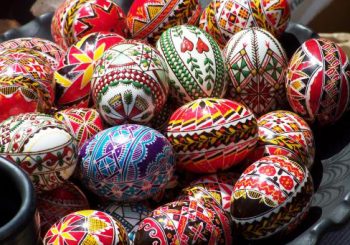
Proper Easter begins in Poland on Holy Saturday (Wielka Sobota, literally Great Saturday). This is the day of preparations. Easter is not Easter without certain props – that are connected with spring, and everything waking up and refreshing. These props are of course eggs (jaja, jajka), but also bunnies, chickens. Many people arrange tree branches with fresh pussy willows (bazie) in a vase. Eggs need to be colored and turned into pisanki. There are many different ways of doing it, and it’s usually a fun activity for kids. In some regions people simply boil eggs with onions, beets or other natural ingredients – which turn the eggshells red. Some people first use melted wax to create patterns on eggs, and then dip them in color. All painted (waxed over) areas are then white. Some people cut small patterns in paper and stick them to eggs. Others prefer to empty the egg, and make a wydmuszka. They pierce a little hole with a needle at the top and bottom of an egg and then blow air inside and the insides of the egg come out through the hole. And then color the shell.

When the eggs are ready, people put them together with a piece of white sausage (biała kiełbasa), a bit of salt, some bread into a specially decorated little basket. This basket (święconka) is then taken to church on Holy Saturday and after some religious abracadabra its contents are all ready for use on Sunday.

Sunday breakfast is the crucial point of Polish Easter. Before the breakfast eggs from the basket are cut and people at the table share them giving good wishes to everyone there. Traditional Easter breakfast consists of żurek (soup made from fermented flour), boiled white sausage, pates, eggs in many forms and cakes (like baba drożdżowalit. yeasty peasant woman, name comes from a traditional holiday folk dress peasant women used to wear, which this cake resembles in shape.

Celebrations continue on Easter Monday (lany poniedziałek), called in Polish śmigus dyngus or śmingus dyngus. It’s a day when people try to splash one another (by sometimes very nasty surprise, of course) with water. It is said to bring good luck. It comes from peasant traditions, when back in the olden days usually single young men splashed young single girls. Today everyone splashes everyone, and the young ones are most engaged in this process. It is advised to stay at home on this day, as it is possible that hoards of youngsters will get you and soak you wet with buckets of water. This is śmigus dyngus taken to extreme.

Some people prefer to be exempt from all the Easter hassle and travel for the long weekend break:)

Tak czy owak Polski Blog życzy Wam wesołych świąt i smacznego jajka
Anyway Polish Blog wishes you happy holidays and tasty eggs (that’s what people do wish one another in Poland).