Archive for February, 2012

Another Meaning of Sputnik

Posted on 28. Feb, 2012 by in Culture, language

I loved Rob’s comment on my Valentine’s day post.  If you’ve been reading this blog for a while, you might remember Rob’s previous guest posts, including Chemistry for Muggles as well as his exhaustively researched comments, both on the blog and on the Facebook page. This particular comment was so amazing that I figured, it needed to be more visible (with Rob’s kind permission). Without further ado, here’s Rob:

From memory, here’s a two-line Russian “poem” about love, author unknown, circa 1993:

Верный парень, нормальный,
Ищет спутника жизни.

I never met the author and don’t know his name; I doubt he had any intentions to be a poet, and I’m sure he would have laughed at the idea that his short объявление (ad; announcement) in the Знакомства (Personals) section of a бульварный (low-brow; vulgar) tabloid newspaper was anything close to “poetry”! Certainly, there’s nothing original or imaginative in the six words; it’s a rather standard and clichéd first sentence in a “seeking love” ad.

But it was poetry for me, as an American student of Russian who was teaching English in Moscow, as a 22-year-old homosexual who had just finished university and had only recently “come out of the closet”; who had already met some young gay and lesbian Russians, and who understood that their futures as gay people in Russia would be a bit more difficult than my own future when I returned home to America.

For me, back in 1993, there was so much significance packed up in that short ad, which struck me like a haunting крик души из тюрьмы одиночества (the scream of a soul from the prison of loneliness).

The ad probably appeared (if my memory is correct) in the back pages of СПИД-Инфо — which, in 1993, may have been the only Moscow publication that was willing to print gay/lesbian personals ads. (By the way, СПИД-Инфо literally translates as AIDS Info — but make no mistake, this was not a sober-minded educational journal intended to teach the public about AIDS and “safe sex”; it was a sleazy tabloid with celebrity sex-gossip and blurry B&W pictures of pretty women showing their breasts, and aimed mostly — though not exclusively — at heterosexual men. I used to buy it because I’d figured out that it was a good source for slang terms that you don’t learn in a college Russian course, such as трахаться (to screw/bang/shag).

So if the same two lines of Russian had appeared in a Brighton Beach newspaper in 1993, they would not have had quite the same Romantic impact for me — they would have seemed less like a послание в бутылке, одновременно полное отчаяния и надежды (a message in a bottle, simultaneously full of despair and hope) — because by 1993, prospects for gays in America were considerably brighter than in Russia.

It’s also possible that the words sounded more “poetic” to me, as a learner of Russian, than they would to a native speaker. The expression спутник/спутница жизни was quite new to me then, and it struck me as a wonderful, colorful, крылатое выражение (“unforgettably catchy phrase”; literally “winged expression”), though perhaps to a Russian it’s only a moth-eaten banality one sees in Знакомства ads.

Let me try to explain the wonderful genius that this phrase holds for a foreign student of Russian. Every English speaker knows the word “sputnik”, but for most of us, it’s simply the name of a beep-beep-beep-ing metallic object, smaller than a basketball, that the Soviets launched into orbit in 1957. However, when you’re a beginning student of Russian, they teach you that спутник is actually the generic Russian term for “satellite”, including natural satellites — so the Jovian moons Io, Ganymede, Europa, etc., are спутники Юпитера, “satellites of Jupiter.” A bit later, your teachers explain that спутник can also refer to a person, with the meaning “traveling companion”, and that when used in this sense, it also has a feminine form, спутница. And even later, you are taught how to analyze the Slavic etymology of Russian words: the-пут- in спутник is related to the noun путь (“way” or “path”), and from the same root comes words like попутчик, which was sometimes translated into English as “fellow traveler,” a Cold War euphemism for “Communist.” But спутник and попутчик are not identical, because the prefix с- suggests a closer and more intimate connection than по- does… [etc.]

So — with the above in mind — if you’re an American student of Russian in 1993, and you see the phrase спутник/спутница жизни in the “Personals” section of a Russian newspaper, you quickly understand from the context that the meaning is close to “life partner” or “significant other”. But, recalling your professor’s explanation of the difference between спутник and попутчик, you know that “life partner” totally fails to capture the metaphorical color of the Russian.

After thinking about it for a while, I decided that an appropriately poetic and idiomatic translation of “спутник/спутница жизни” would be:

“a driving buddy for the road-trip of life.”

Anyway, there was another surprise waiting for me. Probably 95% (or more) of the population is heterosexual. Thus, if you saw the phrase “…ищет спутницу жизни” in an ad, you could generally be sure that the subject of the verb искать (“to seek; to look for”) was мужчина (a man), парень (a guy), or мужик (a man); and if you saw “я ищу спутника жизни”, you could safely assume that “я” was a женщина (a woman) or девушка (a girl).

And thus it came as a moment of astonishment when I read the words “парень ищет спутника…”, and I had to stop and remind myself that both парень and спутник were nouns мужского рода (“of masculine gender”)!

Thus, a парень (guy) was looking for another male… not as a mere партнёр (which can signify “sex-partner”), but as a “traveling companion on Life’s journey”. More than that, the парень had described himself as верный (honest and loyal), and also нормальный (ordinary).

Usually, if a Russian writing a Personals ad describes himself/herself as нормальный/нормальная, you can translate it as “ordinary, likeable, down-to-earth”. But I would assume that for a gay or lesbian in Russia, the word might have a more assertive meaning: “I am not abnormal.”

From Googling, I find that sputnik zhizni is still a popular phrase today, for heterosexuals and homosexuals alike. And nowadays, the expression does not, and cannot, have the same poetic quality that it did back then — because the Internet has taken away much of the одиночество that was once the daily reality for Russian gays and other small minorities.

But Верный парень, нормальный, ищет спутника жизни seemed like poetry to me in 1993, and спутник жизни will always have a poetic quality…


Defender of the Fatherland Day

Posted on 23. Feb, 2012 by in Culture, language, Traditions

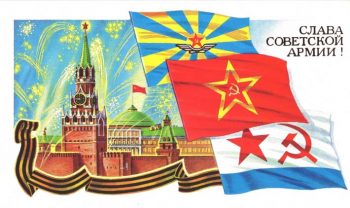
The old Soviet postcard reads: Glory to the Soviet Army! The word “Army” is generic conversational for Armed Forces. So if you say that you are a sergeant in the Army, you might need to specify it further whether you are in the Ground Forces, Air Force, Marines, or the Navy. 

February 23rd is yet another holiday in Russia – День защитника Отечества (Defender of the Fatherland Day). The majority of young Russian males end up serving in the Armed Forces as призывники (draftees). Comparatively few Russian women serve in the military. Besides, women have their own holiday on March 8th. For all these reasons, February 23rd is usually viewed as a men’s holiday.

Since as I mentioned, most Russian males have some армейский опыт (army experience), they tend to tell stories about their days in the military whenever an opportunity presents itself. And that’s those with experience either as солдаты срочной службы (draftee soldiers) who served for two years (if drafted before 2008) or even just one year (if drafter after 2008) or professional контрактники (contract soldiers).

Interestingly, one of the official terms for “military obligation” is воинская повинность (the other one is воинская обязанность). The two words повинность (duty) and провинность (fault, delinquency) are cognates, but shouldn’t be confused.

Back to the holiday… On this day, if you find yourself в русскоговорящем кругу (in a company of Russian speakers), you are likely to hear tales, often tall tales, about their military service days. Or, borrowing a line from the classic, бойцы вспоминают минувшие дни… (soldiers recall the days long gone).

If you are a male, your Russian собеседник (conversation partner) might assume you too served in the military forces of your country. So don’t be surprised if you are asked about your rank or branch of service. Fathers-in-law are particularly prone to this line of questioning.

In case you have served or are serving in the military, here’s some basic info you need to know:

Сухопутные войска (lit. ground forces) would be approximately equivalent to the Army

Военно-воздушные силы or ВВС would be same as the Air Force.

Военно-морской флот or ВМФ is, of course, the Navy

Воздушно-десантные войска or ВДВ are not the Marines, but rather Airborne soldiers. These guys are so tough, they have a holiday of their own on August 2. So, if you are a red beret in the US Army, you get much respect from your father-in-law for sure.

Now, Вооружённые силы Российской Федерации (Armed Forces of the Russian Federation) have something called космические войска which immediately brings to mind the Starship Troopers movie (or am I the only one?). These are Aerospace Defense Forces. The final one is Strategic Missile Troops or ракетные войска стратегического назначения. I think these last two are covered under the Air Force in the US.

So you can say Я служу/служил в ________________ (I serve/served in the ____________) using your branch of service instead of the blank. Don’t forget that you will have to use the prepositional case here.

Я служил в сухопутных войсках 6 лет. (I served in the Army for 6 years).

Я служу в военно-воздушных силах уже 15 лет. Ещё пять и смогу выйти на пенсию. (I’ve served in the Air Force for 15 years. Five more and I can retire).

Я сам не служил, но мой отец был морским пехотинцем (I didn’t serve myself, but my father was a Marine).

Now that we are clear with род войск (branch of the military), it’s time to figure out воинские звания (military ranks).


Russian English
Рядовой Private
Ефрейтор Private 1st class or lance-corporal
Младший сержант Corporal
Сержант Sergeant
Старший сержант Staff Sergeant or Sergeant First Class
Старшина Master Sergeant or Sergeant Major
   
Младший лейтенант 2nd Leutenant
Лейтенант -
Старший лейтенант 1st Leutenant
Капитан Captain
Майор  Major
Подполковник Leutenant-Colonel
Полковник Colonel
Генерал-майор Brigadier General
Генерал-лейтенант Major General
Генерал-полковник Leutenant General
Генерал армии General (four-star general)


Oh, two more absolutely must-know ranks are прапорщик (Warrant Officer) and старший прапорщик (Chief Warrant Officer). Which really puts you in a pickle if you are a warrant officer. You see, in Russia, прапорщик or прапор is usually portrayed as a dim-witted, arrogant, rude and frequently dishonest character. If a joke is not about a colonel or general, then it’s for sure about a warrant:

Не спорь с прапором о том, что земля круглая, а то он заставит тебя её разравнять. (Don’t argue with a warrant that the Earth is round or he will order you to flatten it)

Прапорщик встречает осла. Осёл спрашивает: «Ты кто такой?» Прапорщик отвечает: «Я – офицер, а ты кто такой?». Осёл отвечает: «Ну, тогда я – лошадь».

(A warrant meets a donkey. The donkey asks: who are you? I am an officer, – the warrant says, – and how are you? Well, then I am a horse, the donkey replies.)

No wonder that Russians are mostly phasing out these two ranks and replacing them with sergeants. Which kind of sucks if you are a warrant officer ‘cause in the US a warrant officer is an officer and not an enlisted.

By the way, just as in the US military, in Russian enlisted soldiers must salute their officers. To salute is отдать честь (lit: to render honor) while the word салют means fireworks or gun salvo.

And finally, if you were a commander of a unit, it’s important to know words for воинское формирование (military unit) you commanded:


Russian English
Отделение Squad
Взвод Platoon
Рота Company
Батальон Batallion
Отряд Anything from detachment-size to corps-size element
Полк Regiment
Дивизия Division
Корпус Corps
Армия Army
Округ Zone

Now combine all the elements:

Я служил старшим сержантом сухопутных войск, но вышел на пенсию пару лет назад (I as a Sergeant First Class in the Army, but retired a couple of years ago)

Муж моей дочери – полковник ВВС (My daughter’s husband is an Air Force Colonel).

Мой брат – командир отделения (My brother is a squad leader).

Hopefully, now you can join in the story-swapping. But only if you are a man. Women serving in the military will still have to wait until the International Women’s Day, March 8th.

Time to Visit Your Тёща

Posted on 21. Feb, 2012 by in Culture

YouTube Preview Image

Don’t take this song (or this post for that matter) very seriously. Not all husbands experience intense dislike of their mothers-in-law and not all mothers-in-law can’t stand their sons-in-law. 

This week Russians celebrate the festival of Масленица (Maslenitsa). We wrote a bit about it on this blog before in this post, this one and this one. If you joined us just recently or would like a quick refresher, here are some basic facts.

  • It is sort of like Mardi Gras, except it lasts семь дней (seven days) instead of just one.
  • It is spent eating lots and lots of блины (pancakes) with all sorts of fattening dairy products, such as творог (cottage cheese), сметана (sour cream) and, of course, масло (butter).
  • Since most of the time the festival happens when it’s still cold and snowy, bikinis and throwing beads a la New Orleans are out, but снежки (snowball fights) and sleigh rides are in.
  • Every day has its own name and related customs.

Speaking of customs, this is the time for strengthening family ties and building goodwill, particularly between sons-in-law and their mothers-in-law. In fact, not one, but two days of Maslenitsa are devoted to this.

During Maslenitsa week, Wednesday is the day when зять (son-in-law) is invited to тёщин дом (mother-in-law’s home) for some blini – к тёще на блины. Then on Friday it’s the son-in-law’s time to host and the mother-in-law stops by с ответным визитом (with a reciprocal visit).

So this Maslenitsa week, let’s talk about зятья (sons-in-law) and тёщи (mothers-in-law). First, some Family Structure 101. In English, things are simple. Assuming traditional family structure, once a couple gets married, they each acquire a couple of in-laws – a mother-in-law and a father-in-law.

In Russia things are a bit more complicated. Жена (a wife) becomes невестка (daughter-in-law) to her свёкр (husband’s father) and свекровь (husband’s mother). Муж (a husband), on the other hand, becomes зять (son-in-law) of тесть (wife’s father) and тёща (wife’s mother).

Yet it is тёща that towers above all of them presenting a truly archetypal figure. The number of анекдоты (jokes) about тёща is probably larger than those about Вовочка (little Johnny) and all the characters from 17 мгновений весны (17 Moments of Spring) combined. And, as they say in Russia, в каждой шутке есть доля правды (every joke has a grain of truth in it).

Here are some of the most едкие (caustic) jokes:

Дети – цветы жизни; тёща – кактус смерти.

(Children are the flowers of life; Wife’s mother is a cactus of death)


Тёщa копошится у мaшины перед домом. Зять из окнa:

– Мaм, кудa это вы собрaлись?
- Нa клaдбище, сынок.
- А кто мaшину потом домой пригонит?

(Wife’s mother is unlocking the car. Son-in-law asks: “Mom, where are you going? She: “To the cemetery, son” He: “Ok, but who’s going to bring the car back?”)


Тёща сидит на диване. Над её головой висят старинные массивные часы. Когда тёща встаёт, часы падают. - Вечно они опаздывают! – раздосадовано говорит зять. 

(Wife’s mother is sitting on a couch. Above her hangs the clock. As she gets up and leaves, the clock falls down.  The husband, angrily, exclaims: “This clock is always late!”)

Not to say that all mothers-in-law and their sons-in-law are sworn enemies. Still, as this article points out, дружеские отношения (friendly relationship) between the two are залог успеха (key to success) in marriage. It further suggests some goodwill gestures to win расположение тёщи (wife’s mother’s good graces). Turns out that, since тёщатоже женщина (wife’s mother is a woman too), flowers and gifts for birthdays and March 8th as well as some timely compliments should do the trick. Another suggestion is спрашивайте мнение тёщи в некоторых не принципиальных для вас вопросах (ask wife’s mother for her opinion in non-essential matters).

So if you are going to visit your mother-in-law this Maslenitsa week, bring her a bouquet of flowers, inquire about her health, and cap it all off by suggesting loudly that your wife should ask her mother for the secret to these delicious блины.

Happy Maslenitsa week!