


Frases hechas y expresiones figuradas: de igualdad y de superioridad Posted by Adir on Apr 8, 2010
Spanish has a variety of colorful idioms and expressions of comparison (both of equality and superiority). Let’s learn some more of them! De igualdad 1. andar como Pedro por su casa – to make yourself comfortable, feel like you’re at home. 2. estar como un tren – to be very handsome/pretty 3. estar como sardinas…
The verb “gustar” (to like) Posted by Adir on Apr 5, 2010
The verb “gustar” (to like) in Spanish is a little different from the other verbs because it needs an indirect object to be conjugated. Another peculiarity is that if you like something in the singular, it has one form, and if you like something in the plural, another one. This is because, in Spanish, what…
Semana Santa in Spain Posted by Magda on Apr 2, 2010

We talked about Carnavales (Carnival) a few weeks ago, and now it’s time to do the same about Semana Santa (Easter). The weeks after Carnaval leading up to Semana Santa are known as Cuaresma (Lent), a word related to the number cuarenta (forty), because forty days is the period when Christians prepare themselves with prayers…
Las conjunciones O and U, Y and E Posted by Adir on Apr 1, 2010
O and U mean “or”, but their use follows some rules. 1. When O comes before words that start with an O or HO it must be replaced by U. plata u oro (silver or gold) minutos u horas (minutes or hours) 2. When O comes between numbers, we must replace it by Ó (with…
Evita, el musical Posted by Adir on Mar 29, 2010
El musical Evita, con música de Andrew Lloyd Weber y letra de Tim Rice fue todo un éxito en Broadway y debutó en 1978. La canción ‘Don’t Cry for me Argentina’ has a version in Spanish, No Llores por Mí Argentina, and it is sung by many artists until today. Here’s a video of Spanish…
Greguerías Posted by Magda on Mar 26, 2010
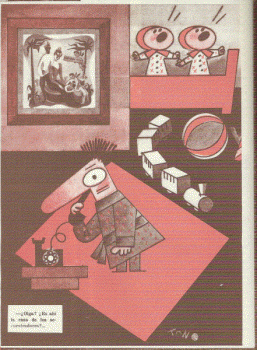
Today we are going to talk about a literary device that is part of Spanish culture: a mixture between “juego de palabras” (pun) and metáfora (metaphor), known as Greguería. The name was coined by the Spanish author Ramón Gómez de la Serna, one of the first writers to use this device. He was born in…
Ser vs Estar Posted by Transparent Language on Mar 26, 2010
One challenge for Spanish learners is distinguishing when to use ser or estar, both of which translate into “to be” in English. Generally, ser is used with adjectives expressing permanent characteristics (including nationality, physical appearance and personality) while estar is used for temporary states or conditions, such as emotions. Sometimes learners believe that a given…