


Archive for 'Grammar'
Word formation and the use of Arabic dictionaries Posted by aziza on Feb 27, 2009
Most Arabic words are formed based on a root and certain patterns. The root typically consists of 3 letters, e.g. (ك ت ب). These letters can be used in a number of formations or patterns to make derivations or words that are related in meaning to the root, e.g. (كاتب)“writer”, (كتابة) “writing”, (كتاب) “book”, (مكتبة)…
The Arabic Sun and Moon Letters Posted by aziza on Feb 14, 2009
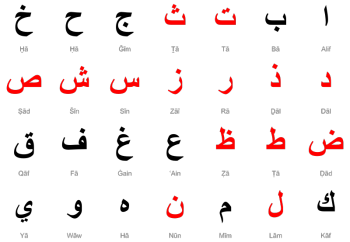
The Arabic alphabet (الأبجدية العربية) contains 28 letters, which are classified into 14 sun letters (الحروف الشمسية) and 14 moon letters (الحروف القمرية). This classification is based on the way these letters affect the pronunciation of the definite article (ال) at the beginning of words. The definite article is assimilated into the sun letters and…
Number Agreement in Arabic Posted by aziza on Feb 9, 2009
In English, words are either singular or plural, yet in Arabic, words can be singular (مفرد), dual (مثنى) or plural (جمع). Singular words refer to one person or thing only, dual nouns refer to two persons or things, while plural words refer to more than two. It is often the case that learners of Arabic…
Noun Gender in Arabic Posted by aziza on Feb 6, 2009
All Arabic nouns carry grammatical gender whether they refer to animate or inanimate objects. For living creatures, grammatical gender corresponds to biological gender, e.g. (رجل) “man” is masculine, while (امرأة) “woman” is feminine. For inanimate objects, the relationship between grammatical gender and objects is arbitrary, e.g. (كرسي) “chair” is a masculine noun, while (طاولة) “table”…
Arabic sentence structure: nominal and verbal sentences Posted by aziza on Jan 29, 2009
Arabic has 2 types of sentences: nominal and verbal. Nominal sentences begin with a noun or a pronoun, while verbal sentences begin with a verb. Nominal sentences have 2 parts: a subject (مبتدأ) and a predicate (خبر). When the nominal sentence is about being, i.e. if the verb of the sentence is ‘to be’ in…