

New: “Iran War Series” Arabic & Farsi Cohort Lessons: Week 1 Posted by cl150 on Apr 17, 2026 in For Learners
Keep your Arabic or Farsi skills sharp for the rapidly evolving situation in the Middle East.
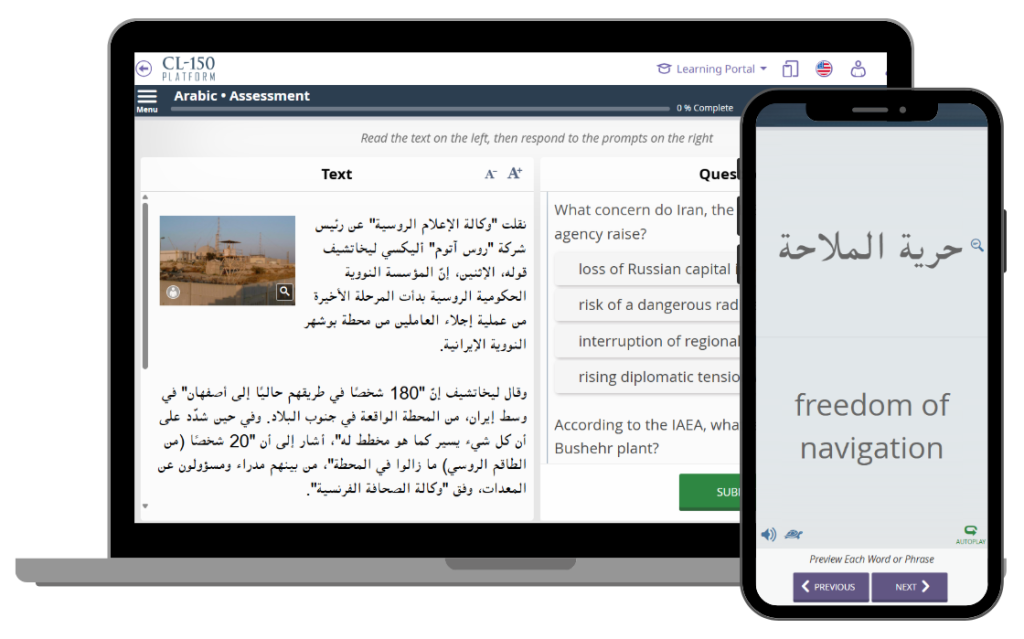 A new “Iran War Series” of CL-150 Cohort lessons is rolling out in Arabic and Farsi at ILR 2, 2+ & 3.
We are launching a special weekly lesson stream in MSA and Farsi that focuses exclusively on Iran and related regional developments. Each lesson is based on current authentic news sources, so your training reflects what’s happening in the world right now.
Six new lessons drop every Monday. One per level, per language.
Ready to get started? Jump into this week’s lessons:
| Language | ILR Level | Week 1 Lesson |
| Arabic (MSA) | ILR 2 | Iran War: Developments at Iran’s Bushehr Nuclear Power Plant |
| Arabic (MSA) | ILR 2+ | Iran War: How the Hormuz Blockade Plan Works |
| Arabic (MSA) | ILR 3 | Iran War: Regional Powers and the Strait of Hormuz |
| Farsi | ILR 2 | Iran War: US-Iran Standoff Continues After Negotiations |
| Farsi | ILR 2+ | Iran War: Qalibaf on Islamabad Negotiations |
| Farsi | ILR 3 | Iran War: The Failure of the Blue Shield |
What Is a CL-150 Cohort Lesson?
CL-150 Cohort lessons help professional linguists sustain the language skills they need most.
Each 60ish-minute lesson is built around authentic sources from the Arabic- and Farsi-speaking worlds, like news articles or op-eds. Topics span the domains that matter most for building cultural and regional expertise—politics, security, society, economy, and beyond—all drawn from what’s happening right now.
In a typical lesson, you can expect to:
- Build key vocabulary needed to understand current events
- Answer DLPT-style reading comprehension questions
- Explore historical, cultural, or political context surrounding recent events
How Do Lessons Vary by ILR Level?
Authentic Sources
Lessons are built around professionally rated texts matched to each level:
- ILR 2: Texts come from news briefs on straightforward topics that are explicit, fact-based, and non-technical.
- ILR 2+: Sources fall somewhere in the middle: think detailed news reports that incorporate opinions in the form of quotes or expert commentary.
- ILR 3: Texts are drawn from speeches, interviews, editorials, and other sources that include the author’s viewpoint, contradictions, and implicit information requiring careful interpretation.
Key Vocabulary
Each lesson introduces 10–20 vocabulary items calibrated to your level:
- ILR 2: Primarily single words, collocations, grammar patterns, and short phrases essential for understanding the text, often including secondary or extended meaning senses.
- ILR 2+: Proportionally more collocations, expressions, and idioms than at lower levels. Words are slightly lower in frequency and may be more technical, domain-specific, or carry extended meanings.
- ILR 3: A strong emphasis on longer phrases, expressions, idioms, and complex grammar patterns. Vocabulary carries extended meaning and cultural connotations, assumes insider knowledge, and is lower in frequency—equipping learners not just to understand the material, but to discuss it fluently.
Learning Activities
Activities are designed to challenge you at the right level:
- Reading Comprehension: At ILR 2 and 2+, questions focus on straightforward comprehension tasks like identifying cause and effect (3–5 questions per lesson). At ILR 3, questions also require identifying implied information and interpreting the author’s perspective.
- Paragraph Fill in the Blank — At ILR 2, blanked-out items are likely to be simple single words, often drawn from the lesson vocabulary. At ILR 2+ and 3, the blanks become longer phrases, collocations, or grammar patterns that must be understood in full context to complete correctly.
Sustaining another language? Explore the archive of CL-150 Cohort lessons in 14 languages. See what’s available in your language here
