


Archive by Author
Exploring the German letter ß Posted by Sandra Rösner on Oct 12, 2010
The German language has a letter that does not appear in its alphabet: the letter ß. Because of its shape the letter ß can be easily mistaken for a B. The ß, pronounced Eszett, is a ligature of the initial- and inner-s and the final-s of the German type font, which was used from the…
ME & YOU: “mir/dir” OR “mich/dich”? Posted by Sandra Rösner on Oct 6, 2010
Very often I can realize that learners of German struggle with using the correct form of the 1st person and 2nd person personal pronouns in the singular. Both “me” and “you” have each two translations in German. “Me” can mean either mich or mir and “you” can mean either dich or dir. The difference between…
German prepositions that require the accusative case Posted by Sandra Rösner on Sep 13, 2010
This is my final post on prepositions and their required grammar cases. German prepositions that require the accusative case are: bis – until; till entlang – along gegen – against um – for; to; in order; around durch – through für – for ohne – without wider – contrary to Usually, nouns themselves do not…
Do you know “wissen” and “kennen”? Posted by Sandra Rösner on Sep 7, 2010
When I communicate with people who learn German as a foreign language I can often recognize that they have some difficulties with using the German verbs “kennen” and “wissen” correctly. Unfortunately, these two verbs have only one translation in English, which is “to know”. Although “wissen” suggest the meaning of having a firm knowledge and…
Prepositions that require the DATIVE CASE Posted by Sandra Rösner on Sep 1, 2010
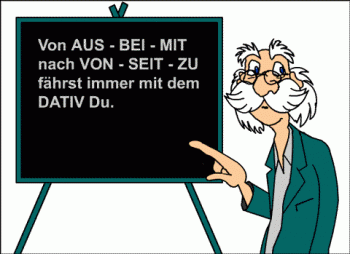
In one of my previous posts I started discussing about prepositions and which grammar cases they require for the following noun. In this post I am going to give some examples sentence with very common prepositions that require the DATIVE CASE. The German prepositions, which require the dative case are: aus, bei, mit, von, seit…
“Gute Zeiten, schlechte Zeiten” Posted by Sandra Rösner on Aug 18, 2010

Every day – from Monday to Friday at 7:45 pm – about 4 Million people in Germany turn on their TV sets to watch Germany’s most popular Seifenoper (soap opera) “Gute Zeiten, schlechte Zeiten” (Good times, bad times). I wonder why this show is so successful nowadays because when the first episode was broadcasted on…
Prepositions that require the genitive case Posted by Sandra Rösner on Aug 11, 2010
In my previous post, I explained to you the basic idea of the four German grammar cases. Remember: DOER-noun = nominative (carries out the action) POSSESSION-noun = genitive (belongs to DOER, INSTRUMENT or TARGET) INSTRUMENT-noun = dative (with what the action is carried out) TARGET-noun = accusative (receives the action) Unfortunately, the German language is…