


Archive for 'Language'
Wieso? Weshalb? Warum? – Why? Posted by Sandra Rösner on Oct 14, 2011
Wer? Wie? Was?Der! Die! Das!Wieso? Weshalb? Warum? Wer nicht fragt bleibt dumm! Tausend tolle Sachen, die gibt es überall zu sehen. Manchmal muss man fragen, um sie zu verstehen! Who? How? What?This! That! This!Why? Why? Why? Who doesn’t ask, remains dumb! Thousands of great things can be seen everywhere. Sometime you have to ask…
Der Lebenslauf – curriculum vitae Posted by jan on Oct 8, 2011
Maybe some of you might be in the situation to make an application for a job in Germany. Therefore I thought on helping you a little. So what does an application look like in Germany? Well, the answer is not that simple. It totally depends on the branch of trade you´re working for and, of…
Wie man Deutsch lernt!? – How to learn German!? (Part I) Posted by Sandra Rösner on Oct 7, 2011
Very often people ask how they can learn or improve their German. Thus, I decided to tell you something about language and language learning, hoping that it will help you to overcome all the obstacles you could face. First of all, you learn German like most languages, too. 1. Accumulation of vocabulary The first step…
Jugendsprache – Teenage Slang Posted by Sandra Rösner on Sep 30, 2011
People define themselves via the language they use. When young people reach puberty they try to distance themselves linguistically from their parents and other adults. This results in Jugendsprache (teenage slang). Jugendsprache develops fast because when the words have established within a linguistic system and even adults use the new created words in their speech…
Deutsche Modalverben – German modal verbs I: dürfen, können, möchten Posted by Sandra Rösner on Sep 2, 2011
Modal verbs modify an action or situation by expressing the ideas of permission, ability, obligation, necessity, etc. The six German modal verbs are: dürfen – may / to be allowed to können – can / to be able to möchten – to like to / to want to müssen – must / to have to…
The German prepositions “zu” and “nach” – “to” Posted by Sandra Rösner on Jul 15, 2011
Sometimes it can be very hard for learners of German to choose the correct preposition. This may be especially the case with the German prepositions “zu” and “nach”, which both mean “to” in English. Even some Germans have difficulties to distinguish “zu” and “nach” or use other prepositions when actually “zu” or “nach” are obligatory…
Instruments – Instrumente Posted by jan on Jul 1, 2011
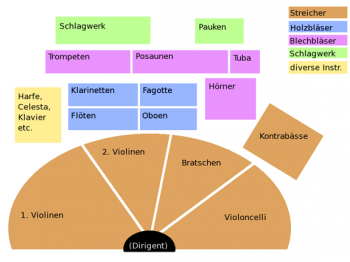
Hey there, as I promised, there will be a blog post about instruments. So let´s start the classic way and have a look at an Orchestra. In it´s main parts it consists of the following instruments: der Dirigent – conductor die Violine/die Geige – violin die Bratsche – viola das Violoncello – violoncello der Kontrabass…