


Do you know “wissen” and “kennen”? Posted by Sandra Rösner on Sep 7, 2010
When I communicate with people who learn German as a foreign language I can often recognize that they have some difficulties with using the German verbs “kennen” and “wissen” correctly. Unfortunately, these two verbs have only one translation in English, which is “to know”. Although “wissen” suggest the meaning of having a firm knowledge and…
Prepositions that require the DATIVE CASE Posted by Sandra Rösner on Sep 1, 2010
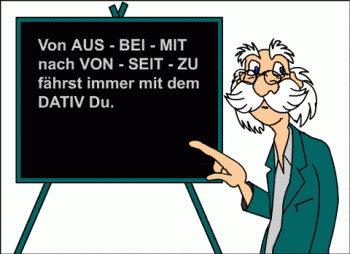
In one of my previous posts I started discussing about prepositions and which grammar cases they require for the following noun. In this post I am going to give some examples sentence with very common prepositions that require the DATIVE CASE. The German prepositions, which require the dative case are: aus, bei, mit, von, seit…
Zungenbrecher – Tongue Twister Posted by jan on Aug 24, 2010
Today I want to introduce some German “Zungenbrecher” to you. I guess they exist in many languages but as you want to learn German this might be a funny alternation. Mostly the Zungenbrecher don´t make many sense but help to train pronunciation…and also laugh about the mistakes you make.
“Gute Zeiten, schlechte Zeiten” Posted by Sandra Rösner on Aug 18, 2010

Every day – from Monday to Friday at 7:45 pm – about 4 Million people in Germany turn on their TV sets to watch Germany’s most popular Seifenoper (soap opera) “Gute Zeiten, schlechte Zeiten” (Good times, bad times). I wonder why this show is so successful nowadays because when the first episode was broadcasted on…
Bicycle Tour Posted by jan on Aug 17, 2010

Some months ago I posted an article about Lake Constance (Bodensee), the biggest See (lake) in Germany. Maybe some of you remember. Due to my long summer holidays, now I had the chance to experience the lake another way as gewöhnlich (usual): Spontaneously my wife and I decided to circle the lake by bike!
Prepositions that require the genitive case Posted by Sandra Rösner on Aug 11, 2010
In my previous post, I explained to you the basic idea of the four German grammar cases. Remember: DOER-noun = nominative (carries out the action) POSSESSION-noun = genitive (belongs to DOER, INSTRUMENT or TARGET) INSTRUMENT-noun = dative (with what the action is carried out) TARGET-noun = accusative (receives the action) Unfortunately, the German language is…
WHO is doing that to WHOM with WHAT and WHOSE is it at all? – The four German cases Posted by Sandra Rösner on Aug 6, 2010
Most learners of German seem to struggle with the language’s grammar cases. In this post I am going to explain why these cases exist and what they mean. The crucial element of every sentence is the verb, since it names a particular action. In this action, there are always specific subjects and objects (nouns) involved…