Archive for 'Culture'

Which Great Wall is the Greatest?

Posted on 19. Jun, 2013 by in architecture, architecture and landscaping, Culture, history

Seeing as how this month has already featured a few posts on the most famous Wall in the world (sorry, Berlin Wall) – the Great Wall Music Festival, how to sleep on the Great Wall, and a video highlight of said overnight camping trip – I figured we’d just keep on going. As I have previously mentioned, there are many options for visiting the Great Wall (长城 – cháng chéng) from Beijing. The most developed section – which is also the easiest to go to and thus the place most tour buses pull up to – is Badaling (八达岭 – bā dá lǐng). I’ve never been to Badaling myself, but I’ve seen the photos and heard the stories, and it just doesn’t appeal to me. I’d rather see nothing but the landscape than hordes of people pushing for a photo opp when I visit the Great Wall. In my years living in Beijing, I have managed to visit many sections of the Wall. To give you a better idea of what your options are and how to make these trips happen, here’s an introduction to five different sections of the Great Wall of China:

Mutianyu (慕田峪 – mù tián yù)

Near the wall at the Mutianyu Village.

Next to the Badaling Great Wall, Mutianyu is probably #2 in terms of its development for tourism. There’s both a cable car and a toboggan to take visitors up and down, which are great if you’re feeling lazy or just want to have some fun sledding down the Great Wall. You’ll find plenty of touts both outside of and on the Wall, trying to sell you all sorts of stuff. There’s even a Subway right near the entrance. So yeah, it’s pretty developed (and not necessarily in a good way, if you ask me). That being said, it is still a great hike along the Wall with stunning views of the surrounding hills (on a clear day, of course). The path has been restored here, so it’s not too adventurous – just a lot of up and down stairs. Slick Willy Clinton even visited the Mutianyu Great Wall, which he apparently said was “very beautiful, very grand, more beautiful and grander than what I imagined.” It’s pretty easy to get here from Beijing via public bus, and there are also a variety of guesthouses and restaurants in the surrounding villages so you could even stay for dinner or overnight.

Transportation: Take bus #867 from Dongzhimen at either 7 AM or 8:30 AM. If you miss those, just jump on bus #916, take it to Huairou county, and change to either a mini-bus or cab.

Cost: An entrance ticket is 45 RMB for adults and 25 for children. The cable car and slide both cost extra, and you can buy one-way or round trip tickets.

Walking along Mutianyu.

Nice, restored watchtower on the Wall.

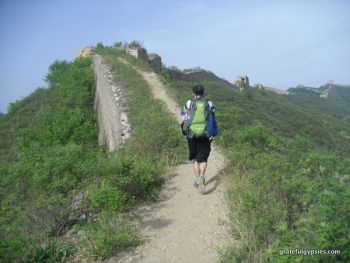
A not-too-strenuous stroll on the Wall.

Jiankou (箭扣 – jiàn kòu)

Wild Jiankou in the winter.

This section of the Wall actually connects with Mutianyu, and it is far less developed and thus much less crowded. You will not find a ticket office here; however, you will find a local villager charging a few kuai for hikers to use his homemade step ladder in order to access the Wall. The steep mountains, beautiful scenery, and overall rugged feel of the Jiankou section make it a great place for those more interested in challenging hikes and adventure than simply getting that “I climbed the Great Wall” t-shirt. Camping is also allowed on this part of the Wall, so you could bring your tent and sleeping bag along for a real adventure. Many hiking groups often make a Jiankou to Mutianyu trek, which I did a few years ago and can highly recommend. Otherwise, it’s still possible to get yourself there by a mixture of buses and cabs.

Transport: Take either bus #916 or #936 from Dongzhimen and get out to Huairou. Just have the name of the Jiankou Great Wall written out in Chinese or saved on your phone, and someone will either point you to a mini-bus or offer to drive you there. Be sure to haggle, as drivers tend to rip off tourists.

Cost: You may have to pay a local guy 2 RMB to use his ladder, but that’s about it!

The only entrance ticket you'll have to buy here.

Don't come here expecting a restored and paved path.

Incredible views at Jiankou.


Huanghuacheng (黄花城 – huáng huā chéng)

Beautiful views at the Yellow Flower Wall.

As the entire village underneath this section of the Wall is immersed in a sea of yellow flowers during the summer months, it is called the “Yellow Flower Wall.” While the initial climb up is steep and difficult (bring plenty of water in the summer), the views from the top more than pay off. At this section, you’re treated to views of the hills and a lake. Hiking along is relatively easy at times, and quite difficult at others. This one is definitely for those with a higher level of fitness – no cable car or slide here. It’s also located in Huairou district, so it’s convenient to get there from the city center.

Transport: Get yourself to Huairou first on bus #916 and then switch to a mini-bus or cab.

Cost: An entrance ticket costs 34 RMB.

Looking down from the top.

Mountain peaks off in the distance.

Our guide leaving us all far behind.

Jinshanling (金山岭 – jīn shān lǐng)

Sunset over the mountains and the Wall - picture perfect.

This section includes a longer trek than the others, as it is actually located in Hebei province about 125 km northeast of Beijing. Parts of the Wall here have been restored, while others are falling apart; this makes for an interesting contrast and some great photo ops. Previously, you could hike from Jinshanling to Simatai, which involved crossing a suspension bridge and then having the option of taking a zipline ride down over a small lake. As Simatai is under construction, this option is not available at the moment, but it will supposedly be back this October. Alternatively, you can hike the other way and go from Jinshanling to Gubeikou. I camped here back in 2009, but on a recent visit we saw a sign that said “no camping,” so I’m not sure if the rules have changed since then.

Transport: There’s a special tourist bus that runs here from a long distance bus station just north of the big hub at Dongzhimen. It only operates on the weekend and it leaves at 7:30 AM sharp, so don’t miss it! Otherwise, you’re going to get stuck paying a hefty fee for a cab from Miyun county (200-300 round trip).

Cost: It’s 65 RMB/person from March to November, and 55 in the winter.

A bit more difficult of a hike than other sections.

Hanging out in an old watchtower.

Ziplining down after hiking from Jinshanling to Simatai.


Gubeikou (古北口 – gǔ běi kǒu)

It's a beautiful day for hiking at Gubeikou!

At the Gubeikou Great Wall, there are two different areas you can visit – the Crouching Tiger Mountain (卧虎山 – wò hǔ shān) or the Coiling Dragon Mountain (蟠龙山 – pán lóng shān) – this one obviously wins for the coolest name. You will not find huge crowds out here, just small groups of hikers in the morning. If you wait until the afternoon to visit, you may find the Wall to be devoid of people as far as the eye can see. The scenery here is absolutely stunning on a clear day, and there’s one watchtower that has been restored and makes a perfect place to set up a tent and sleep under the stars. It takes a little bit longer to get here than other sections, but the extra time spent on the bus definitely pays off.

Transport: From Dongzhimen, take bus #980 out to Miyun County. Get off at the Drum Tower and then switch to mini-bus #25. Take it to the end, and you’ll be right there near both sides of the Wall. You might need to pay a driver 10 RMB or so to take you to the gate.

Cost: A ticket is 25 RMB/person here.

An amazing place for backpacking.

Sunset at Gubeikou.

And sunrise.

Wherever you decide to go, you really can’t go wrong with an excursion out to the Great Wall. I’m often amazed when I meet local Beijingers who have never even been to the Wall (plenty of my students fall into this category); at the same time, they’re always amazed to hear that I’ve been there over 10 times to multiple sections, for hiking, camping, and even a music festival. If you have any questions, comments, or tips to share about visiting the Great Wall, please feel free to leave them here!

Top 10 Places in Beijing – 798

Posted on 15. Jun, 2013 by in architecture, architecture and landscaping, Art, Culture, history, sightseeing, travel

We’re counting down the Top 10 places in the Chinese capital here, based on my experience living here for over 4 years. With so many interesting places to visit in Beijing, it’s been tough whittling the list down to just ten. In the first post, we explored the student hangout of Wudaokou, which features some of China’s most renowned universities, delicious food, and a wild nightlife scene that ensures plenty of students show up for class late and hungover. Today, we’re heading to the complete opposite side of town to get artsy.

#9 – 798 Art District (798艺术区 – qī jiǔ bā yì shù qū)

798 - Beijing's thriving art district.


Located in the northeast part of Beijing is the hip art area known simply as 798. The name comes from one of many factories which once flourished in this area under the large umbrella name of the Joint Factory 718. Ground broke on this new factory district back in 1954 in a three-way Communist Power Trio partnership of China, the Soviet Union, and East Germany. At one point, it was one of the best places to work in China, as workers enjoyed vast social benefits, such as: sports teams, an orchestra, literary clubs, and the best housing for workers in Beijing. Thousands of people worked here producing a variety of both civilian and military equipment. Maoism study workshops ensured that the army of workers remained loyal to the Party, and some of Mao’s famous slogans can still be seen painted on the ceilings today.

The old factory's exterior still remains.


Old Maoist slogans remain.

Step forward in time a bit, and the area experiences drastic changes under Deng Xiaoping and his policy of “Reform and Opening Up” (改革开放 – gǎi gé kāi fàng). It lost support from the government and gradually declined, with most workers being laid off and most factories closed in the early ’90s. As luck would have it, Beijing’s underground art community was, at the very same time, evicted from their space on the other side of the city and in search of a new place to call home. Throughout the decade, more and more artists (both Chinese and foreign) began moving in, setting up galleries, shops, and cafes.

One of the many buildings housing artwork in 798.


Funky art is everywhere you look.

Today, 798 is one of Beijing’s most popular attractions, drawing in locals, tourists, art aficionados, and plenty of Chinese couples looking for quirky wedding photos. As most galleries are free of charge, it’s a great place to spend a day without spending much kuai. Of course, there are plenty of ways for you to part with your RMB – artworks are for sale in most galleries, plenty of shops line the streets, and a wide variety of cafes, restaurants, and bars can be found. Taking in the modern, often times avant-garde artwork makes it hard to believe you’re in the same country that experienced Chairman Mao’s Cultural Revolution not too long ago. Controversial artists such as the Gao Brothers display pieces of art that would have had them sent to labor camps a generation ago. It really is incredible to see how far China has come in terms of its art scene and freedom of expression, although they still have a long way to go.

Yes, that is Chairman Mao with boobs. By the Gao Brothers.

Old and new China collide in art.

Big exhibits change often and artists are always coming and going, making 798 a place you could feasibly visit once a month and find something new every time. Meandering through the streets, dropping into any gallery that looks interesting, snapping photos, taking in the post-industrial vibe of the Maoist China of old, and then kicking back with a nice cup of coffee to chat with friends makes for a great day in Beijing.

Elaborate outdoor exhibit on display in 798.


Buddha resting atop a pile of old clothing.

Once in a while, you’ll even find special shows, concerts, and parties going on within the 798 area. In past years, local electronic music labels have thrown a variety of huge bashes here, such as the Intro Festival and the legendary YEN parties. The artistic mega-event called the Creator’s Project has even rolled through 798 on its way around the world.

YouTube Preview Image

A short video from the Creator’s Project in Beijing

With art, drinks, music, architecture, food, history, shopping, and more, it would be hard for someone to come to 798 and not enjoy themselves. It’s definitely one of my favorite places in the Chinese capital, but it only managed to come in at #9 on my list, which begs the question – which eight places in Beijing are somehow even cooler than this one? You’ll just have to stick around and find out!

YouTube Preview Image

Take a video tour of 798!


Camping on the Great Wall (Video)

Posted on 13. Jun, 2013 by in architecture, Culture, history, sightseeing, travel

The Great Wall of China is one of the new Seven Wonders of the World, and rightfully so. While there are many options available for visiting the Great Wall, nothing compares to an overnight camp out in one of the Wall’s many watchtowers. Watch the sunset and sunrise over the hills in the distance, and enjoy hiking along a wild section of the Great Wall in this video.

YouTube Preview Image

背包 – bèi bāo
backpacks

三明治 – sān míng zhì
sandwiches

密云 -  mì yún
Miyun

面包车 – miàn bāo chē
van (lit. “bread car”)

古北口长城 – gǔ běi kǒu cháng chéng
Gubeikou Great Wall

吃午餐 – chī wǔ cān
eat lunch

望楼 – wàng lóu
watchtower

搭帐篷 – dā zhàng péng
set up a tent

睡袋 – shuì dài
sleeping bag

日落 – rì luò
sunset

威士忌酒 – wēi shì jì jiǔ
whiskey

百事可乐 – bǎi shì kě lè
Pepsi

日出 – rì chū
sunrise

豆腐,拍黄瓜,西红柿炒鸡蛋,炸酱面,大包子
dòu fu, pāi huáng guā, xī hóng shì chǎo jī dàn, zhá jiàng miàn, dà bāo zi
tofu, cucumbers, scrambled eggs and tomatoes, fried sauce noodles, big stuffed buns

干杯 – gān bēi
Cheers!