


Hwaiting: ‘Fighting’ Posted by Transparent Language on May 22, 2008 in Vocabulary
Far from a battle cry, 화이팅 hwaiting is a commonly used word of encouragement, as well as a cheer. I’m told it made its way into Korean from its obvious English origin via the Japanese—and hence the unusual pronunciation. Language purists insist that it should be spelled 파이팅 paiting to reflect a closer approximation to the English word fighting. (As I typed 화이팅 above, and again here, the spell check tried to change it to 파이팅!) However, it’s universally pronounced hwaiting and so you will encounter both spellings. Although in use for decades, it’s inclusion into dictionaries has been met with some reluctance, still considered merely slang.
You’ll often hear Koreans try to translate 화이팅 as fighting, understandably, but we can actually translate it a couple of ways, depending on the situation…
At sporting events, the crowd will cheer on their team with 화이팅, sometimes preceded by 아자, 아자! aja aja! just to get pumped up, and in international matches: 대한민국, 회이팅!! daehanmin-guk, hwaiting!! or even 코리아 화이팅!! koria hwaiting!! Go, Korea!!
To wish someone luck before a difficult endeavor, such as before a test, parachuting out of a plane or approaching a woman in a bar! 파이팅! hwaiting! Good luck!
If you are looking for more materials to help you learn the Korean language, check out transparent.com for free resources like Korean Word of the Day and our Korean Facebook community, or try the new free trial of our self-guided online Korean language course.
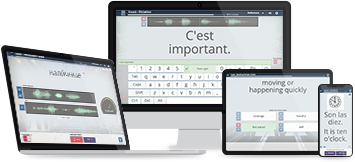
Build vocabulary, practice pronunciation, and more with Transparent Language Online. Available anytime, anywhere, on any device.


About the Author: Transparent Language
Transparent Language is a leading provider of best-practice language learning software for consumers, government agencies, educational institutions, and businesses. We want everyone to love learning language as much as we do, so we provide a large offering of free resources and social media communities to help you do just that!
Comments:
j:
This is very interesting. 🙂
Clint:
파이팅!
tina:
World Cup 2010; Dae Han Min Guk hwaiting!
boo:
wow first hit on google for “korean fighting”… which is what i was looking for… hear this a lot on korean dramas… it’s my favorite korean saying.. i always get a chuckle when i hear it…. at first i thought they were really saying “fighting” (in english).. then i realized.
great explanation thanks!! hwaiting!!
brian:
My wife and I are korean. She’s first generation, I’m 2nd and can’t speak korean well. I grew up neglecting my korean background all the way through college and into my career. But after meeting my wife of 7 years now, I’ve been embracing anything korean. I regret my past.
My wife was sick recently, so before I left for work, I made sure she was nice and comfortable, had the things she need next to her, kissed her, and said,
“Fighting!”
She whispered “Fighting!” back to me with a smile.
Fluent Korean:
Great Post! http://www.fluentkorean.com
Chris:
I’ve always thought it sounded like “fighting!” from k-dramas until someone corrected me. It’s one of the konglish expressions that confuse native English speakers.
아기:
I hear this all the time!
화이팅!
=D
mizzleli:
you Koreans must be proud of this, because it has brought you to the eyes of the world. I’m from Malaysia and i know this through K-dramas. this is a very unique type of culture 🙂
Herro:
I am overflowing with fighting!
yhayhen03:
화이팅 hwaiting UKISS!
Tetsuo:
OK, but WHY do they say “hwaiting”? Where does it come from and why does it mean what it does?
Nita:
– What was the war over?
– Any other information?
manila gehl:
can i just a question about korean language? coz in the kdrama coffee prince, how did the characters refer to yoon eun hye’s character? i mean, what pronoun did they use? coz i saw somewhere online that third personal pronouns in korean language are also gender specific,like in the english language? in some of the english subs of the kdrama, she was alternately referred to as her or him which would have been a dead giveaway. i was wondering if it really was so in the korean dialogue. thanks in advance for answering.
Asuka:
wow thanx for sharing… ^^ MBLAQ 화이팅 !
iluvkorea:
Hmmmmmm…… I am from Malaysia and a shawol, and I have always heard the word hwaiting but never knew what that meant… I guess now I know!!
Hector Liberti:
I discovered your blog site on google and appearance a few of your early posts. Keep up the outstanding operate. I simply extra the RSS feed to my MSN News Reader. Seeking for forward to reading far more on your part later on!’¦
noplacelikehome:
@manila gehl 17 February 2012 at 1:56 am:
Koreans can refer to someone in third person without revealing the sex by using “gue” or “gye”. When we want to specifcy, we can say “gue namja” for male and “gue yuja” for female.It’s very commone to use the asexual third pronouns.
ubezpieczenie turystyczne usa:
I have learn several excellent stuff here. Definitely value bookmarking for revisiting. I surprise how so much attempt you set to make such a fantastic informative website.
ارشفة:
Attractive section of content. I just stumbled upon your weblog and in accession capital to assert that I acquire in fact enjoyed account your blog posts. Any way I’ll be subscribing to your feeds and even I achievement you access consistently fast.
florida cheap auto insurance:
Hi there! I could have sworn I’ve been to this website before but after looking at some of the articles I realized it’s new to me. Anyways, I’m definitely happy I stumbled upon it and I’ll be bookmarking it and checking back often!
شات ليبيا:
Attractive section of content. I just stumbled upon your weblog and in accession capital to assert that I acquire in fact enjoyed account your blog posts. Any way I’ll be subscribing to your feeds and even I achievement you access consistently fast.
case vendita:
Wow that was unusual. I just wrote an incredibly long comment but after I clicked submit my comment didn’t appear. Grrrr… well I’m not writing all that over again. Anyways, just wanted to say great blog!
payday loans:
Simply desire to say your article is as amazing. The clearness in your post is just cool and
i can assume you’re an expert on this subject. Fine with your permission let me to grab your feed to keep updated with forthcoming post. Thanks a million and please carry on the rewarding work.
Giovanni Geesey:
I savour, result in I discovered just what I was having a look for. You have ended my 4 day lengthy hunt! God Bless you man. Have a nice day. Bye
Carlita Cicatello:
Great article and right to the point. I am not sure if this is actually the best place to ask but do you guys have any thoughts on where to hire some professional writers? Thanks in advance.
iOS Town:
iOS download info is now avail now, you can check also know about it.
Chris:
To me, it sounds more like something between “hwhiting” and “(p)iting” — essentially I NEVER hear the “a” part. This is another case where I think the pronunciation is different (like with words in English or any other language) than the spelling and the Romanization.
I’m glad Koreans tend to translate it as “fighting”. I like keeping cultural idioms in tact. It’s easy enough to pick up the meaning from the context and body language. I first encountered it in Korean dramas, and it quickly became apparent that it was an expression of solidarity or support or encouragement, like “Go get ’em!” or “Keep it up!” or “You/We can do it!” There are LOTS of suitable English expressions it could be translated to, but I’m glad the idiom perseveres in most translations I see.
Really great to see the history and the details on the word, though. Nice post!
Kootaka:
In 1993 out side the main gate for Yongsan Military Garrison, I cheered “Fighting!” after being interviewed by Korean news after a handful of ROK and US military saved two South Korean teenagers from the sex trade. My Korean was awful. “Fighting!” to all come together for a common cause so that we all can triumph. – That’s my definition.
“Fighting!”
Crystal:
“Fighting” feels more encouraging to me than “good luck.” “Fighting” tells me to be more proactive, whereas “good luck” is more like a blessing that may or may not come to pass.
Buddy:
화이팅 여자친구(Hwaiting Yeoja Chingu/Gfriend)
Jamie:
“To wish someone luck before a difficult endeavor, such as before a test, parachuting out of a plane or approaching a woman in a bar! 파이팅! hwaiting! Good luck!”
I’m confused because you wrote hwaiting, but wrote 파이팅. Just wondered if it was a typo. Thanks! Great Article!
Tony Kitchen:
@Jamie Hi Jamie!
Thanks for your comment. There are basically two ways to write this word, since it is the Hangul version of the word “Fighting.” Since there isn’t an “F” in the Korean language, it is either written as 화이팅 or 파이팅, depending on the pronunciation or spelling preference. Both are equally correct and understood.
abe:
화이팅 is Korean spelling of fighting. It should have been “fight on” i.e. an encouraging cheer for continued struggle for success or improvement. Probably it is “keep on fighting” abbreviated / mangled into 화이팅(fighting).
Trojans, Fight On ! — USC
And we’ll keep on fighting ’til the end. — “We Are The Champions” Queen
Asian Apple:
It actually IS a battle cry – not simply wishing someone good luck. It puts you in a stronger frame of mind, like “yes you can do it!!” “yes we can do it!” A battle cry in the sense that the obstacle to be overcome will be tackled as if you are a soldier. It’s closely linked to the Italian “into the mouth of the wolf!” in spirit 😉