Archive for November, 2008

Introducing: «Советский анекдот» [the Soviet Joke]

Posted on 29. Nov, 2008 by in Soviet Union, Uncategorized

Russia is not only terribly fascinating just because it is the wildest, most chaotic and most unpredictable place on the face of the Earth, but also because it was once home to another country – yes, you guessed it – the Soviet Union. It is difficult to sum up the Soviet Union in a short sentence, so let’s just say that it was the biggest country in the world. In this aspect it’s got nothing on Russian Federation because Russian Federation is also the biggest country in the world. Nowadays. But RF reminds a lot of USSR, though one must not mistake the one for the other, or the other way around – the other for the one [this rule applies not only to politics, but also to dating]. In USSR life was, so they tell me, very illogical. Today life in RF is not any less illogical, I would like to add, but, they say, there is a big difference here – in RF one can say whatever one might want to say (though I’d fight them on this one), whereas in USSR – not so much. From this – the impossibility of speaking one’s mind in combination with an utterly absurd reality, that demanded at least some kind of reaction – were created a great cultural phenomena: «Советский анекдот» [the Soviet Joke]. A long time ago in a galaxy far away I collected Soviet jokes. I managed to collect 116 until I stopped. I collected them in English, because I did not speak Russian at the time. But I’m sure that if I would start with this hobby again, but in Russian, I would find many more in a much shorter amount of time. (Keeping in mind how much larger the internet itself has grown since way back when.) Today I want to share a couple of them with you. If you have any Soviet jokes of your own, in Russian or in English, feel free to share them here in the comments! Laughter prolongs life, I was taught in school – and even more so is laughter needed in times of economic crisis as it is… absolutely for free.

It is perfectly normal to feel confused as to where one is currently located in Russia, especially as signs of ‘the old country’ are abundant and ubiquitously. Like for example on the ceiling of Novosibirsk’s train station.

1. Son: What will communism be like when it is perfected?
Father: Everyone will have everything they need.
Son: But what if there is a shortage of meat?
Father: Then there will be a sign over the butcher’s shop saying “nobody needs meat today”.

2. What are the last six pages of a Lada user’s manual reserved for?
The train and bus timetables.

21. In America, you watch television. In Soviet Union, television watches you.

22. In America, you check books out of library. In Soviet Union, library
checks you out.

23. In California, you can always find a party. In Russia, The Party can always find you.

41. An American and a Soviet soldier kill each other and end up at the pearly gates
at the same time. Peter says “well, we have national division in hell as well,
but you may choose where you’d like to go. There is an American hell and a
Russian hell.”
American: what’s the difference?
Peter: well, in the American hell you have to eat a shovel of shit a day.
Russian: and in Russian hell?
Peter: two shovels of shit.
American: I’ll go to American hell.
Russian: well, two shovels of shit, it’s not nice, but I was a Russian alive
and I died a Russian and I’ll go to Russian hell.
Millenniums later, the same two soldiers end up doing sentry duty at the
checkpoint at the border between American and Russian hell at the same time.
Russian: Hi hi hi! How you doing! Long time no see!
American: Hey! How are you, you look good!
Russian: how is it over there in American hell?
American: oh, one shovel of shit a day, you get used to it. How about Russian
hell?
Russian: well, you know how it is, one day there’s no shit, the next day no
shovels. . .

58. Will there be KGB in communism?

No, by then people will have learned to arrest themselves.


88. What’s the difference between a Christian and a Communist?

The Christian hopes to get to Paradise after death, and the Communist – to be posthumously rehabilitated.


92. What is Russian business?

Stealing a box of vodka and selling it so as to have money to spend on drink.


And this one is my personal favorite…

102. In a Soviet school, the teacher talks about Lenin. Suddenly, one student asks her a question: “You personally knew Comrade Lenin, could you say anything good about him?” The teacher thinks for a long while and replies: “One day Comrade Lenin was peeling a skin off an apple with a knife, and a hungry child came to him and asked for a piece of the apple. Comrade Lenin told him to go to hell” Seeing the surprise on the faces of her students, she added: “You see, he could have cut the little bustard, and he did not, that’s how good he was.”

Seeing Things “Russianly”, or «Языковая картина мира»

Posted on 26. Nov, 2008 by in language

It doesn’t happen too often, but sometimes it does, and when it does, the joy I feel knows no boundaries – I’m talking about the rare occasions when what I’m studying at the Master’s Program in Russian Literature coincides with a current event in the real world. Or, as was the case this time; with an article in my favorite source for a weekly dose of Russian news. Last Thursday we discussed the problem with «языковая картина мира» in my linguistics class [I translated this into English as "linguistic worldview", but when I googled it I got nothing, according to wiki it is something close to linguistic determinism'], and when I opened the fresh number of «Русский репортёр» I got rather ecstatic when I found an article called «Картина мира, нарисованная языком» [‘A painting of the world, painted with language']. And even though I know this post will be a little bit too long, and that I should’ve broken it up in two, I really don’t want to, because I’m too exited and can’t wait to share it all with you! This is something I’ve been thinking about a lot, ever since I came to Russia, and realized that the world around me in Russian was very different from how the world around me had been in Swedish (and I’m not just talking about the sheer fact of dissimilarities between life in Gothenburg and life in Siberia), but even Sweden was different in Russian, and Russia was different in Swedish. In class I gave the other, all Russian, students the following example from when I first realized that we look at things differently: One spring day in Omsk my Russian friend told me: «Сегодня на улице грязно» [It is dirty outside today.] I looked at the street, but I still couldn’t understand, so I told her: «Нет, там просто мокро» [No, it's just wet there.] What my Russian friend meant was that the street was muddy (due to large amounts of snow melting), but she used the word «грязь» [dirt] for this, as the melting snow was rather dirty after lying next to heavily trafficed roads for over four months. But in my Swedish head the combination dirt (smuts) + nature is impossible; nature is always clean in Swedish. But it didn’t take me long to see things “Russianly” in this case – a few days and a couple of cleanings of my shoes later and I made peace with the fact that streets in Russian can be ‘smutsiga’ [dirty] indeed.

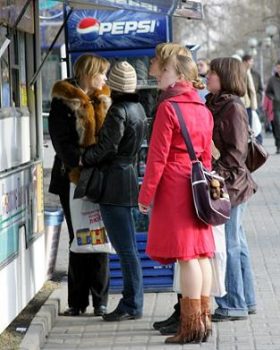
This doesn’t really have anything to do with this post, other than that this fact may help you to ‘see things Russianly’ – don’t be surprised if a Russian will ask you if you’d want some «пипси» [pipsi] instead of some «пэпси» [pepsi]. This is due to the stress falling on the -i in this word, turning the -e into an -i, thus following rules of Russian phonetics.

The article has the sub-title of «Толковый словарь как путеводитель по национальному характеру» [The Defining Dictionary as a Guide Book to National Character] and compares Russian words with words in English and Japanese. The basis for it is the Sapir-Whorf hypothesis that a “particular language’s nature influences the habitual thought of its speakers: that different language patterns yield different patterns of thought”. In other words – what we call something decides how we perceive this particular thing. If you’ve got an old wooden boat it’ll work much if you start calling it ‘your yacht’, that is. The article contains comparisions of the following words in these three languages, keeping in mind the context of national character:

«Корысть, [profit; advantage; gain; self-interest] выгода» [profit; gain; benefit; advantage]

«Долг, [duty] обязанность» [duty; responsiblity]

«Правда, истина» [truth]

In Russian there’s a difference between truth and truth. There can be many truths when you’re talking about «правда», but when it comes to «истина», then ‘she’ can only be one, and more often than not there’s a little ‘holiness’ to her, and she’s not to be understood by people.

«Радость, [joy; gladness] удовольствие [pleasure], наслаждение» [delight; pleasure; enjoyment]

«Счастье» [happiness]

Perhaps the fact that Russians are among the most unhappy people in the world – according to international statistics, that is – can be blamed on the question «Ты счастлив/а being far from as easy to answer positively as the English version: «Are you happy?”

«Собираться» [to gather, assemble; to collect; to prepare; to get ready; to be about to; to intend to]

This last verb, which in Russian doesn’t have to lead to any result at all, when in English, for example, saying: “I’m going to fire!” mean you’re really about to fire, whereas the Russian translation: «Я собираюсь стрелять!» doesn’t sound threatening at all… In Japanese, however, there is no such action; the whole article ends with the author trying to explain to the advisor on Japanese language at Moscow State University without any luck because – «мол, у него другая картина мира» [he has another linguistic painting of the world].

And to this I, as a native speaker of Swedish, can relate to. There is no such action called «собираться» in my native language [only in the meaning of ‘gather a group of people together somewhere' can it be translated]. In Swedish you’d in this context use one of the two kinds of constructions to make the verb in future tense; either the one that’s for actions depending on you, or the one that’s for actions depending on others or the universe, thus being ‘out of your control’. Or just use the verb in present tense – which is actually just a third way of expressing the future tense in Swedish… Simple, isn’t it?

While In Russia Beware of… Windows?

Posted on 21. Nov, 2008 by in Culture, language, Traditions

In the world of silly/strange/solicitous statistics, apparently, Russia is – rather unexpectedly, I must admit – the leader when it comes to the number of people that fall out of windows on a daily basis. In Russia 17 people fall out of windows daily. I had almost forgot how to smile, let alone laugh, at the peculiar wonders of Russian reality, when a fellow Gothenburgian’ girl from the Swedish Embassy in Moscow, visiting Yekaterinburg for the ‘Days of Sweden’ in our city, told me this today during lunch. Until I have found any firm facts to confirm this statement it will remain within the category of «анекдоты» [anecdote; jokes; funny stories], [I've been googling myself mad today to find the source for this information, but failed helplessly. If you've heard of it or know where it's from, please let me know!] but it still makes you think, doesn’t it?

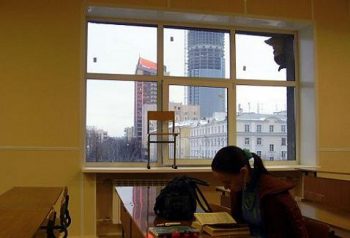
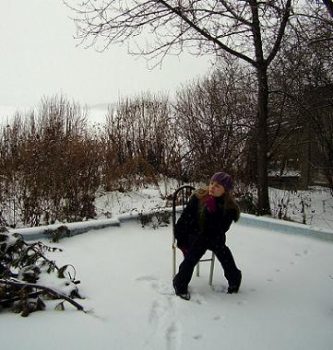
On the picture above is a textbook example of the way Russians deal with windows. In this case it is rather clear why the average Ivan Ivanov might mistake this chair for seating, instead of a way of keeping the window ‘a teeny tad bit’ open. The results will, «в натуре», be disastrous!

As I am always trying to understand Russia through Russians – «узнать Россию через русских» – and not from jumping to conclusions, I decided to ask some Russians about this, and hear their point of view on the issue as to why their nation has a tendency to fall out of windows.

The first one said: «Это потому, что русские самы моют свои окна, а не клининговая компания!» ["It is because Russian themselves clean their windows, and no cleaning company!"]

The second one said: «Нет, это потому, что у русского человека всегда был, будет и есть стремление к полёту. Поэтому и пьют, коли из окон не падают.» ["No, it is because the Russian (person) always had, always will have and has a yearning to flight (i.e. yearns to fly). That's why they drink, if they're not falling out of windows, that is."]

Then the second person added: «Либо сначала напьются, и потом выпадут, либо просто напьются, и этого и так хватает для полёта…» [Either they first get drunk, and then fall out (of windows), or just get drunk, and that's enough as it is for a flight...]

Whatever the reason may be for this, uhm, phenomena – I myself thought perhaps it had something to do with the current financial crisis and people jumping away from their problems to an instant relief in death from sky scrapers in Moscow, but I may be wrong – there is indeed a lesson in this for everyone to learn. Beware of windows, especially while in Russian Federation. Do not let any people in Irkutsk lure you to lean out of their window to look at the sky on a starry night just because – «ах, красота какая!» Be careful when cleaning windows in the Volga region, you never know just how slippery soap can be until it is too late. And when tightening those cracks in the Soviet windows of your room in a dormitory in the Urals, make sure not to open them any more than necessary.

The last advice concerns a very much present problem for me – as winter draws closer and the temperatures drop I might have to do just that this weekend or I’ll be waking up with frost on my eyelashes and that, let me tell you, is overrated.