Archive for 'Thailand Politics'

The Hand

Posted on 13. May, 2013 by in Beginner, Culture, Thailand Politics

There are three distinct levels of vocabulary all language learners must pass to become truly natively fluent. A beginner learns basic vocabulary, like ‘snake, cow, horse, pig, fish, and bird’. Branching out, an intermediate learner learns more specific vocabulary, such as ‘rattle snake, side winder, cobra, python, and serpent’. An expert learner would get even more detailed, learning the individual species names of each rattle snake: ‘diamondback rattlesnake, dusky rattlesnake, South American rattlesnake, Timber rattlesnake’, etc. Native speakers rarely learn this last level as its very specialist knowledge.

In the last post we learned the basic body parts. Now that you’ve learned a general list of body parts, let’s go to the intermediate level and get more specific with one of them: the hand (meuu1 มือ).

This article will teach you the parts of a hand, and other related vocabulary.

Let’s start with the finger names:

Thai

Karaoke

English

นิ้ว New4 Finger
นิ้วโป้ง New4 bong3 Thumb
นิ้วชี้ New4 chee4 Index
นิ้วกลาง New4 glaang1 Middle finger
นิ้วนาง New4 naang1 Ring finger
นิ้วก้อย New4 gawy3 Pinky
นิ้วเท้า New4 tow4 Toe
รอยนิ้วมือ Roy1 new4meuu1 Fingerprint

With reference to the above list, chee4 ชี้ means ‘to point’, glaang1 กลาง means ‘middle’, and tow4 เท้า means ‘foot’.


Sometimes, instead of holding hands, a Thai couple would hold pinky fingers. This is called:

เกี่ยวก้อย

Giew2goy3

to hold pinkies together


In our previous lesson you learned that kaw1 คอ means ‘neck’. In Thai, the wrist below your hand is also a ‘neck’:
คอมือ

Kaw1 meuu1

wrist


The Thai word for ‘grab’ or ‘to hold’ is jab2 จับ. To hold hands is:

จับมือ

Jab2 meuu1

Hold hands


The word for ‘raise’ is yok4 ยก. To raise your hand, to ask a question or whatever, is:

ยกมือ

Yok4 meuu1

Raise [your] hand


Practice raising your hand:


In English, an expert can be referred to as an ‘old hand’. You can also say this in Thai, where gow2 เก่า means ‘old’:

มือเก่า

Meuu1 gow2

experienced person, ‘old hand’


But that above expression is uncommon, so it’s better to say:

มืออาชีพ

Meuu1 aa1cheep3

experienced person


A beginner is called a ‘new hand’, where mai2 ใหม่ means ‘new’:

มือใหม่

Meuu1 mai2

novice, beginner


Your right hand is:

มือขวา

Meuu1 kwaa5


And your left is:

มือซ้าย

Meuu1 saai4


A cellphone, referred to as ‘a hand carry’ in Thai, is:

มือถือ

Meuu1 teuu5


A gunman has a gun in his hand, so he is a:

มือปืน

Meuu1 beuun1

Gunman


Someone who is empty handed, or unarmed, or whatever, is:

มือเปล่า

Meuu1 blaow2

empty handed


A second hand item, something already used, is just like in English:

มือสอง

Meuu1 saawng5

second hand


A ‘couple’ is called คู่. A ‘manual’, or instruction booklet, is the ‘couple’ for your hand.

คู่มือ

Kuu3 meuu1

manual


This following political term below has two definitions:

1) a euphemism for the monarchy and those in the inner royal circles

2) outside unknown individuals, not directly connected to any known political groups, but intent on causing political violence for specific political purposes

มือที่สาม

Meuu1 tee3 saam5

the Third Hand

Constitutional Thai Vocabulary

Posted on 31. Jul, 2012 by in Intermediate, Thailand Politics

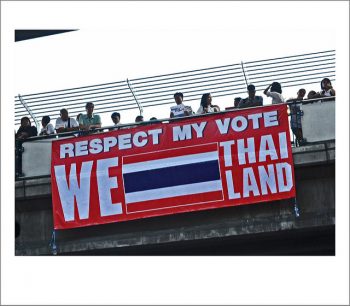
If you have been following Thai news in the last few months, you would have noticed quite a lot going on related to the Thai Constitution. Most of it is highly controversial and very politically charged, so I’ll spare you the details. Proponents of amending the constitution argue that the current one is very non-democratic – and not just because it was written by a military coup government. Opponents to the change argue that the current constitution is democratic and any changes to it can only benefit Thaksin Shinawatra (a highly controversial ex-Prime Minister currently in exile).

Thais sometimes want to know a farangs opinion on the political situation, and so one day you may be asked about it. Or maybe you just like to talk politics. Either way, the below related vocabulary I’ve prepared for you can perhaps help you explain what’s on your mind.


English Karaoke Thai
Charter/Constitution rat4ta2tum1ma1nuun1 รัฐธรรมนูญ
Amendment (for constitution) Gaan1gae3kai5rat4ta2tum1ma1nuun1 การแก้ไขรัฐธรรมนูญ
Bill (for a new law) Yat1dti2 ญัตติ
Constitutional court Saan5 rat4ta2tum1ma1nuun1 ศาลรัฐธรรมนูญ
Constitutional Tuuk2 dtawng3 tee3 ra4bu2 wai4 nai1 rat4ta2tum1ma1nuun1 ถูกต้องที่ระบุไว้ในรัฐธรรมนูญ
Debate, discuss A2pi4braai1 อภิปราย
Petition Kum1 rawng4 dto2 saan5 คำร้องต่อศาล
Submit Yeun2 puea3 gaan1pi4jaa1ra4naa1 ยื่นเพื่อการพิจารณา
Rule (of a court; to make a decision) Pi4paak3saa5 พิพากษา
Verdict Kum1 pi4paak3saa5 คำพิพากษา
Authority (has power to do something) Um1naat3 อำนาจ
Overthrow Kon1 um1naat3 โคนอำนาจ
Illegal Pid2 got2 maai5 ผิดกฎหมาย
Dissolve (a party) Yub4 paak3 ยุบ(พรรค)
Referendum Bra2chaa1ma4dti2 ประชามติ
Coup Rat4bra2haan5 รฐประหาร
Prime Minister Naa1yok4rat4ta2mon1dtree1 นายกรัฐมนตรี
MP (minister) rat4ta2mon1dtree1 รัฐมนตรี
Withdraw Tawn5 dtua1 ถอนตัว
Cast a vote Long2 ka4naen1 ลงคะแนน
protester Puu3 bra2tuwang4 ผู้ประท้วง
political opposition party Fai2 kaan4 ฝ่ายค้าน
Parliament Sa2paa1 สภา

The Four Capitals of Thailand

Posted on 25. Jul, 2012 by in Beginner, History, Thailand Politics

In the early Thailand years, before the first capital, there was no country of Thailand. It was a collection of city states each with their own kings. There were no defined borders, and they were more like governed islands surrounded by a sea of ‘international’ land. Languages of each region were very similar, like the regional Thai dialects today are very similar. And on occasion, these city states even went to war against each other.


Sukhothai (approximately from 1238 – 1378AD)

สุโขทัย su2koo5tai1

Sukhothai, which literally means ‘Dawn of Happiness’, was the capital of the Thai Empire for approximately 140 years. The Thai alphabet was developed during this time. At this time, Sukhothai and Ayutthaya both simultaneously existed as different kingdoms. But in 1378 Sukhothai lost to an invasion from Ayutthaya, they were united in 1448 from a royal marriage, and finally annexed by Ayutthaya in 1583. See a map of Sukhothai in 1300.

Learn more about Sukhothai at Wikipedia.


Ayutthaya (approximately from 1350 to 1767)

อยุธยา a2yu4ta4yaa1

Ayutthaya was a huge prosperous trading city which eventually was sacked and burned by an invading Burmese army in 1767. Ayuttaya was a warring state, and had militarily conquered many surrounding regions, including Sukhothai, Chiang Mai, Angkor (of Cambodia), Laos, Malaysia, etc. Burma and Ayutthaya had repeatedly gone to war with each other, with neither being successful at conquering the other until 1767. Fortunately for Thailand, Burma was also at war with China and had to retreat it’s forces not much later to save itself.See a map of Ayutthaya in 1400.

Learn more about Ayutthaya at Wikipedia.


Thonburi  (1767 to 1782)

ธนบุรี ton1bu2ree1

The details are fuzzy, but after Ayutthaya was sacked and the capital was moved to Thonburi, King Taksin apparantly was becoming mentally ill. Or, at least that was the reason used for the coup that over threw and executed him to install Rama I. King Rama then moved the capital to Bangkok. Supposedly Thonburi also had flooding problems which was a major factor for the move. Thonburi even today still has flooding problems.

<a href=http://en.wikipedia.org/wiki/Thonburi>Learn more about Thonburi  at Wikipedia</a>.


Bangkok (1782 to present)

กรุ่งเทพฯ grung1tep3

The advantage of the capital being located in Thonburi and later Bangkok was both for militarily strategic reasons to defend against the Burmese, but also closeness to sea trade ports. There was talk in 2012 about moving the capital again for flooding reasons. The city is in the middle of a flood delta and the land is slowly sinking below sea level.