


China’s Labor Strikes Posted by Stephen on Jun 8, 2010
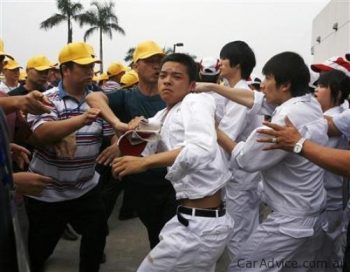
If you’ve been following the news of late, you’ve most likely heard rumblings about factory workers in China striking for better pay (most notably, at Foxconn). Someone asked me what these labor strikes mean for China, both domestically and globally. In terms of the effect on the rest of the world it will mean higher…
Talking about Income Inequality Posted by Transparent Language on Jun 8, 2010
The income gap in China is a topic of frequent discussion, and below are some relevant terms that can help you understand news reports as well as participate in discussions of your own. Numerous reports of the Foxconn employees leaving their 宿舍 (su4she4 – dormitories) to 跳楼 (tiao4lou2 – jump [from a] building) has raised…
NBA in China (美国篮球联赛) Posted by Stephen on Jun 7, 2010
Move over pingpong and say so long to soccer because China has turned into a nation obsessed with the sport of basketball. Flip through the CCTV channels and you’re almost sure to find a replay or live match of the NBA finals with Chinese announcers calling the game. Walk outside to various parks and sports…
Comparing Ideas or Actions Posted by Transparent Language on Jun 3, 2010
Earlier I discussed how to compare people, places, and things. What about comparing ideas? Take a look at the first example, which follows from the previous illustrations of how to make comparisons using 比 (bi3). Swimming’s more fun than dancing. 游泳比跳舞好玩 (you2yong3 bi3 tiao4wu3 hao3wan2 – lit. swimming [compare] dancing fun) To form a negative…
Easy Characters to Mix Up Posted by Transparent Language on Jun 1, 2010
Every time you learn a new character, you may feel like you’ve met a new person or a new friend. At the same time, just like meeting real people, make sure you don’t mistake your new friend for any lookalikes! Below are some characters which I’ve found easy to mix up. 部 (bu4 – department)…
Simple Comparisons Posted by Transparent Language on May 27, 2010
When speaking Mandarin, there are several ways to make comparisons between people, places, and things. Positive Comparisons 1. He is taller than she. 他比她高 -ta1bi3ta1gao1 2. He is taller than she. 他高过她 -ta1gao1guo4ta1 I have always found that the second structure is more comfortable, albeit more of a vernacular formation which I have encountered more…
North-South Variations Posted by Transparent Language on May 25, 2010
After moving from Beijing to Shenzhen last year, I noticed numerous differences between the spoken Mandarin that I was accustomed to up north and the Mandarin spoken in this new city full of 外地人 (wai4di4ren2 – out-of-towners) from all over China. As Shenzhen is located in Guangdong province and next to Hong Kong and Macau…