Arabic calligraphy (الخط العربي) is a very important aspect of Arabic art and culture that has enjoyed an important status in Arabic culture for centuries. Calligraphy is defined as beautiful or decorative handwriting, which is a feature of the majority of writing systems around the world. In Arabic and Islamic culture, calligraphy has enjoyed a distinguished status, due to its use in the writing of the Qur’an and in Islamic architecture.
Arabic writing has been in use before the advent of Islam, but it is believed that it was rather primitive then, and that it started to gain its important status as a competent system of writing in the first century after the rise of Islam. Two important factors contributed to the development of calligraphy. First, it was used in the writing of the holy book of Muslims, the Qur’an. Second, Islam does not approve the depiction of living creatures in art, which encouraged Muslim artists to excel in the art of calligraphy. Furthermore, calligraphy was utilized in architecture, textiles, and other materials, rather than being restricted to writing on paper. Third, the spread of Islam in Asia and Africa resulted in the adaptation of the Arabic alphabet by various peoples and the evolution of many new calligraphic styles as a result.
The main styles of Arabic calligraphy are:
1- Naskh (النسخ)is one of the earliest scripts to evolve. Naskh style displays a very rhythmic line. It is the most widely used in print, and in the writing of the Qur’an.
2- Ruq’ah (الرقعة) evolved from Naskh and became simplified. Riq’a is rounded and densely structured. It is the most popular script for handwriting all over the Arab world.
3- Kufi (الكوفي) named after the city of ‘Kufah’ in Iraq is distinguished for its angularity and squareness. It is widely used in ornamental forms.
4- Thuluth (الثلث) script has enjoyed enormous popularity as an ornamental script. It is characterized by curved letters that are linked and sometimes intersecting.
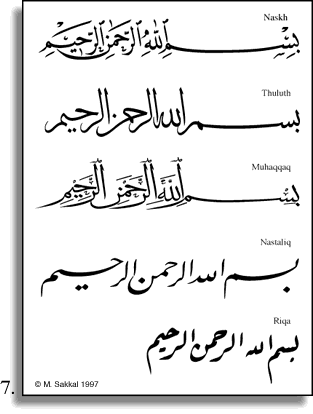
Arabic calligraphy has been extensively used in a number of purposes, not just for printing. It has been used in architecture for the decoration of buildings, mosques, etc. It has also been used in jewelry and textiles, in addition to numerous other uses. Arabic calligraphy has been used also in the writing of the Bible. It has developed recently and adapted itself to artistic trends and adopted new styles .




Comments:
adi.maulana30@yahoo.co.id:
semua keren kan
Sam:
Can someone help read what is on the lion shaped words. Thanks, Sam
sarah:
yes i can tell you what is on the lion shaped words
the name of allah in diffrint ways of writting in Arabic.
Aziza:
Ahlan Sarah,
Thank you very much for your effort. I cannot read it in full myself, but I can distinguish some words which make me disagree with you, e.g.
علي محمد كل
I do not think that these fit into your answer.
Thank you very much for trying.
Salam,
Aziza
fatima talhi:
wonderful work of art, could anyone plse tell how can i buy one or two of these examples as a wall hanging. where can study arabic calligr. in uk
Magda:
Marhaba
To answer the question about what is written on the lion caligraphy: it’s a prayer towards Ali – Prophet’s nepwhew and son-in-law.
Salam,
Magda
othmaan:
prayer is only n only for Allah and Ali(R.A) is cousine n son in law of prophet Muhammad(S.A.W)
Aziza:
Thank you very much Magda.
Aziza
Aziza:
Thank you very much for your comment Othmaan
Aziza
Julz10:
salaam~ where can i get the software for the arabic calligrapher?
Aziza:
Salaam Julz10,
Sorry, I do not know such software!
Nina:
Came across this post searching for Arabic Calligraphy. Very nice examples.
I am also interested in knowing the prayer itself depicted in the form of the lion.
Many thanks for any help.
Kind regards
aziza:
@Nina I do not know for sure what it means, but one of the readers suggested that it would be a praise for Ali.
shakkeer ali k a:
The art of arabic. It may help to the whole world to study about Islam.
Mohamad:
@shakkeer ali k a Shakkeer, I had to edit your comment. I hope you understand.
Regards,
Mohamad
Emad:
Hi, is there anyone who can write the name of the lowing land Palestine in arabic in calligrafi-style becuse I want it as a tattoo
Muder:
Can any 1 tell me how can i learn arabic calligraphy
aziza:
@Muder Try to search locally where you live. Try online sites like upmystreet that may guide you to a local calligraphy school.
Salaam,
Aziza
Scheich Josef:
السلام عليكم
The beautiful calligraphic lion in this post has attracted some questions and comments. Therefore the following information might be of interest.
The calligraphic lion was created in Lahore, Punjab, in the 19th century. It belongs to
the Victoria and Albert Museum in London:
http://collections.vam.ac.uk/item/O67547/painting/
and a description of the text (in English) is given there: The hymn Naadi ‘Ali (نادي علي ) or “Call upon Ali” starts at the nose of the lion and continues throughout the picture.
Here are two typical examples of a Naadi ‘Ali hymn on Youtube:
http://www.youtube.com/watch?v=9wJfrZuI4zY
http://www.youtube.com/watch?v=efv-pj0xAGs
and the significance of the Naadi ‘Ali is explained here:
http://www.amaana.org/ali/nadeali.htm
According to the Encyclopedia Britannica
http://www.britannica.com/EBchecked/topic/15223/Ali
and the Wikipedia article
http://en.wikipedia.org/wiki/Haydar_%28name%29
Ali (علي بن أﺑﻲ طالب), the cousin and son-in-law of the Prophet Muhammad, was called by his mother Haydar (حَيْدَر) or “Lion” and by his followers Haydar al-Karraar (Arabic حيدر الكرار) or “Invincible Lion.”
Especially in Shia calligraphy the shape of
a calligraphic image is related to its content.
In this case, the content is indeed “a praise for Ali”, the “Invincible Lion”, as aziza pointed out.
إلى اللقاء
يوسف
Scheich Josef:
@ fatima talhi
The last calligraphy in this post with the Arabic word حُرِّيَّة for Freedom is due to the Palestinian calligrapher Nihad Dukhan. Together with many other modern calligraphies exhibited on his web site
http://www.ndukhan.com/
on contemporary Arabic calligraphy designs you can buy it there as greeting card, t-shirt or poster.
Salaam
Josef
Jennifer DeCamp:
I am setting up a website for Arabic translators. May I use the lion you have on your site?
Thanks.
Jen
aziza:
@Jennifer DeCamp Sorry, I got linked to this image from the internet. I do not hold the copyrights
Haydar:
I’m going get the lion calligraphy as a tattoo. Great shia symbolism. You’ll find simular great art all around iran.
Calligraphy at Artocraft:
Also see Calligraphy Art of Aslam Kamal
turfa:
I loved your blog. very informative and very clear.
I was talking to friend yesterday about arabic calligraphy and I am glad I found your blog while surfing.
great job.
aziza:
@turfa Thank you very much and good luck!
Mehmet Bayraktar:
Hello Dear Friends,
I really want to know the English translation of the caligraphy in the ‘Lion’ form.
Thank you
Mehmet
Art Business:
Amazing Calligraphy art and the lion Calligraphy is great
Hafiz Safiullah Kaatib:
Very Very good work
Ezzat:
I agree with you that Arabic calligraphy is part of our culture. It is fascinating to see it evolve over time…graphic artists and designers now use it in their work.
Thank you for sharing!
Gatubela:
The colors poster was very helpful thank you. 🙂
Flore:
Hello,
would you (or 1 of your friends) be interested in doing some calligraphies over 1 evening for approx 80 guests, from 5.00 pm to 11.00 pm (with a food break of 30 min), the 17th March-12, in Dubai ?
The calligraphies would be only the firstnames of the guests in Arabic.
Thank for the reply,
Best regards
F.
Ling Favors:
i love this 🙂