


Archive by Author
Greek abbreviations Posted by Ourania on Jun 11, 2014
Sometimes, learners of the Greek language, but even native speakers as well, have difficulty understanding what all these abbreviations that we find in books, notes and reference tables stand for. Here’s a great opportunity to see some of the most commonly used ones as well as to analyze what they mean or how they are…
Survival phrases in Greek (part two) Posted by Ourania on Jun 3, 2014

It’s summertime in Greece and people make holiday plans. If you are going to go to Greece for the holidays and would like to say some basic phrases in Greek, check the entry called “Survival phrases in Greek”. If for a reason you have to or want to say more things in Greek…
Animal sounds in Greek Posted by Ourania on May 28, 2014

People speak different languages and have different accents. What about animals? Do Irish cats sound the same as Serbian cats? The sound that animals make is not affected by the country they live in. However, humans use their own onomatopoeias (ονοματοποιίες, sounds) to describe an animal sound. This is a list of some Greek onomatopoeias…
Feminine nouns ending in – ος Posted by Ourania on May 13, 2014

Summer is on its way and my mind is travelling to the Greek islands. Before taking the ferry though, let’s do some grammar. Some of the islands names end in –ος: Μύκονος (Mykonos), Ρόδος (Rodos, Rhodes), Ζάκυνθος (Zakynthos) etc. The nouns ending in –ος give Greek learners a hard time. When they find in…
American Movie Quotes in Greek Posted by Ourania on May 5, 2014

In 2005, the American Film Institute (AFI) made a list of the 100 top movie quotes. Below, there’s a translation of the 10 top quotes in Greek. 1. Ειλικρινά, αγαπητή μου δε δίνω δεκάρα- Όσα παίρνει ο άνεμος (Eelikrina agapeetee mou de dino dekara- Osa pairnee o anemos) Frankly my dear, I don’t give a…
Building vocabulary with mind maps Posted by Ourania on Apr 29, 2014
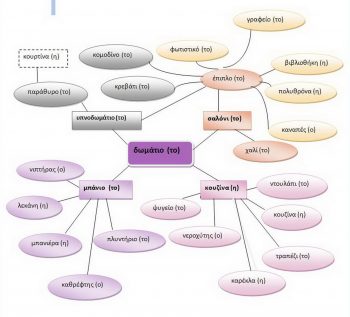
There are many techniques used while learning new vocabulary, some of which are cloze activites, memorization, use of flashcards, word dominos, use of the new word in sentences, and the list goes on. Mind maps can also be an effective technique that helps learners face the challenge of “digesting” the new vocabulary by making connections…
Use of the conjunction “na” Posted by Ourania on Apr 21, 2014
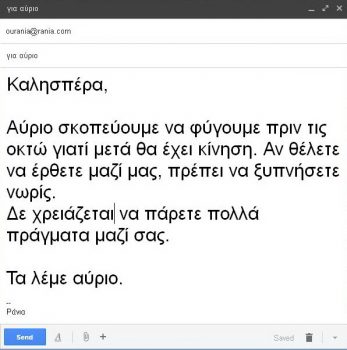
The right use of the conjunctions ότι, πως, να (oti, pos, na) which mean “that” and “to”) is not always clear and Greek learners often misuse them (ελπίζω που instead of ελπίζω να etc.). Verbs that express desire, wish, necessity, exhortation, possibility and prohibition are followed by the conjunction να (na, to) and a verb in…