


Search Results
Phoric & emphatic pronouns Posted by leire on Apr 23, 2012
Phoric pronouns Singular Plural Masculine Feminine Neuter Masculine Feminine Neuter Nominative is ea id ei (ii) eae ea Accusative eum eam id eos eas ea Genitive eius eorum earum eorum Dative ei eis (iis) Ablative eo ea eo eis (iis) As the name suggests, its main function is the phoric: it is used…
Possessive & demonstrative pronouns Posted by leire on Apr 12, 2012
Possessive pronouns One holder Several holders 1st person meus, -a, -um noster, nostra, nostrum 2nd person tuus, -a, -um uester, uestra, uestrum 3rd person (reflexive) suus, -a, -um Its main function is the morphemic: they express the category of person and number. The reflexive possessive suus, -a, -um has also a phoric function…
Latin Numerals Posted by leire on Feb 25, 2012
The cardinal numerals The cardinal numerals express the number or quantity. Most of the cardinal did not decline, the only ones that were declined are: UNO Masculine Feminine Neuter Nominative unus una unum Accusative unum unam unum Genitive unius Dative uni Ablative uno una uno DOS Masculine Feminine Neuter Nominative duo duae duo…
Latin Adjectives II Posted by leire on Feb 19, 2012
DEGREES OF SIGNIFICANCE Comparative degree The systematic degrees of comparison are: inferiority, equality and superiority. The comparison of inferiority and equality is made with an adverb that modifies the adjective in positive degree and the second term (which will be in the same case as the first) introduced by quam. Titus minus doctus quam…
Latin Adjectives I Posted by leire on Feb 16, 2012
1st GROUP They are declined using the ends of the first and second declensions. Using the second declension for masculine and neuter, and the first for feminine. Singular Plural Masculine Feminine Neuter Masculine Feminine Neuter Nominative -us, -er -a -um -i -ae -a Vocative -e, -er -a -um -i -ae -a Accusative -um…
Roman calendar Posted by leire on Jan 29, 2012
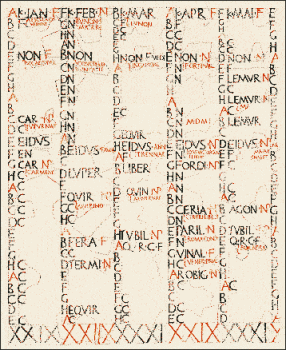
The calendar we use nowadays corresponds with very light variations, to the one that Julius Caesar used. However, in the history of the Roman calendar we can distinguish three stages: initial, Numa Pompilius’ reform, and the reform of Julius Caesar. In the initial phase, which was a lunar calendar, the year was made up of…
Latin Epigraphy II Posted by leire on Jan 11, 2012
TYPES OF INSCRIPTIONS Honorary: in statues or monuments devoted to an important figure. Name of the figure (in dative, also in nominative or otherwise), name of the dedicator (nominative), dedication reasons and possible additional sentences. Funerary: in the tombs or other monuments erected in memory of a deceased. The formulas varied over time and places, but the…