


Search Results
Non-personal verbal forms Posted by leire on Jun 15, 2012
The verb forms which do not have personal ending are known as non-personal verbs or noun-verbs. These verb forms simultaneously have nouns’ characteristics (they are nouns or adjectives) and verbs’ characteristics (tense, voice…). In Latin we have three verbal nouns (infinitive, gerund and supine) and two verbal adjectives (participle and gerundive). Morphology is as follows…
Relative, interrogative-indefinite & other pronouns Posted by leire on Apr 26, 2012
Relative pronouns Singular Plural Masculine Feminine Neuter Masculine Feminine Neuter Nominative qui quae quod qui quae quae Accusative quem quam quod quos quas quae Genitive cuius quorum quarum quorum Dative cui quibus Ablative quo qua quo quibus The relative pronoun’s only function is the phoric, as it always refers to the antecedent, with which…
Phoric & emphatic pronouns Posted by leire on Apr 23, 2012
Phoric pronouns Singular Plural Masculine Feminine Neuter Masculine Feminine Neuter Nominative is ea id ei (ii) eae ea Accusative eum eam id eos eas ea Genitive eius eorum earum eorum Dative ei eis (iis) Ablative eo ea eo eis (iis) As the name suggests, its main function is the phoric: it is used…
Possessive & demonstrative pronouns Posted by leire on Apr 12, 2012
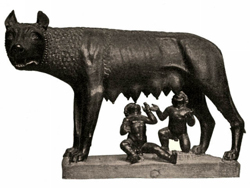
Possessive pronouns One holder Several holders 1st person meus, -a, -um noster, nostra, nostrum 2nd person tuus, -a, -um uester, uestra, uestrum 3rd person (reflexive) suus, -a, -um Its main function is the morphemic: they express the category of person and number. The reflexive possessive suus, -a, -um has also a phoric function…
Pronominal morphology & Personal pronouns Posted by leire on Apr 9, 2012

What are pronouns? Traditionally pronouns are defined as words that are used in place of the name. However, this definition is unsatisfactory, in a phrases like: I will go to the movies tomorrow What name replaces “I“? It is obvious that it does no replace any name. ‘I‘ is a first-person morpheme that indicates the…
Latin Numerals Posted by leire on Feb 25, 2012
The cardinal numerals The cardinal numerals express the number or quantity. Most of the cardinal did not decline, the only ones that were declined are: UNO Masculine Feminine Neuter Nominative unus una unum Accusative unum unam unum Genitive unius Dative uni Ablative uno una uno DOS Masculine Feminine Neuter Nominative duo duae duo…
Latin Adjectives II Posted by leire on Feb 19, 2012
DEGREES OF SIGNIFICANCE Comparative degree The systematic degrees of comparison are: inferiority, equality and superiority. The comparison of inferiority and equality is made with an adverb that modifies the adjective in positive degree and the second term (which will be in the same case as the first) introduced by quam. Titus minus doctus quam…