Tag Archives: roman culture

Garum

Posted on 30. Oct, 2012 by in Roman culture

Almost like our mayonnaise, ketchup or tomato sauce accompanying many of our meals and dishes, the Romans had their own typical sauce: garum. Because of its high price and scarcity, it might be better to compare it with the occasional spices or condiments more expensive and bizarre of our time, but hey, it serves as an introduction to this sauce.

The garum, Roman delight, was produced as follows: they used fish guts or, occasionally, the whole fish, and left it marinate in salt for a few days. What remained after this first step, was “distilled” by passing it through successive  strainers making it increasingly finer, and of course, more expensive in each distillate.

As you see, the truth is that Roman delight does not seem very appealing at first glance. Also the smell should not be very attractive since the great chef Apicius recommended avoiding the smell of garum with laurel, honey and wine.

Perhaps the closest food to garum among the ones known nowadays could be anchovies paste, slightly denser than oil. Now… does anybody want to join me to have lunch at an Italian restaurant? :)

The garum produced throughout the southern Iberia and the coastal strip between the current Lisbon and Cartagena had a special fame and was very appreciated the one manufactured in Baelo Claudia, in the Strait of Gibraltar, because it was made ​​with tuna.

The disappearance of this sauce in the kitchens,   in the Mediterranean trade, resulted from the breakup of the Roman Empire after the invasion of the barbarian peoples of northern Europe. The disappearance of virtually all communications infrastructures and the impoverishment of the population made garum a not very popular food. It only kept being produced in specific locations until almost the middle ages, especially in the Byzantine Empire, but not only there.

This product was targeted to large cities and therefore was an expensive luxury, which made it a great deal for those who manufactured the product. The location of the industries were generally in the suburbs of the coastal cities where they were produced or, as in the case of Baelo Claudia, where the economic base of the city’s economy was based.


Place to make garum. Photo by Poblado de Doña Blanca

Place to make garum. Photo by Poblado de Doña Blanca.


Hygiene in Ancient Rome

Posted on 26. Oct, 2012 by in Roman culture

When waking up men washed their hands and face with water, and after they requested the assistance of the tonsor. This was responsible for shaving the beard and cutting hair, the aristocratic classes possessed one or more of them, we know that Julius Caesar’s liked  keeping all his body perfectly shaved. But those citizens who did not have such possibilities, they approached the nearest tavern, and in there were the tonstrinae, public barber shops, even if a poor slave had no possibility that his master’s barber shove him, the alternative way was to wakl in the streets of the city and hire one, as some of them were offering their services in the streets.

Cosmetics in Rome was a thriving industry, lanolin, as used nowadays for perfumery and cosmetics, was known among the Roman ladies. It was extracted from the wool of sheep and it was strongly perfumed to avoid its original smell. Slaves filled their mouth with perfumes and then spited it on the face and body of the lady they served.

Poets wrote satirical mocks about excessive colors on women’s cheeks and Petronio, describing some lady in his Satyricon, says: “On her forehead bathed in sweat flowed a torrent of oil, and in the wrinkles of her face she had such amount of plaster that I would have said that it was an old decrepit wall crossed by the rain.” An interesting detail is that they considered beautiful eyebrows that joined together just above the nose, for that it was used a compound of crushed ant eggs with flies.

Romans brushed their teeth with renal secretions (urine), the most valued were those of Iberian origin.

Roman women went to sleep fully dressed: a bra or corset, tunic, and sometimes with a mantle.

Baths of Caracalla. Photo by isawnyu.

Baths of Caracalla. Photo by isawnyu.

Conversation guide for the Ancient Rome

Posted on 24. Oct, 2012 by in Latin Language, Roman culture

A few years ago, before going on a trip abroad, it was habitual buying a travel guide of the destination which also included some useful phrases or basic expressions to comunicate with locals. Today, these guidelines are being relegated for Internet applications or smartphones, but if you ever have the good fortune to travel to the Ancient Rome, sure this guide will be very useful ;)


If you are lucky enough to make beutiful Roman friends – or whatever -:

Nomen mihi est xxxx. Salve! / Hello! My name is xxxx

Magna cum voluptate / Nice to meet you

Estne pugio in tunica, an tibi libet me videre? / Do you have a dagger in your tunic or are you just happy to see me?

Noli me vocare, ego te vocabo / Don’t call me, I’ll call you

Hora et triginta minuta in mora es / You’re one hour and a half late

Lapsus linguae erat / It was a mistake

Noli me tangere / Don’t touch me

Volo, non valeo / I’d love to, but I can’t

Sirem improba / Damn tempting

Spero nos familiares / I hope we still can be friends

Vade retro! / Go (away)!

Haec omnia? / Is that all?

Nocte quater / Four times a night

Ursus perpauli cerebri sum / I am a bear with very little brain

In flagrante delicto / Red-handed

Fabricare diem / Make my day

Re vera, cara mea, mihi nihil refert / Frankly my dear, I don’t care

Anguis es / You’re a snake


In the streets of Rome:

Quo vadis? / Where are you going?

Mihi ignosce / I’m sorry

Ubi sum? / Where am I?

Auxilium mihi, si placet? / Can you help me, please?

Noli me necare, cape omnem pecuniam meam / Don’t kill me, here’s all my money

Pace tua / With your permission

Manus manum lavat / I will help you if you help me

Quod in abysso dices? / What the **** are you saying?

Necios quid dicas / I don’t know what you are talking about

Estne juxtim caupona/mansio? / Is there a bar/hotel near?

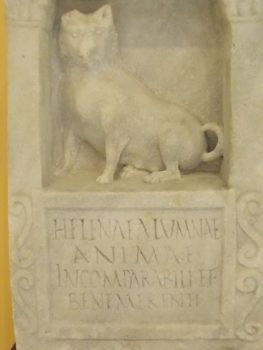
Cave canem / Beware of dog

Vade in pace / Go in peace

Utinam tuus currus deleatur! / I hope you have a cart accident!

Pedicabo te! / F*** you!


If you go shopping in a market:

Pecuniam mihi monstra / Show me your money

Quantum est? / How much is it?

Hoc est nimis! / It’s very expensive!

Pecuniam mihi redde / Give me my money back

Hoc affer tecum / Take it

In hac tunica obesa videbor? / Does this tunic make me look fat?

Pistrix rapax / Greedy shark

Vinum/fermentum bellum iucundumque est / Not bad this wine/beer


When you are back home:

Domus propia domus optima / Home sweet home

Deliranti isti Romani / These Romans are crazy


And if in your journey back you bring with you an Ancient Roman citizen you can help him/her integrate using the dictionary for translating modern terms, written by Cardinal Bacci in 1963:

Salivaria gummis / Chewing gum

Vinolentiam propensio / Alcoholism

Lucis horror / Photophobia

Fulminea verticularum occlusio / Zipper

Curatio per chimica medicamenta / Chemotherapy

Stomachi ac tenuis crassisque intestini inflammatio / Gastroenteritis

Absurda symphonia / Jazz

Homo machina / Robot

Inflatio venarum ani / Piles

Follius pedunque ludus / Soccer, football

Rotula moderatrix / Steering wheel

Nicotianum fumun sugere / No smoking

Latrina defluente aquae profluvio instructa / Toilet