Language Learning Software Comparison: Rosetta Stone vs. Transparent Language

Posted on 07. May, 2013 by in Uncategorized

It’s tough being the “other one” in the language-learning business, especially when competitors employ a heavy marketing strategy.  Rosetta Stone is a household name, and those yellow boxes are everywhere.  Many people feel that if they are paying hundreds of dollars for a language solution, well, they must be buying the best solution, right?  Maybe, maybe not.  But one thing we all know is that a heavily advertised, high priced product has to have an awful lot of marketing costs built into that price.

We don’t do heavy advertising like they do, but we do feel (not surprisingly) that Transparent Language makes the best language learning software.  Ironically, it’s because we didn’t develop our programs for the consumer market.  Our technology, methodology, and product lines were originally created for serious U.S. Government language schools, where failure is not an option.  But don’t think that means we don’t care about individual learners!  We love languages, and genuinely want YOU to succeed with your language learning.  So we also develop language programs for individual learners, public libraries, schools, companies, and other organizations, which leverage the same technology and methodology as our programs for government language schools.

To illustrate the contrast between our programs and those of Rosetta Stone, we have prepared a white paper explaining the differences between Rosetta Stone and Transparent Language.  It should help you better understand what we’re about, the capabilities of our programs, the instructional methods we use, and how you can succeed as a learner.

Learning about other languages and cultures is so important in today’s world.  It can provide a career advantage, and open the door to countless new friendships.  Not only that, but it makes your brain smarter and more agile.  Even if you ARE just in it to woo an Italian supermodel, we want you to have the best possible shot at success and the best language-learning experience possible.

The bottom line is, every language learner is different, and no single product alone can satisfy every learner’s needs.  You should research, experiment, and see what works best for you as an individual.  We hope our comparative analysis inspires you to explore all your language-learning options.

New Alphabet Courses in Transparent Language Online

Posted on 29. Apr, 2013 by in Language Learning, Product Announcements

If you’re learning a script-based language and your time is limited, learning a few words and phrases in transliteration, using the Latin alphabet you already know, may be the way to go.  But there’s great advantage in learning the native script.  Learn the native alphabet in Russian, Georgian, or Arabic, for example, and you’ll see and feel the language more authentically.  Imagine, even as a beginner, being able to sound out road and store signs when traveling or watching movies and news footage.  Later, the native script will serve as your membership card to the world of native literature, texting, and email.

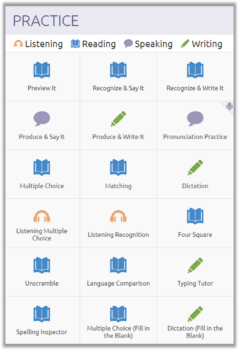
To support this idea, we’ve added a new type of course to Transparent Language Online designed to teach native alphabets.  These alphabet courses include a suite of activities designed to help users achieve basic familiarization with the alphabet of a new language.  Activities include Alphabet Explorer, Preview It, Alphabet Learner, Matching Letter to Sound/Sound to Letter, Recognize and Say It, and a Reference section.  So far, we’ve added alphabet courses for Armenian, Russian, Mongolian, Hungarian, Punjabi, Georgian, and Greek.  More are on the way.

When these courses were first being developed, we turned to members of our Facebook community to take our Russian course for a spin and let us know what they thought.  We selected Facebook fans not already learning Russian.  Our testers then spent an average of just over an hour learning the Russian alphabet using the alphabet course in Transparent Language Online.  Their feedback was helpful in shaping the final product, and we really enjoyed reading their comments:


“At first it seemed really fast to just go from one activity to the other without stopping to repeat (which you can do, but I just didn’t), but it is actually amazing how you learn the alphabet without even noticing it… I never thought I’d get it all correct in the assessment!” (Note: the average score by our tester group on the final assessment was 95%)


“Very, very good!  I now know the Russian alphabet and now have an interest in learning Russian, thank you!  Something completely different from English, French, and German, which I speak all to fluency or near-fluency.”


“[The Alphabet Explorer activity] is a great idea because some letters in the Russian alphabet did not have the same sound as the letter in English.  I appreciated seeing both upper- and lowercase letters.  I found the pronunciations to be very helpful and played them multiple times to familiarize myself with the slightly different pronunciations of each letter.”


“I felt that [the Alphabet Learner activity] was the first that really challenged my retrieval skills.  I liked how it drilled me more on the letters I got wrong.”


“[The Recognize and Say It activity] was the best exercise for me, as I can usually choose correctly when given a multiple choice, but when I have to come up with the answer from scratch is when I truly know I have learned something.”


Many thanks to our fans for participating in our Alphabet course testing!  Now that we’ve started adding these courses to Transparent Language Online, we invite everyone to sign up for a Transparent Language Online free trial, and explore a language… from the alphabet up.

The Emotional Roller Coaster of Language Learning

Posted on 26. Apr, 2013 by in Language Learning

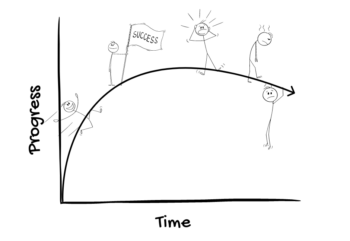
You’ve just decided to learn a language, and You. Are. Pumped. We’re excited for you, but we also feel the need to warn you, learning a language can be a bit of an emotional roller coaster…

Stage 1: SO! EXCITED!

You’re going to learn Spanish and impress your boss. You’re going to learn Arabic so you can finally speak to your husband’s family. You’re going to laugh along when the ladies at the nail salon make fun of you in Chinese, because the joke will finally be on them, right? Yes, you’re super excited right now, it’s all going to be SO MUCH FUN.

Stage 2: Very Confident

You’ve picked up some study materials, enrolled in a class, harassed every Brazilian-looking person in a 12 block radius to practice the 10 words you know in Portuguese. It’s new, it’s fun, it’s exciting! You’re going to be fluent in no time!

Stage 3: Moderately Less Confident But Still Determined

Hmm… you’ve made it past the first lesson, and all of the pleasantries are over. No more “Bonjour!”, a lot more –er, –ir, and –re verb conjugations. You feel so close to understanding all these new concepts, but you just keep getting STUCK.

Stage 4: Struggling

What IS that letter? Am I saying this right? Okay so speaking this is a little more difficult than expected. You may or may not have hocked a loogie on your cat while trying to roll your R’s, but he’ll get over it.

Stage 5: Paralyzing Self-doubt

Well now it’s just ridiculous!!! You know a few hundred words and you can ask for “more bread, please”, so you don’t really need to know anything else anyway, right? Subjunctive mood? Genitive case? Ain’t nobody got time for that.

Stage 6: Regret

Wait, what was the word for “bread”? …I shouldn’t have quit learning, languages are awesome. What was I thinking?

Stage 7: Renewed Determination

Jump back to Stage 1—remember how TOTALLY FUN AND INTERESTING this language is!? Remember that you want tell your mother-in-law that you don’t actually like her cooking… in GERMAN!? That’s right, get motivated again. Find some new resources to make things fun. Watch funny Youtube videos in Italian. Read the Harry Potter novels translated into Dutch—they were written for a 14 year old? You don’t care, nothing can stop you now!

Stage 8: VICTORY!

You just had a conversation in another language… and they understood! That’s right, your Thai food order came out right, and It. Was. Delicious. Then of course you tried to ask the waiter for the check, and accidentally asked for his phone number. But, whatever. You’re conquering a new language, and it’s awesome!